Supported by the William L. Bucknall Excellence in Teaching Award, faculty from across the University of New Haven reflect on how their participation in the American Public Health Association's Policy Action Institute is helping to strengthen research-to-policy translation, advocacy, and student learning.
As an educator, I often return to a quote by author Lisa Bodell: “Change cannot be put on people. The best way to instill change is to do it with them. Create it with them.” That philosophy has guided my teaching throughout my career. I believe education is most meaningful when it extends beyond the classroom and prepares students to address real-world challenges.
When I was honored to receive the University of New Haven's 2025–2026 William L. Bucknall Excellence in Teaching Award, I wanted to use the award in a way that reflected Bodell’s philosophy. Rather than focusing solely on my own professional development, I wanted to create an opportunity that would benefit colleagues across the University and, ultimately, the students we teach. The Bucknall Award provided exactly that opportunity.
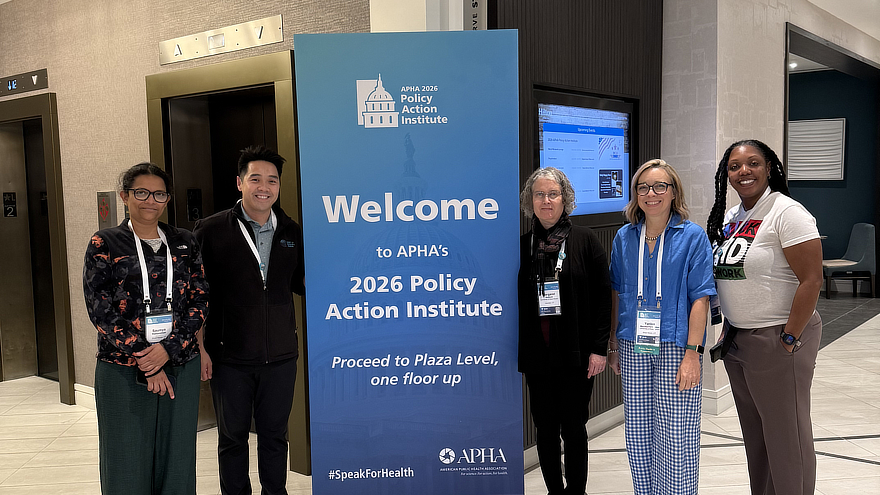
Thanks to the generosity of William L. Bucknall Jr. '63, '65, '08 Hon. and his daughters, Kristin Loranger and Elise Bucknall, I was able to bring faculty representing public health, physician associate studies, biology, criminal justice, and health policy to the American Public Health Association's (APHA) Policy Action Institute in Washington, D.C. While the Institute focused on strengthening research-to-policy translation and advocacy skills, the broader goal of this Bucknall-supported initiative was to create a shared learning experience that our faculty could bring back to their classrooms, research programs, and students.
The Policy Action Institute convened public health professionals from across the country to examine today's evolving policy landscape and strengthen the skills needed to translate evidence into action. Through sessions focused on communicating science to policymakers, navigating political differences, engaging communities, coalition building, and using storytelling to advance public health, we were challenged to think beyond publishing research and consider how our work can influence real-world decisions.
Although we represented different disciplines, we realized that many of us were asking the same question: How can we better prepare our students to translate research into meaningful action?
‘Understand how scientific discoveries can inform… public-health recommendations’
For Saumya Ramanathan, Ph.D., associate professor in the Department of Biology and Environmental Science, the conference fundamentally reshaped how she thinks about the role of scientists.
“Publication is close to the beginning of that responsibility,” she said.
Dr. Ramanathan reflected that she plans to, “build a policy communication component into my lab's scholarly workflow,” treating the translation of research for non-specialist audiences as a standard scholarly product alongside manuscripts and conference presentations. She also plans to ask students working in her laboratory to articulate, “the downstream policy or clinical relevance of their findings,” helping them understand how scientific discoveries can inform screening guidelines, funding priorities, and public-health recommendations.
The importance of ensuring research reaches communities and decision-makers also resonated with Yanice Méndez-Fernández, Ph.D., MPH, professor of practice and director of academic education for the Physician Associate Program.
“Research findings are usually disseminated through scholarship activities that include publication in peer-reviewed journals and presentations to professional peers,” she shared. “While these activities contribute to the expansion of knowledge in a given field, the relevant information does not always reach decision-makers or the communities from which the data was extracted from.”
Dr. Méndez-Fernández further reflected that researchers need to maintain, "a community-centered and community-participatory approach throughout all the stages of the research process," developing dissemination plans that effectively communicate findings to the communities that participate in and are impacted by the research. The Institute also inspired her to incorporate advocacy principles and storytelling into the Person-Centered Care and Evidence-Based Medicine courses she teaches.
‘Figure out who is already telling the story’
Speakers at the conference repeatedly emphasized that evidence alone rarely changes policy. Stories help people connect with data, understand its relevance, and remember why it matters.
That message resonated deeply with Maggie Holland, Ph.D., MPH, assistant professor in the Department of Population Health & Leadership.
“Sometimes, the best thing you can do is figure out who is already telling the story you need policymakers to hear,” she said. “Instead of trying to tell the story yourself.”
Dr. Holland also reflected that “people connect with and remember stories more than data.” As she prepares to teach Public Health Policy and Advocacy this fall, Dr. Holland plans to incorporate advocacy exercises from the Institute into her classroom, including an activity that challenged participants to communicate concise policy asks while receiving peer feedback. She also plans to place greater emphasis on storytelling as an essential component of effective advocacy.
'We must be willing to listen’
For Danielle Cooper, Ph.D., associate professor and director of research for the Tow Youth Justice Institute, the experience reinforced that advocacy begins with listening.
“It is important to value my story and the role of storytelling in building alliances,” she said.
Dr. Cooper also reflected and added that, “we must be willing to listen, even to people we think we disagree with.” Inspired by the Institute, Dr. Cooper plans to participate in Connecticut legislative public hearings on youth justice policy and use those experiences to engage students in understanding how research, personal stories, and public testimony can shape policy.
Jessica Holzer, Ph.D., associate professor in the Department of Population Health & Leadership, participated virtually in the Institute, and she appreciated hearing from advocates with diverse lived experiences.
“It was invigorating to be in a space with others as conscious of the importance of policy” she said.
Dr. Holzer also reflected that, “building the relationships, knowing the personal and policy interests of potential contacts, and attending to policy opportunities takes time and resources.” She plans to involve student research assistants in policy advocacy by encouraging them to participate in Connecticut policy events while helping them identify and better understand the stakeholders shaping insurance policy and maternal health.
‘Cultivate a University-wide culture of teaching, scholarship, and service’
Listening to these reflections, I realized that the greatest impact of this experience will not be measured by the number of sessions we attended or pages of notes we collected. Instead, it will be reflected in how these lessons shape our classrooms, mentoring, scholarship, and service over the coming years.
Whether our students pursue careers in healthcare, public health, criminal justice, biomedical research, or education, they will benefit from learning how to communicate evidence, engage communities, build partnerships, and understand the policy process. Those skills are increasingly essential for translating knowledge into meaningful change.
As part of my William L. Bucknall Excellence in Teaching Award project, I look forward to continuing these discussions throughout the fall semester by inviting leaders with expertise in research-to-policy translation and state-level advocacy to campus.
Together, we will continue exploring how evidence informs policy, how storytelling strengthens advocacy, and how faculty can better prepare students to become thoughtful leaders capable of transforming research into action.
We are deeply grateful to William L. Bucknall Jr., Kristin Loranger, and Elise Bucknall for investing not only in faculty development but also in the thousands of students whose education will be strengthened by these experiences. That is the lasting legacy of the Bucknall Excellence in Teaching Award: creating opportunities that extend beyond a single classroom, a single conference, or even a single faculty member to cultivate a University-wide culture of teaching, scholarship, and service.
Alvin Tran, ScD, MPH is associate professor and chair of the Department of Population Health & Leadership and director of the WeEmbody Lab at the University of New Haven. He is a recipient of the 2025–2026 William L. Bucknall Excellence in Teaching Award.
Danielle Cooper, Ph.D. is associate professor and director of research for the Tow Youth Justice Institute in the Henry C. Lee College of Criminal Justice and Forensic Sciences at the University of New Haven.
Maggie Holland, Ph.D., MPH is assistant professor in the Department of Population Health & Leadership at the University of New Haven.
Jessica Holzer, Ph.D. is associate professor in the Department of Population Health & Leadership at the University of New Haven.
Yanice Méndez-Fernández, Ph.D., MPH is professor of practice and director of academic education for the Physician Associate Program in the School of Health Sciences at the University of New Haven.
Saumya Ramanathan, Ph.D. is associate professor in the Department of Biology and Environmental Science in the College of Arts and Sciences at the University of New Haven.
Contact
Get the highlights!
Stay up to date with our weekly e-newsletter, highlighting stories from around the University and media clips featuring our faculty experts.
Recent News
University News
University of New Haven Welcomes 15 New Corporate Partners, Doubling Network of Cutting-Edge Industry Collaborators
Charger 360