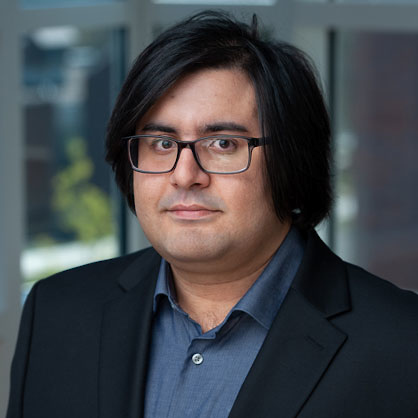
Led by Mehdi Mekni, Ph.D., the University of New Haven is embedding artificial intelligence directly into its Bachelor of Science in Cybersecurity to help address Connecticut’s growing workforce demand for AI-enabled cyber professionals. It is supported by a grant from the state’s Tech Talent Accelerator 3.0 program.

The University of New Haven is expanding its leadership in cybersecurity and artificial intelligence through a new AI for Cybersecurity concentration, supported by a grant from the State of Connecticut’s Tech Talent Accelerator 3.0 program.
The initiative is led by Mehdi Mekni, Ph.D., professor and director of the B.S. in cybersecurity program, in collaboration with Ardiana Sula, Ph.D., Shivanjali Khare, Ph.D., and Tirthankar Ghosh, Ph.D. from the Electrical and Computer Engineering and Computer Science Department (ECECS). The innovative concentration embeds applied AI skills directly into the University’s ABET-accredited Bachelor of Science in Cybersecurity.
“The inspiration came from a very real and urgent workforce need in Connecticut,” said Dr. Mekni.
‘Increasingly rely on AI-enabled tools’
As demand for AI-skilled talent accelerates across the state, employers are increasingly seeking professionals who understand both cybersecurity fundamentals and applied AI techniques. Dr. Mekni said that gap is especially visible in industries such as insurance and financial services.
“Travelers, our lead industry partner, faces growing challenges in fraud detection, compliance, and cyber-risk management, all of which increasingly rely on AI-enabled tools and workflows,” he said.
At the same time, he noted, higher education has not always kept pace. “Connecticut’s universities remain behind national trends in integrating AI into computing curricula.”
‘It is an academic program built with industry’
What makes the University’s approach distinctive, Dr. Mekni explained, is how deeply industry is embedded into the design of the concentration.
Unlike programs that treat AI as an elective or standalone certificate, the University of New Haven has integrated AI directly into its nationally recognized cybersecurity degree, aligning it with its designation as a National Center of Academic Excellence in Cyber Operations.
“This ensures rigor, portability, and national recognition,” Dr. Mekni said.
Students will also earn stackable, industry-recognized credentials built directly into the curriculum, including in Google Data Analytics, AWS AI/ML Specialty, and CompTIA Data+, designed in direct collaboration with Travelers.
Equally important, Dr. Mekni emphasized, is that industry leaders are not simply advising the program. They are helping to build it.
“Travelers’ cybersecurity and data science teams are co-designers of modules, reviewers of skills maps, and hosts for supervised work-based learning,” he said. “This is not an academic program inspired by industry; it is an academic program built with industry.”

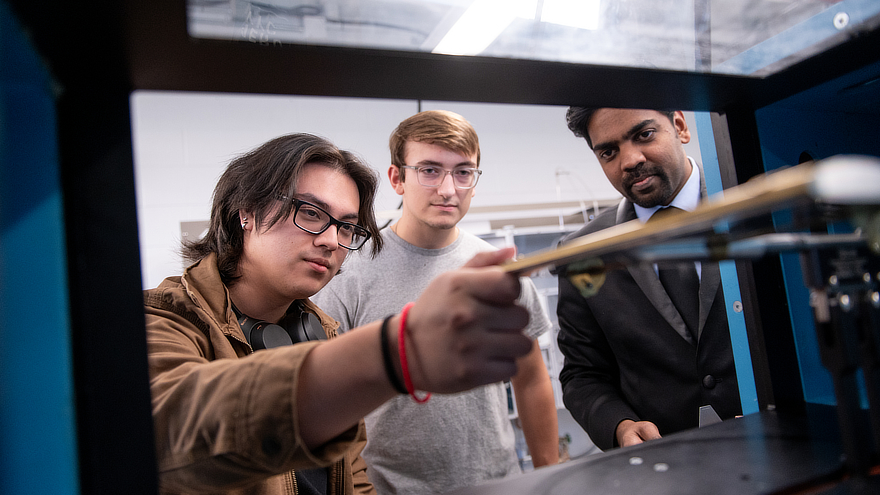
Under the leadership of Mehdi Mekni, Ph.D., students gain hands-on experience applying artificial intelligence to real-world cybersecurity challenges
‘The grant is building a sustainable, employer-validated AI-Cyber ecosystem’
The grant also supports a broader transformation in how the University prepares students for AI-enabled cybersecurity roles. “The grant is launching a new concentration, but it is also building a sustainable, employer-validated AI-Cyber ecosystem at the University of New Haven,” Dr. Mekni said.
The funding supports a comprehensive market analysis, using Lightcast data to identify AI-related cybersecurity skill gaps across Connecticut, particularly in the insurance sector.
It also funds curriculum-design workshops with industry subject-matter experts to ensure every learning outcome reflects real-world applications.
Draft modules and credential pathways will be piloted and refined through structured feedback loops with industry partners.
“The concentration is designed to move students from concept to application to workforce-ready capability,” Dr. Mekni said. “Learners will apply classroom knowledge to real-world challenges in fraud detection, compliance, and cyber-risk management.”
‘Learners will apply classroom knowledge to real-world challenges’
Structured work-based learning opportunities, including internships and project-based collaborations, will further strengthen career readiness.
“Travelers will consider hosting supervised work-based learning experiences, contingent on operational capacity and budget,” Dr. Mekni said.
The partnership also strengthens the University’s role as a statewide leader in artificial intelligence education. “As a founding member of the Connecticut Artificial Intelligence Alliance (CAIA), our university is leading statewide efforts to embed AI into postsecondary curricula,” Dr. Mekni said.
Ultimately, he believes the initiative positions both students and the state for long-term success.
Embedding AI into a core computing program and linking it directly to employer hiring pathways creates a replicable model for other Connecticut institutions. “The concentration is designed to be scalable and transferable, supporting the state’s broader workforce strategy,” Dr. Mekni said.
Contact
Get the highlights!
Stay up to date with our weekly e-newsletter, highlighting stories from around the University and media clips featuring our faculty experts.
Recent News
The Charger Blog

Family Day Celebration Highlights Connections Across Charger Community
University News