A first-generation masters’ graduate from Jamaica, Jamesha Barrett ’26 MPH says her journey to the University of New Haven required faith, resilience, determination, and discipline. The opportunities she took on helped her discover strengths she didn’t even know she had.
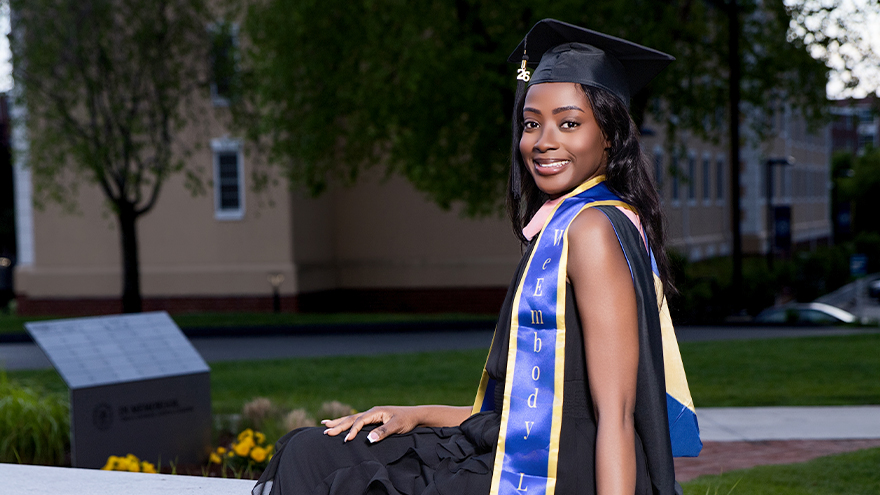
Ahead of Commencement, we reached out to Jamesha Barrett ’26 MPH, who graduated from the University of New Haven with a Master of Public Health with a certificate in Epidemiology.
How does it feel to be graduating?
To be honest, I am still processing it all. The feeling is both overwhelming and humbling. When I think about this milestone, I am constantly reminded of how God has been kind and merciful to me. As a first-generation master's graduate from Jamaica, I learned that traveling to the United States to pursue this Master of Public Health degree required a tremendous amount of faith, resilience, determination, and discipline. I did not know exactly where the journey would take me, but I was committed to giving it my absolute best.
My heart is completely full, and, now I can clearly see how every challenge and setback was necessary to prepare me for the joys of this moment. I am truly proud of how far I have come, but I am even more grateful for the grace of God that made it all possible.
Tell me about your plans after graduation.
My plan after graduation is to continue building a career in public health where I can contribute to addressing health disparities and inequities while using evidence-based approaches to strengthen the systems and programs that support population health. Currently, I am seeking opportunities that will allow me to apply my skills in research, program coordination, health promotion, and community engagement while continuing to grow as a public-health professional.
As I prepare for this next chapter, I will continue to volunteer with the Connecticut Chapter of the Society for Public Health Education (CT SOPHE), where I previously completed my internship, and with the New England Rural Health Association, where I serve as a Conference Planning Committee member.
Looking back at your time here at UNewHaven, what are a few things you are grateful for?
When I reflect on my time at the University of New Haven, I was given countless opportunities to serve, lead, learn, and grow, for which I am most grateful. My experiences such as serving as president of the Graduate Student Council, a Research and Advocacy Fellow with the WeEmbody Lab, coordinator of the President's Public Service Fellowship, graduate assistant at the Myatt Center, and vice president of the Student Public Health Association, along with many more external roles, allowed me to develop as a leader, researcher, advocate, and public health professional. These experiences truly challenged me to step outside of my comfort zone, build meaningful relationships, and discover the strengths I never knew I possessed.
In addition to my campus engagement, I was humbled to receive recognitions such as the University’s Presidential Medal for Outstanding Achievement, the Future Public Health Leader Award from the School of Health Sciences, the Graduate Student Research Paper Award from the Society for Public Health Education, and the Excellent Student Research Award from the American Public Health Association. I am deeply honored by these achievements, and I view them as a testament to God’s goodness, and a reflection of the people that supported and mentored me throughout this journey.
While milestones and accomplishments are often the most visible parts of one’s journey, they only tell a small portion of the story. The road that led to these achievements wasn’t a smooth one. I’ve faced many challenges that tested me in ways I never anticipated and required me to navigate far more than the demands of my coursework and leadership commitments. There were moments of intense grief, significant changes within my family, financial loss and uncertainty, but I'm so grateful that God didn't allow those seasons to prevent me from moving forward.
What I remember most is not the difficulties I experienced, but the people who stood beside me.
This institution has blessed me with some of the most remarkable mentors, advisors, supervisors and professors I could have ever asked for: Alvin Tran, Sc.D., MPH, Ophelie Rowe-Allen, Ed.D., Diane Polo-Conklin, MPH, Sheila Smith, MBA, Steve Macchiarolo, M.S., Greg Overend, M.A., Quinn Duclos, Ph.D., Jhinelle Dawson, DH.Sc., MPH, Crystal N. Holick, Sc.D., MPH, MBA, Jamie Luckhardt, MPH, CHES, Roheeni Saxena, Ph.D., MPH, CPH, and Joseph Soto, MPH, M.S., NRP, EMS-I. I’m beyond grateful for their guidance, wisdom, and for contributing to my professional and personal growth.
I am deeply grateful for my parents and siblings, whose prayers, unwavering faith, and countless sacrifices laid the foundation for so much of what I have accomplished. I am also grateful for meeting the McKenzies, who became my second parents on this journey. Being away from my family was not always easy, but the genuine care, love and support they provided made me feel at home and reminded me that I was never alone. Additionally, I am grateful for the amazing friends I met at the University, whose encouragement and companionship kept me going.
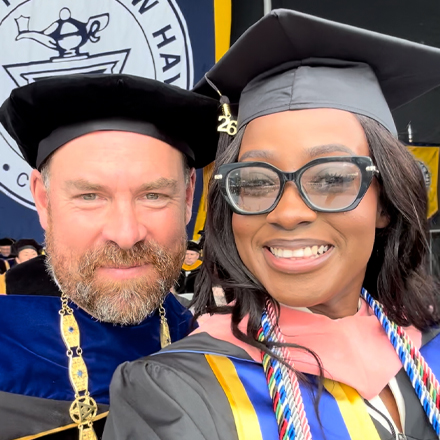
What are some defining moments that helped shape who you are today?
There are so many defining moments, but serving as the president of the Graduate Student Council (GSC) was one of the most impactful. I have experienced so much personal growth, and I’ve learned many valuable lessons that I will take with me into my career.
I had the amazing opportunity of overseeing operations that supported 42 graduate and hybrid recognized student organizations and working alongside 10 exceptional executive board members to lead initiatives that support the holistic well-being of students. We implemented initiatives and tailored policies that improved graduate student governance, enhanced operational processes for recognized student organizations, promoted equity, and elevated the role and recognition of graduate student leadership within the University. I also had the privilege of collaborating with University leaders and served on several University committees, where I represented the voices and interests of graduate students in discussions surrounding mental health, student success, campus policies, and institutional initiatives.
During my presidency, I simultaneously managed the demands of my coursework, research responsibilities, my internship with CT SOPHE, my role as a graduate assistant with the Myatt Center, and other leadership commitments. Learning how to prioritize, stay organized, and balance responsibilities while remaining committed to each of my duties truly strengthened my resilience and allowed me to exercise great discipline.
Through it all, I learned the value of delegation and mentorship, because effective leadership is not about doing everything alone. I learned how important it was to trust others, to empower, and to recognize and value the unique strengths each member brings to a team. Not every resolution was met with immediate agreement, and there were moments when students challenged our ideas. However, those conversations became some of the most valuable learning experiences of my presidency. They reinforced the importance of listening first and seeking to understand before responding. I came to appreciate the value of creating an environment where individuals felt comfortable asking questions, probing decisions, and expressing their differing views. As an aspiring public health leader, I found these experiences to be incredibly formative. They taught me the importance of selflessness in leadership, creating more room for impactful service, collaboration, and results.
I am extremely happy and grateful that my journey led me to the University of New Haven because it provided the resources, opportunities, and platforms that empowered students such as me to lead, advocate, serve, and grow into the best versions of themselves. I must extend special recognition to University President Jens Frederiksen, Ph.D., Vice President of Student Affairs and Dean of Students Ophelie Rowe-Allen, Ed.D., Greg Overend, M.A., Christopher Cheslog, and Brandon Woods for the tremendous support, guidance, and encouragement they provided throughout my presidency. They have invested in the success of the Graduate Student Council and empowered my team and me to better serve the graduate students. Special thanks to all my GSC Executive Board members, whose dedication, commitment, and collaboration made our accomplishments possible.
How did you get involved during your time here at the University of New Haven?
When I started this journey, I honestly had no roadmap. I only knew that I had a genuine love for people and a passion for serving, so I made a conscious effort to position myself to build connections and say yes to opportunities that would allow me to live out that passion for inspiring and transforming lives while growing professionally. Doing so brought great meaning to my life and a deeper sense of purpose.
What are some of your favorite memories made during your college career?
Some of my favorite memories were made through the experiences that allowed me to connect with my friends and team members outside of the classroom and through our leadership responsibilities. I enjoyed exploring Connecticut with my friends and going on bonding adventures with my GSC Executive Board. I will forever cherish the conversations, laughter, and relationships that were built.
Outside of those adventures, I also enjoyed the many networking events and conferences that allowed me to connect with public health professionals and students from across the country.
Which class, project, professor, endeavor had the biggest impact on you?
I must say that all of my classes had a significant impact on me, but my most unique learning experience was through my involvement with the WeEmbody Lab under the mentorship of Dr. Tran, of the Department of Population Health and Leadership.
It was through the WeEmbody Lab, that I had the opportunity to conduct a Photovoice research project that focused on addressing the barriers international students face in accessing healthy and culturally appropriate food. The findings revealed insights that can guide health-supportive behavior changes for students and assist University leaders in building inclusive and responsive campus environments. This research led to opportunities to present my work at national conferences. I delivered an oral presentation at the American Public Health Association (APHA) annual meeting, where my abstract received one of the five highest student scores and earned an Excellence in Student Research Award. I also presented a poster at the Society for Public Health Education (SOPHE) annual conference, where I received the Graduate Student Research Paper Award.
Beyond these recognitions, I am grateful for the mentorship and support received from Dr. Tran. His guidance helped me to grow tremendously as a researcher and public health professional. The training received has helped me develop skills in community-engaged research, health advocacy, and the translation of research findings into meaningful conversations about policy.
What are your future career goals?
My future career goal is to become a public health leader who helps improve the health outcomes of communities using my knowledge and skills in research, health education and promotion, community engagement, and advocacy. I want to be a part of the team of public health professionals who are actively striving to address health disparities, advance health equity, and ensure that the voices and lived experiences of communities are central to the development of public-health solutions.
What is one piece of advice you have for incoming first-year students?
Get involved outside of your academics. Some of the most meaningful opportunities of my graduate experience happened because I chose to engage beyond the classroom, and each experience provided an opportunity to learn valuable lessons and grow into the person I am today. I also want to let you know that you don’t have to have it all figured out to start. Putting your best foot forward and having the willingness to remain humble while learning will carry you through. Do not be afraid to ask questions and step outside of your comfort zone to engage in networking. Most importantly, believe in yourself and take advantage of the opportunities that come your way. Your background, challenges, circumstances, nor the negative expressions of others define what you are capable of achieving. In fact, your challenges are what will strengthen you. Write down your goals, stay committed to them, trust the process, and be open to change.
Contact
Get the highlights!
Stay up to date with our weekly e-newsletter, highlighting stories from around the University and media clips featuring our faculty experts.
Recent News
In the Media

Westchester and Fairfield Business Journals: Top Colleges and Universities in Greater Fairfield and Westchester Counties 2026
In the Media