During his sabbatical dedicated to writing a book about the history of Tallinn, the capital of Estonia, professor Bradley D. Woodworth, Ph.D., had an experience that reminded him of his work helping to educate incarcerated individuals in Connecticut. The moment inspired him to seek out opportunities to interact with incarcerated students in this country of northeastern Europe and led him to learn more about its rehabilitation-focused prison system.
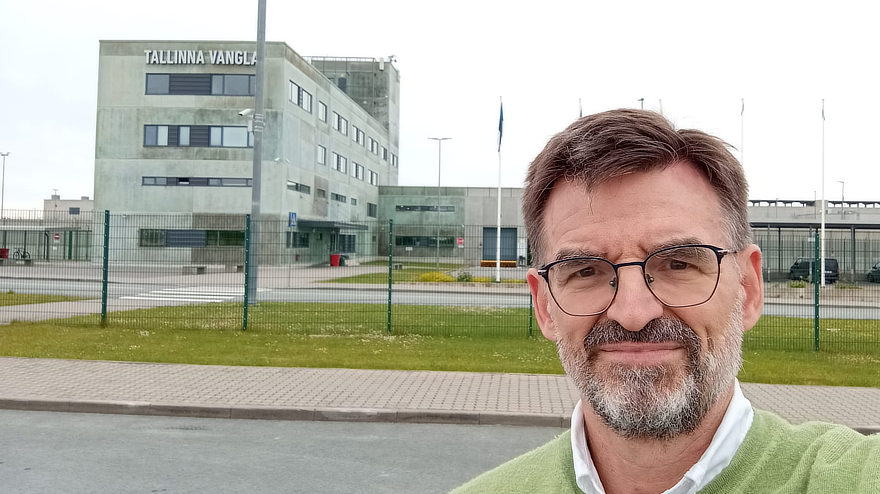
While working this past spring semester on finishing a book on the history of the multiethnic population of the city of Tallinn, today the capital of Estonia – and doing so in the city itself – I have had the opportunity to give three lectures in two prisons in this small country in northeastern Europe.
For the past several years I have been involved in the work of the prison education program run in the state of Connecticut by the University of New Haven Prison Education Program and its partnership with the Yale Prison Education Initiative and Yale University. This program provides courses for academic credit for incarcerated students in a number of prisons in the state, including the MacDougall-Walker Correctional Institution, which has the largest number of incarcerated people in Connecticutthe largest prison in New England, and is where I taught courses in the fall 2023 and fall 2025 semesters. Within the program, students are also able to complete two- and four-year degrees with the University of New Haven programs.
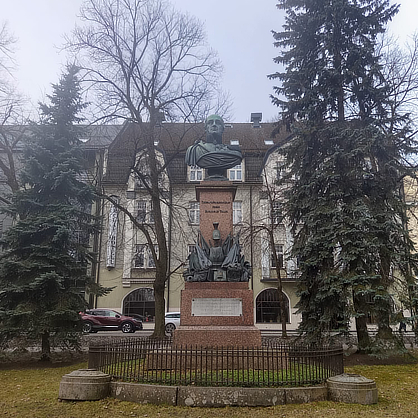
In April, I visited the town of Tartu in southern Estonia to attend a conference. While there I walked by a monument to Prince Michael Barclay de Tolly, who was a commander-in-chief of imperial Russia’s army during the Napoleonic wars of the early nineteenth century and is buried about 45 miles away. I had seen this monument many times during earlier visits, but now it affected me more deeply than ever before. Why? In a course I taught at MacDougall-Walker in the fall 2025 semester – History 3386: War and Peace in Tolstoy’s Russia – we read about Barclay de Tolly, a Baltic German and one of many non-Russian officers in the tsarist army who loyally served the empire. I was now standing in his homeland. Looking at this monument, I really could only think about the students in my fall course. While teaching the course I had been able to share with students my impressions of several locales in the novel from some of my previous visits to central and northeastern Europe, including the area near Austerlitz in the Austrian Empire (today, Slavkov u Brna in the Czech Republic), where a battle in 1805 took the lives of at least 35,000 Russia, Austrian, and French troops, and the Nieman River (now separating Russia and Lithuania), where in 1812 some of Napoleon’s mounted troops recklessly rode directly into the river to display their devotion to him.
As I reflected about teaching this course last year in MacDougall prison, I thought about the prisons in Estonia. I knew already that prison populations here include people speaking differing languages – Estonian and Russian. In both my 2023 and 2025 courses in MacDougall prison I had emphasized the multiethnic nature of the Russian Empire, which Estonia was part of for more than two hundred years. I decided to find out about educational programs in prisons here in Estonia.
'I discussed what history is'
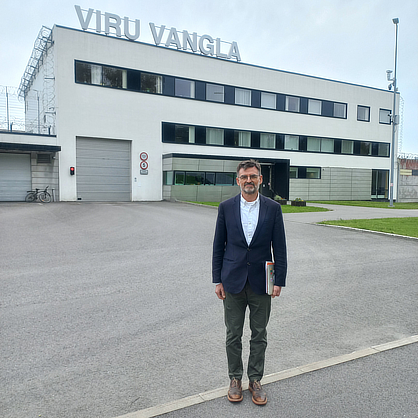
I contacted the Ministry of Justice and Digital Affairs of the Republic of Estonia and then met in Tallinn with Emma Bachmann, a project manager in the Resocialization Division within Estonia’s prison system. She invited me to give a lecture at the Viru Prison in the town of Jõhvi, in eastern Estonia, and I did so.
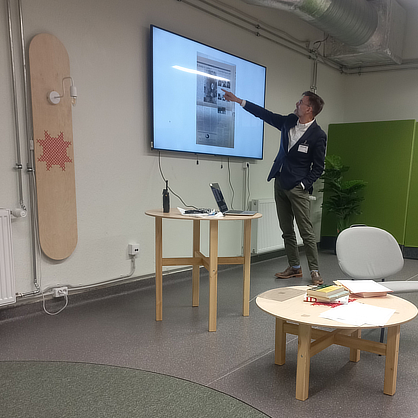
On that day, I met for an hour and a half with fifteen male incarcerated people, about half of whom were ethnic Estonians and half ethnic Russians. At the request of the Ministry of Justice, I gave my lecture in Estonian but added some in Russian in places. I discussed what history is, focusing on ideas from the Enlightenment and the historian’s craft. I spoke a bit about my own background and how I first became engaged with the country of Estonia in the 1990s.
I ended with some thoughts on my own current work on the history of the multiethnic population of Tallinn in the nineteenth century and early twentieth century, when it was a provincial center in the tsarist Russian Empire. Together with the lecture, we had time for discussion and questions and answers. My guide through the prison was the Estonian-language studies coordinator Marina Kõrvoja.
Ms. Bachmann invited me to give two additional lectures in the Tallinn Prison, located just outside the city. Both this prison and Viru Prison are fairly new facilities, with the Tallinn Prison completed in 2018. Both are much smaller than the MacDougall-Walker facility, with between 800 and 900 persons incarcerated in the Tallinn Prison and 400 and 500 in the Viru Prison, with each of these well under their full capacity.
Both prisons have extensive, attractive spaces for classroom learning. (A third prison, in Tartu, has a steeply declined number of incarcerated people, and Estonia’s parliament has approved legislation to allow for this prison to be the site of incarceration for prisoners from Sweden.)
Probably the most poignant moment in all of my time teaching in the two prisons came in the discussion with incarcerated students in the Tallinn Prison. At one point I remarked that it was during the period of perestroika in the late 1980s that Estonians saw that leaving the USSR was something that could be contemplated, something that was possible. One Estonian immediately responded, “We wanted out the entire time!” He was referring to the fact that Estonia was forcibly occupied by Soviet armed troops in 1940. Then after World War II, Estonia remained under Soviet occupation until the collapse of the USSR in 1991.
'The country’s prison education programs are focused on rehabilitation'
Education programs in Estonia’s prisons are provided in cooperation with Estonia’s Ministry of Education and Research. Prisons provide spaces and help form study groups, but the educational programs themselves are delivered and administered by the Ministry of Education and Research. This approach, called the “import model,” is adopted from Norway’s Correctional Service.
Overall, the country’s prison education programs are focused on rehabilitation, helping the incarcerated to be prepared for success upon release, both through offering various kinds of classroom experiences and gaining new hands-on occupational skills. Each person has an individual sentence plan that also includes an education plan, though participation in education programs is not mandated.
While there is not a program offering university courses, the prisons and the Ministry of Education and Research collaborate so that incarcerated persons can complete their educations. This includes not only high-school courses but college courses as well, which are sometimes completed through meetings between faculty and incarcerated students over Zoom.
A significant issue facing the country’s prisons is that over half of those incarcerated do not speak Estonian as their native language. Most of these are native Russian speakers. Estonia, like other countries that were part of the former Soviet Union, has a large Russian-speaking minority population, and issues remain in helping Russian speakers become fully integrated into Estonian society. While some of those incarcerated have some knowledge of Estonian (and a small number speak it quite well), one of the tasks of the country’s prison educational programs is helping incarcerated persons learn Estonian. In my visits to both prisons, I met with the Estonian-language studies coordinators responsible for running these language programs.
'It was a privilege to meet with them'
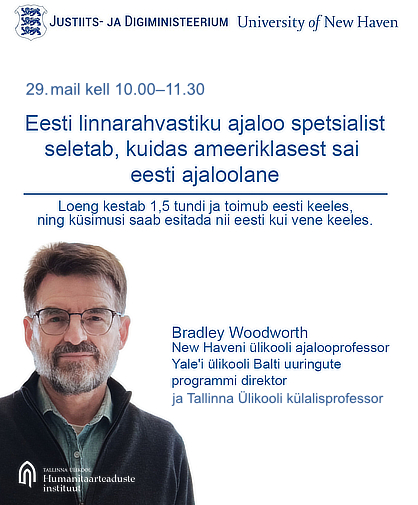
My lectures in Tallinn Prison were to larger groups – between 25 and 30 incarcerated people responded to the advertising flyer. Unlike the Viru Prison, which holds only men, the Tallinn Prison has some women, and present for my lectures here were several women. In the first lecture, I recapitulated what I had taught in the Viru Prison. In the second, I responded to what Tallinn Prison chaplain Allan Kroll reported the incarcerated students wanted to hear about: the Christianization of Estonian lands in the medieval period by crusaders from western Europe and the Great Northern War of the early eighteenth century, a turning point in the history of the region.
I did discuss these, but I began with a discussion of the centuries-long process preceding the arrival of missionaries and crusading knights in which peoples of differing languages and cultures intermingled, sharing ideas about agricultural practices, trade, governance, and various aspects of material culture. Knowing that I would be speaking before a mixed-language group, with some Russian speakers intermingled among a mainly ethnic Estonian group, I emphasized that the peoples in northeastern Europe – as everywhere in the world – have throughout history come together to exchange ideas and learn from each other.
In my meetings with students in these two prisons, I emphasized that for me it was a privilege to meet with them, and that I wanted each person to know I wanted them to understand me. From time to time during all three lectures, I paused in speaking Estonian to repeat also in Russian the idea I was communicating.
After my lecture, my host, chaplain Kroll, took me on a tour of the prison. I visited the common areas within cell blocks, viewed an un-occupied cell, and saw several prison workshops. In one, incarcerated people were making fireplace flues; I also visited woodworking and sewing workshops. In both prisons, I was taken to see the multi-confessional chapel; in fact, my lectures in the Tallinn Prison were held in the chapel.
Ms. Bachmann has encouraged me to consider returning to the country’s prisons to teach again, and I would love to do so.
Contact
Get the highlights!
Stay up to date with our weekly e-newsletter, highlighting stories from around the University and media clips featuring our faculty experts.
Recent News
University News
University of New Haven Welcomes 15 New Corporate Partners, Doubling Network of Cutting-Edge Industry Collaborators
Charger 360