Selected for a prestigious national fellowship, Mehdi Mekni, Ph.D., is leading efforts to transform computer science education through industry partnerships, stackable credentials, and workforce-driven learning.
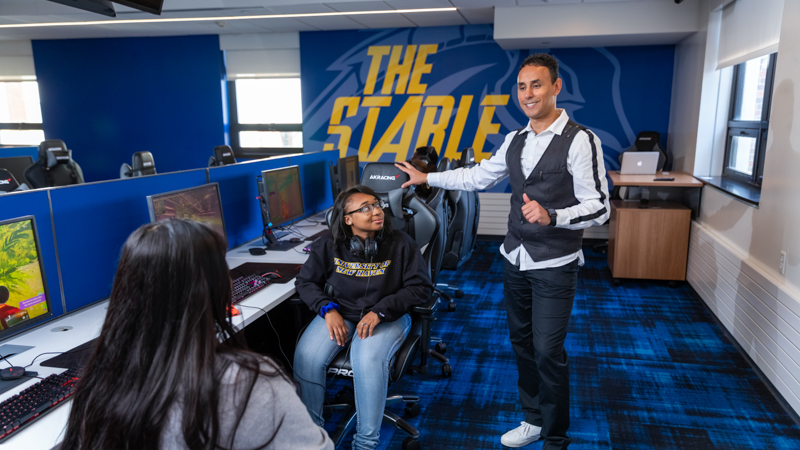
Mehdi Mekni, Ph.D. spent 15 years working in industry before stepping into a classroom as a professor of computer science, creating a wealth of experiences that shaped the way he sees both education and innovation today.
“I never thought my Ph.D. would be used for academia,” Dr. Mekni reflected. “I thought it would give me the depth and knowledge I needed for a career in the private sector.”
It’s because of his views on connecting academia and industry that led Dr. Mekni to receive an Innovation Fellowship from the Business-Higher Education Forum (BHEF). As one of just 28 faculty nationwide — and the first from the University of New Haven to be selected — Dr. Mekni is working alongside industry leaders and higher ed changemakers to build a future where students combine classroom learning with practical experiences, building the career-ready skills they need to excel.
When Dr. Mekni applied for the BHEF Innovation Fellowship, he did so with the encouragement and sponsorship of Tagliatela College of Engineering Dean Ron Harichandran, Ph.D. — a gesture that highlights the University’s commitment to bridging academic learning and industry needs, also a central focus of President Frederiksen.
“Receiving the fellowship is a nice recognition of my efforts on workforce development and the integration of industry-recognized credentials, curricular pathways, and traditional diplomas,” he said. “It’s about offering students the best of both worlds.”

‘I believe students shouldn’t have to select one or the other’
Dr. Mekni’s commitment to blending industry and academia partially grew out of a project he launched in 2023, funded by the Connecticut Tech Talent Accelerator (CT TTA). That initiative led to a partnership with Unity Technologies, one of the world’s largest game-engine service providers, enabling University of New Haven students to earn industry-recognized certifications alongside their bachelor’s degrees.
“A student who graduates with a computer science degree in game development but has no experience — it’s usually a very risky asset for employers,” he explained. “Employers tend to go after candidates with some experience, a small portfolio, and credentials. I didn’t want my students to pay that price.”
Thanks to the partnership, more than 20 students graduated not only with their degrees, but also with certifications from Unity — a combination that gave them a competitive edge in a fast-moving job market.
“I believe students shouldn’t have to select one or the other,” Dr. Mekni said. “Industry and academia need to start working closely together to develop the skills the workforce needs to sustain economic development, locally and nationally.”
‘It’s about creating programs that are flexible and relevant’
As part of the BHEF Innovation Fellowship, Dr. Mekni is expanding his vision beyond game design. His current project focuses on embedding stackable microcredentials into the University’s programs, particularly in fields such as gaming, artificial intelligence, and cybersecurity — areas he calls the “pillars” of computer science and software engineering.
“It’s about creating programs that are flexible and relevant. I want our traditional students to graduate with a degree and a portfolio of credentials that set them apart, but I also want to reach adult learners — people who don’t have the time or resources for a full degree but still want to reskill or upskill.” Mehdi Mekni, Ph.D.
The fellowship includes workshops and training sessions with business leaders, fellow faculty innovators, and higher ed experts. From San Diego to Washington D.C., Dr. Mekni has been learning strategies for leading transformational change — skills he says his technical background never taught him.
“They’re preparing you for the leadership and innovation side of a project: communication, alliances, momentum, and solving challenges,” he said.
‘My goal is for students to hit the ground running’
For Dr. Mekni, the lessons he’s bringing back from the fellowship all lead to one simple message: learning doesn’t end when the semester does. “In technology, you sleep and wake up the next day and there are new things to learn. It’s a dynamic, global ecosystem.”
Continuous learning and practical experience, he believes, is what will ultimately prepare students for careers beyond the classroom — whether they’re heading into game design, AI, cybersecurity, or industries that haven’t even been invented yet.
“My goal is for students to hit the ground running,” Dr. Mekni said. “And I want them to do it with confidence.”
Contact
Get the highlights!
Stay up to date with our weekly e-newsletter, highlighting stories from around the University and media clips featuring our faculty experts.
Recent News
In the Media

Westchester and Fairfield Business Journals: Top Colleges and Universities in Greater Fairfield and Westchester Counties 2026
In the Media