
Led by Mehdi Mekni, Ph.D., an avid gamer with a personal and professional interest and background in game design and development, the new concentration brings together students of diverse majors, enabling them to collaborate to create their own video game.

When Emiliano Vega ’23 was in high school, he did an internship at IBM that helped spark his interest in game development. He had the opportunity to learn Python and write a program for a game, and he plans to turn his passion for gaming into a career.
Now a computer science major at the University, Vega is pursuing a concentration in game design and development. It’s a new program at the University – the first two courses offered this fall filled up quickly – that informs, challenges, and trains students such as Vega to enter a technology field where technology is constantly changing.
Vega is currently taking “Introduction to Game Development,” taught by Mehdi Mekni, Ph.D., the program coordinator.
“In Dr. Mekni's class I've been learning about the process of game development,” said Vega. “I enjoy the work that I've been given, and Dr. Mekni gives great feedback.”
‘The goal is for students to have a mature enough prototype…they can showcase’
An associate professor of computer science and cybersecurity, Dr. Mekni wants the University to be a “one stop shop,” of sorts, for students who are interested in computing. He wants to make sure they find exactly what they’re looking for, and that this concentration will provide another exciting option at the University – along with programs such as cybersecurity, computer engineering, and data science – for students.
A passionate gamer in his own right, Dr. Mekni has a personal and professional interest in game design and development. His research and doctoral dissertation have focused on virtual environments and the interaction of actors in them, such as creating a virtual simulation of an evacuation to determine how much time it will take. His professional experience also includes working for Ubisoft, game design and development company.
“I got paid to do something I love,” he said. “I’ve built games, and I love games. I wanted the game design and development concentration to offer a path for students to do the same.”
The bachelor’s degree program in computer science with a game design and development concentration is nationally accredited by the Computing Accreditation Commission of the Accreditation Board for Engineering and Technology (CAC/ABET). It prepares students to be game designers and developers.
As part of the program, students will take courses such as “Extended Reality for Games,” “Applied Artificial Intelligence (AI) for Games,” and “3D Modeling and Rendering.” They will complete an internship and collaborate with their classmates to create their own game, defining the genre, creating graphics, and developing the game’s story.
“The goal is for students to have a mature enough prototype of a game for their portfolio that they can showcase to companies and potential employers,” said Dr. Mekni.
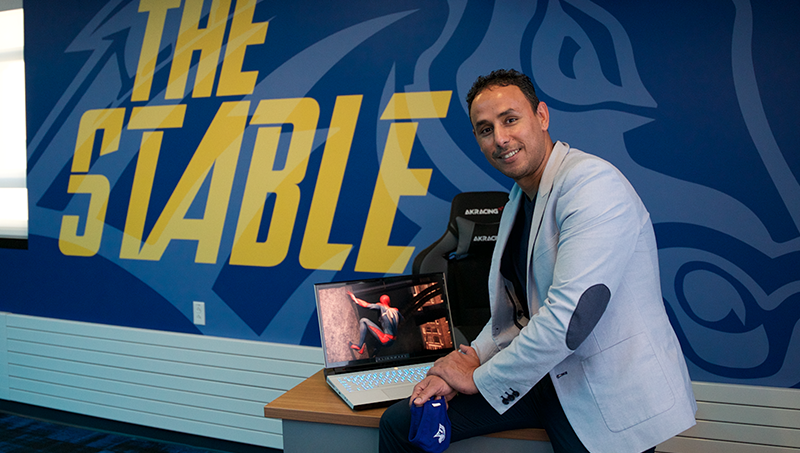
‘Anyone can have a seat in my class’
The concentration aims to offer students hands-on experience that will prepare them to apply for positions at game production or development companies around the world and to develop the knowledge and expertise to be able to create their own path. They will gain an entrepreneurial mindset, preparing them to build their own games as independent developers.
A key component of the concentration is that it is multidisciplinary. While it is offered within the computer science major, it is designed to include students from all majors and skill levels. “Introduction to Game Development,” a 200-level course, does not require a computing background, and it covers the history of gaming.
“I want students to know that anyone can have a seat in my class,” said Dr. Mekni. “The course will teach students the types of roles a game development team needs to have to be successful. They need three components: the art, the science and technology, and they need the business knowledge.”
Students in fields such as computer science handle the mechanics of the game, for example. Games also need music, scenery and avatar design, and some games require a knowledge of history. Enter music, art, and history majors. Business students come in to help with licensing, marketing, and ensuring the game is profitable.
‘Marketing actually plays an important role in game development’
Luca Pietrangeli ’22, a marketing major, is taking “Introduction to Game Development.” His career goal is to own a business, and he has already launched a sustainable coffee business called Moose Coffee Co. An avid gamer, he had always been interested in learning more about game design, and he took the course to explore it further. He has especially enjoyed the creative opportunities the course has offered.
“Marketing actually plays an important role in game development because it is the main way that people will see your game,” he said. “It is how you learn about the game, how you see the gameplay of it, and how you make money. All of the concepts we learn in marketing are applied here, from social media marketing to target audiences and demographics. The class is helping me with looking at my own business from different perspectives, and I could go through the process of game designing and apply it to my own business.”
‘I’ve learned how to take an idea for a game and bring that idea to fruition’
Dr. Mekni’s goal is to eventually develop a joint program in game design and development that involves B.S. and B.A. degrees to support students from the arts as well as science, technology, and business – and offer opportunities for them to collaborate. He hopes to bring together students and faculty from a variety of disciplines, and to create exciting and hands-on opportunities for all students who are interested in learning more about or pursuing careers in gaming.
Vega, the computer science major, aspires to work as a front-end developer and he is considering paths in mobile development. He’s already confident he will be prepared to excel.
“I’ve learned how to take an idea for a game and bring that idea to fruition,” he said. “This concentration will help me by teaching me how to create web and mobile games.”
Contact
Get the highlights!
Stay up to date with our weekly e-newsletter, highlighting stories from around the University and media clips featuring our faculty experts.
Recent News
University News

University of New Haven Faculty Earn Three Connecticut DOT Research Awards in a Single Year
The Charger Blog