Krupa Ann Mathew '25 MPH reflects on publishing a peer-reviewed article in a highly regarded international journal that examined dating app use, tribe identity, and health-related behaviors among sexual-minority men.
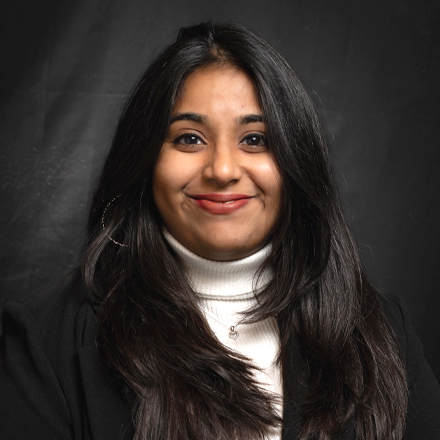
Looking back on my time as an MPH student at the University of New Haven, I am struck by how quickly the transition from student to public health professional unfolded. One moment I was deeply immersed in data analysis, drafting and re-drafting a manuscript (it felt like a never-ending cycle), and the next I was applying those same skills in professional settings where the issues I studied had real faces, names, and stories behind them.
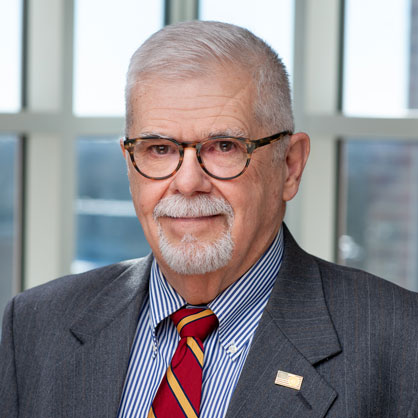
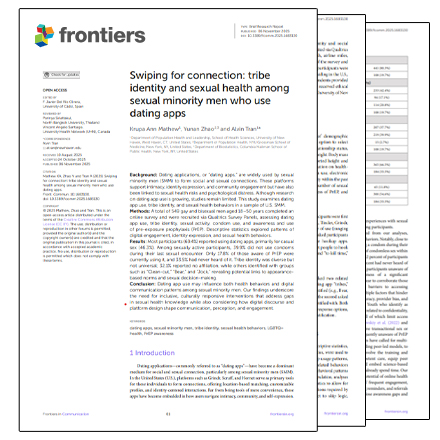
For me, one of the most meaningful experiences from my time at the University of New Haven was publishing my very first first-authored manuscript, Swiping for Connection: Tribe Identity and Sexual Health Among Sexual Minority Men Who Use Dating Apps. My paper, published in Frontiers in Communication as part of a special research topic focused on sexual health as a fundamental human right and essential component of well-being, grew out of my work with the WeEmbody (WE) Lab under the mentorship of Alvin Tran, Sc.D., MPH, associate professor and chair of the Department of Population Health & Leadership.
My study examined how gay and bisexual men, collectively referred to as sexual-minority men, use dating apps, identify with app-based "tribes," and engage in health-related behaviors. Using survey data from 549 sexual minority men across the United States, I explored how labels such as "Bear," "Jock," "Clean-cut," and "Daddy" shape experiences of identity, belonging, and community within digital spaces.
What Dr. Tran and I found was striking. While the study identified important gaps in HIV prevention awareness and behaviors, it also highlighted the potential of dating apps as spaces for health communication and outreach. These platforms are often discussed through the lens of risk, but they are also places where people build community, explore identity, and form meaningful connections.
Dr. Tran once noted, "Dating apps have become an important part of how many sexual-minority men build community, explore identity, and form relationships. Our findings help move the conversation beyond assumptions about risk and toward a better understanding of the social, cultural, and health factors that shape how people use these platforms."
‘Having a mentor who trusted me to take the lead gave me confidence’
One of the most rewarding aspects of this project was the opportunity to take a leadership role in the research process. I led the original manuscript drafting and contributed to the analysis and interpretation of the findings. Having a mentor who trusted me to take the lead gave me confidence I didn't fully know I had.
I would not have been able to accomplish this without the support of Dr. Tran, my research collaborators, and the other WE Lab Fellows. This experience taught me that research is about more than data. It is about asking meaningful questions and caring about the people behind the numbers.
Today, as a public health professional, I appreciate even more deeply why this work matters. The communities represented in research are not simply statistics. They are people with stories, identities, and experiences that deserve to be understood and supported.
As I now work as a Clinical Documentation Specialist at Prime Healthcare St. Francis Hospital in Chicago, I continue to apply and build upon the skills I developed throughout my MPH training. I am able to bridge clinical practice and public health by ensuring patient narratives are accurately translated into structured data that identifies gaps in care, supports health equity, and informs the kind of population-level research that drives meaningful change.
This was my first publication, but I know it will not be my last. If this research helps even one person think differently about how we understand and support sexual-minority men, then every revision was worth it.
Contact
Get the highlights!
Stay up to date with our weekly enewsletter, highlighting stories from around the University and media clips featuring our faculty experts.
Recent News
University News
Fall Undergraduate Open House - University of New Haven
In the Media