As part of a recent University-wide conversation, several professors and experts in fields such as maternal health and psychology explained what the Supreme Court’s decision means for people in Connecticut and across the country, as well as the possible longer-term consequences of the ruling.

For Danielle Cooper, Ph.D., CPP, the Supreme Court’s decision to overturn Roe v. Wade last month was overwhelming – as it was for so many people. She wanted to offer her support to members of the University community in the wake of the decision.
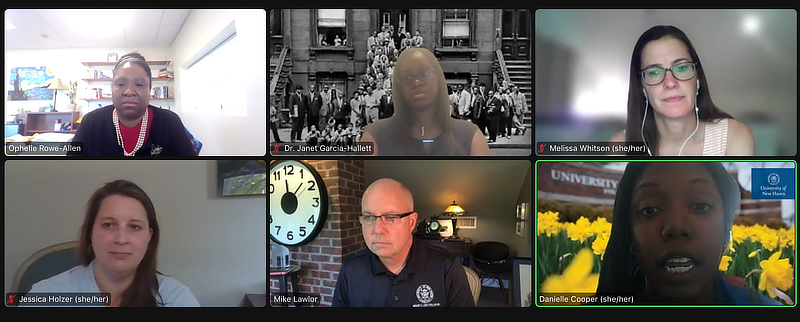
While moderating a recent virtual panel discussion for members of the University community, Dr. Cooper shared her own reaction. She acknowledged that it has been difficult to process, and she wanted to make sure her fellow Chargers understood they were not alone in experiencing a wide range of emotions.
“I want to encourage us all to take a deep breath,” said Dr. Cooper, associate professor of criminal justice and director of research for the Tow Youth Justice Institute. “This is a conversation where, if you’re like me, you feel it in your body and it can bring a wide range of emotions. It also gives us an opportunity to be in conversation with each other.”
‘An urgent issue that demands action’
Recognizing and acknowledging the potential impact the decision has on the safety, health, and well-being of many members of the University community, the University hosted the discussion as part of its Courageous Conversation series to provide a space for Chargers to come together to discuss the impact of the ruling. It brought together faculty representing several of the University’s academic colleges and schools.
For Jessica Holzer, Ph.D., assistant professor of health sciences whose research focuses on improving maternal health, the ruling was personal. She has close friends in a state in which abortion is now illegal.
Discussing the fear the ruling has created, Dr. Holzer explained that many of the decisions that will have to be made going forward are not clear cut – such as when abortion can be considered lifesaving care and what the dividing lines are between helping an individual access an abortion, respond to a miscarriage, or deliver a baby.
“When you think about revoking healthcare of any other type from any population, imagine making insulin illegal to access, or imagine you’d have to travel out of state to access it,” said Dr. Holzer. “You’d consider it an urgent issue that demands action. Abortion saves lives of people who need an abortion. Lack of access has negative consequences for individuals, families, and communities. It can also contribute to continuing poverty and generations of potential harm when it is combined with lack of access to healthcare and safety nets on a national level.”
‘In Connecticut there is a clear right…’
Mike Lawlor, J.D., associate professor of criminal justice and a lawyer, explained what the ruling means for Connecticut. Under current state law, the Supreme Court’s decision to overturn Roe v. Wade does not affect access to abortion or other reproductive healthcare in Connecticut. Prof. Lawlor also discussed the state’s Reproductive Freedom Defense Act, which went into effect on July 1, prohibiting state courts from enforcing a different state’s penalties against someone who provided an abortion that is considered legal in Connecticut.
“In Connecticut there is a clear right for persons who become pregnant to end a pregnancy,” he explained. “They’ve expanded the list of those allowed to perform abortions to include advanced practice registered nurses, nurse-midwives, and physician assistants.
“They’ve also made it clear that Connecticut will not participate in providing information about what happens in Connecticut to other states,” he continued. “If, say, a Connecticut doctor performs an abortion in Connecticut on a Texas resident, Connecticut will not participate in extraditing the doctor to Texas.”
‘This impacts college students’
Janet Garcia-Hallett, Ph.D., assistant professor of criminal justice, says the Supreme Court ruling will not stop abortions from happening. She explained that access to abortions has always been limited for certain groups of individuals, and that barriers to medical care most impact marginalized populations.
“All this does is make abortions unsafe and criminalize the women and doctors trying to help them,” explained Dr. Garcia-Hallett, author of Invisible Mothers: Unseen Yet Hypervisible after Incarceration. “This turns women from being patients into being criminals. Not only are you criminalizing the women, but you are criminalizing those trying to assist them. These are real people. These are our families and friends we’re talking about.”
Who exactly is seeking abortions was a point that Melissa Whitson, Ph.D., professor of psychology and an expert on childhood trauma, endeavored to contextualize. She explained that many people don’t really understand the process of an abortion or, even, what constitutes an abortion. She told the University community that more than half of those seeking an abortion are already parents who are not seeking an abortion as a form of birth control. Students, she said, are also in the group of people most likely to seek an abortion, according to the statistics.
“For college students there’s direct impact,” she said. “There’s this 50-year precedent that’s been there since most of us have been alive. Now that it’s overturned and there’s this impact on privacy, this impacts college students as they begin their careers. It can affect where they want to live and get a job, as this becomes a state issue.”
‘This is about much more than abortion’
Panelists stressed the importance of continuing the conversation. The University is planning more panel discussions that will address timely and pertinent issues for this fall, including a Courageous Conversation series event about gun violence planned for October.
In the meantime, faculty members addressed the fear that many are now experiencing in the wake of the Supreme Court’s decision – from what the ruling will mean for people seeking an abortion to concern that other laws will be overturned.
Describing the ruling as a case in which the “dog has caught the car,” Prof. Lawlor warned of the proposed legislation that could follow, including that which could lead to the arrest of more pregnant people seeking an abortion as well as healthcare providers and anyone trying to help them.
“This is about much more than abortion, and it is a very scary prospect,” he said. “For most of our adult lives we’re going to be dealing with the consequences of this decision. If you don’t approve of this kind of thing, you have to vote accordingly. This is a threat to our democracy. I have a lot of faith in our younger generations to fix this, but it’s not going to happen tomorrow.”
Contact
Get the highlights!
Stay up to date with our weekly e-newsletter, highlighting stories from around the University and media clips featuring our faculty experts.
Recent News
The Charger Blog

University of New Haven Research Team Presents Digital Transformation Study at Major International Conference
The Charger Blog