The federally funded program will help prepare 25 Connecticut high school educators to teach and promote online safety and cybersecurity in the classroom.
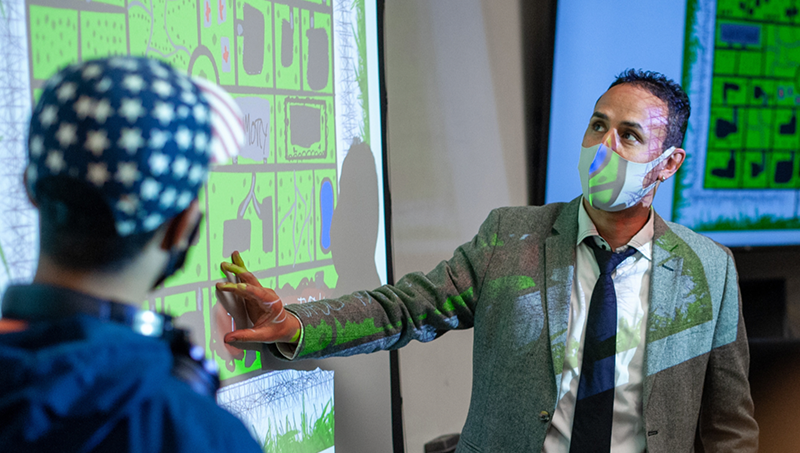
Mehdi Mekni, Ph.D., believes in the importance of cybersecurity education and the significant role it can play in protecting the nation and promoting safety online. He recently received a grant – his first at the University – that will enable him to share his passion with local educators.
Funded by the National Security Agency and the National Science Foundation, the grant will enable Dr. Mekni to take a unique approach to cybersecurity education by making high school teachers the students. He is creating Connecticut’s first GenCyber Teacher Academy, training high school teachers to teach and promote cybersecurity.
“If you teach the teacher, that teacher will shape, influence, and improve the preparedness of students year after year,” explains Dr. Mekni, an associate professor of computer science and cybersecurity. “When you get into training teachers and give them the tools they need, such as teaching materials, lesson plans, and equipment to incorporate cybersecurity education into their programs, that’s real value.”
‘I’m a builder’
Dr. Mekni, who will oversee the program and deliver the content, will be joined by University of New Haven faculty such as Liberty Page, M.S., and Amir Esmailpour, Ph.D. The weeklong program will enable 25 teachers at public, private, or charter high schools in Connecticut to learn how to apply cybersecurity concepts in their classrooms.
Offered free of charge, the GenCyber Teacher Academy is geared toward teachers with science, technology, engineering, and math (STEM) backgrounds. Teachers are not required to have prior knowledge or experience in computer science or cybersecurity. The hands-on program will include lesson plan design, lectures, labs, and games. Participants will also receive a Chromebook to take with them to their classroom, free of charge.
“I’m a builder, and this program will build bridges with high schools,” he said. “Teachers will interact with peers, horizontally sharing what they learned, and they will also teach it to countless students. I expect the investment of training teachers will impact future generations.”
‘I hope the GenCyber Teaching-Learning Community will keep growing’
Dr. Mekni’s goal is to help meet the rising need for highly skilled cybersecurity professionals to protect the nation and support its governmental workforce. The program will apply culturally-responsive teaching to cybersecurity education. It will cover important topics such as social engineering, Python, cybersecurity awareness, and network fundamentals. Teachers will leave the program with materials they can use in the classroom, such as lesson plans.

“Since his arrival, Dr. Mekni has been a welcomed, positive force at the Connecticut Institute of Technology,” said Ibrahim “Abe” Baggili, Ph.D., founding director of the Connecticut Institute of Technology at the University of New Haven. “His new grant will allow us to give back in other ways to the state of Connecticut. We started with our student camp, now we will also help train teachers in the state. We thank NSA and NSF for their continued support.”
The program, which will include pre- and post-camp activities that will be offered online, will also build and foster a GenCyber Teaching-Learning Community, the program’s legacy, of sorts. Teachers and program instructors will meet virtually after the camp for follow-up sessions. Teachers will report what has been successful and the challenges they have faced, and they will continue to have support as they apply what they learned.
Dr. Mekni looks forward to welcoming the inaugural cohort of teachers to the University in August, and he hopes to offer the program every summer.
“I hope the GenCyber Teaching-Learning Community will keep growing as new cohorts join, and we keep building it,” he said. “We want to train them and make sure they can and will use what they learned.”
For more information about GenCyber Teacher Academy: /engineering/index.php.
Contact
Get the highlights!
Stay up to date with our weekly e-newsletter, highlighting stories from around the University and media clips featuring our faculty experts.
Recent News
The Charger Blog
University of New Haven Chemical Engineering Students Earn Research Awards, Scholarships, and Fellowships
The Charger Blog