Forty students from around the region spent a week tracking down cyber criminals, decrypting codes, cracking passwords, and learning how to hack into major websites – to ultimately understand how to protect them – as part of the University of New Haven’s GenCyber Agent Academy, an innovative program supported by the National Science Foundation and the National Security Agency.
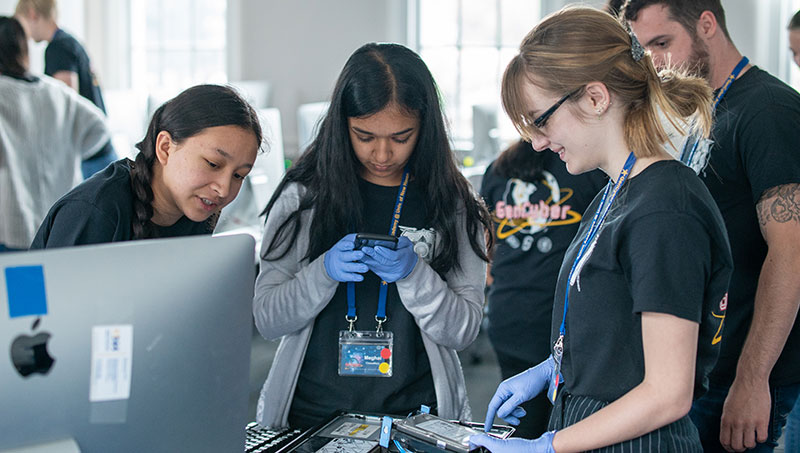
Paige Campbell, a high school senior from Hamden, Conn., was having breakfast at Westside Hall, talking with her fellow campers about everything they’d were learning as part of the University of New Haven’s GenCyber Agent Academy: Python programming, cracking passwords, using Wireshark software to read unencrypted network traffic, and how to do a digital forensic investigation – and they hadn’t even reached the midpoint of the weeklong camp.
"A lot of this is about puzzles and critical thinking," said Campbell. "You just have to try to piece these things together, and that’s a lot of fun. It’s all so hands-on."
"They teach you software, then they give you challenges to see how you’d apply it to a real-life scenario," added Michael Innocenzi, a junior from White Plains, N.Y. "We did one hacking challenge where we had to find the password in encrypted Wi-Fi. It was really interesting trying to find it."
"It’s fascinating," interjected Paige Jurkevich, a sophomore from Woburn, Mass.
"You just have to try to piece these things together, and that’s a lot of fun. It’s all so hands-on."Paige Campbell, Hamden Conn.
The central missions of the GenCyber Agent Academy, said Liberty Page, lecturer and coordinator of the University’s undergraduate program in cybersecurity and networks, is to generate excitement and draw high school students to the fields of cybersecurity and cyber forensics.
In 2016, Page; Ibrahim (Abe) Baggili, the camp’s director and the University’s Elder Family Chair of Computer Science and Cybersecurity; and Frank Breitinger, assistant professor of computer science, received funding from the National Security Agency and the National Science Foundation to create the first-of-its-kind summer academy in Connecticut that encourages young women and individuals from traditionally underrepresented groups to explore the field of cybersecurity.
For each of the last three years, more than 160 high school students from Connecticut, New York, Massachusetts – and beyond – have applied for the 40 slots, for 20 females and 20 males, with all student costs covered by the grant.
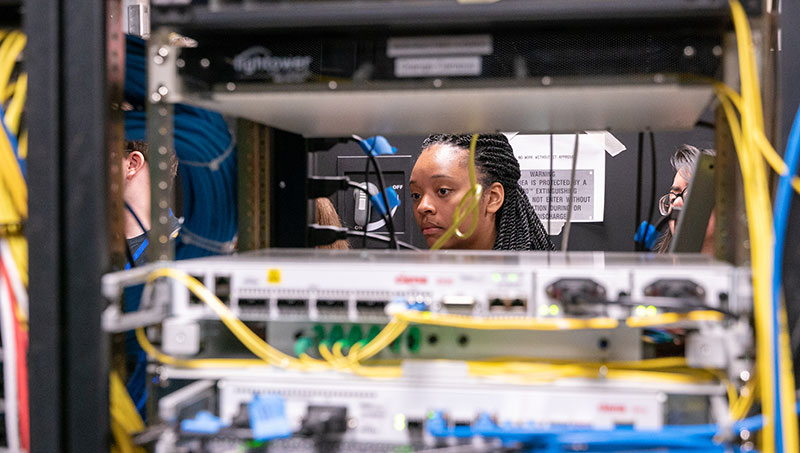
"We show them that if you like solving a puzzle maybe cyber forensics is your thing," Professor Page said. "If you like programming, maybe you want to build the tools to help people solve these problems, or if you like hacking and finding a way in, you can learn to ethically hack. We let them see there is something for everyone."
Dr. Baggili added, "It’s important to excite kids about the cybersecurity field and the opportunities in it at young age. Many of them have no idea about the amazing career opportunities waiting for them across every industry."
As part of the camp, the high school students compete in a complex, campus-wide cyber forensic scavenger hunt and take part in talks with industry professionals. The week ends with a capture the flag competition, where students work in teams competing for points and prizes, "using all the skills they’ve developed," Professor Page said.
"They’re very smart, so we have to make the competitions challenging," said Shirley Urban, an educational consultant who works with the Tagliatela College of Engineering faculty and teaching assistants.
"It’s important to excite kids about the cybersecurity field and the opportunities in it at young age. Many of them have no idea about the amazing career opportunities waiting for them across every industry."Abe Baggili, Ph.D.
Back at the mid-week breakfast, Rebeccah Fleischmann, a senior from West Hartford, Conn., was talking with some of her fellow campers about Johnny A.I., the fictional cybercriminal they tracked the day before across Twitter, mobile devices, and hard drives, bagging and tagging every single clue they found, just as they would at a real crime scene.
"We had to look at his tweets, and he’d say stuff like ‘the key to my heart is…’ so we knew the key is ‘my heart’ and there was a full line of code we had to decrypt," Fleischmann explained. "It was such a great team building exercise and so challenging."
Yamilett Hernandez, a sophomore from New Haven, Conn., said the creative ways the camp faculty taught – using challenges such as tracking down Johnny A.I. – "brought what we are learning to life. It really helps us understand the concepts."
Added Destiny Ray, a senior from Norwalk, Conn., "I loved it!"
Contact
Get the highlights!
Stay up to date with our weekly e-newsletter, highlighting stories from around the University and media clips featuring our faculty experts.
Recent News
The Charger Blog

University of New Haven Research Team Presents Digital Transformation Study at Major International Conference
The Charger Blog