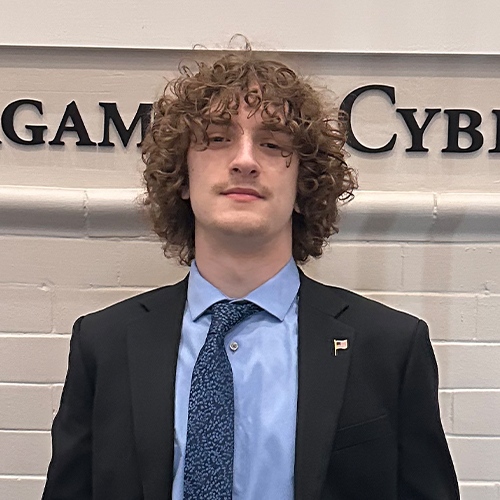
University of New Haven students George Pappas ’28 and Sydney Lamberty ’27 reflect on a Brehm-Boucher Speaker Series conversation with former Reuters diplomatic correspondent Arshad Mohammed, who shared firsthand experiences reporting from Air Force One on September 11, 2001.
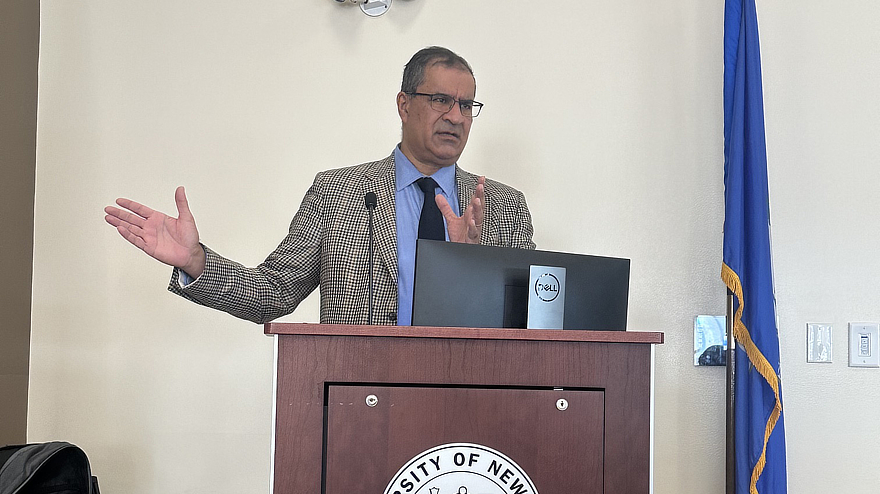
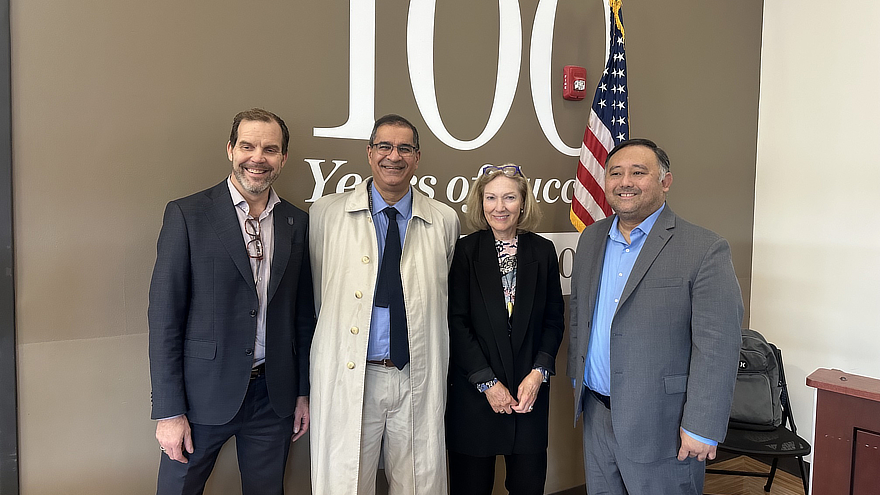
A recent Brehm-Boucher Speaker Series conversation gave University of New Haven students a firsthand look at journalism, diplomacy, and the importance of accuracy in moments of crisis. Arshad Mohammed, former diplomatic correspondent for Reuters, the world's largest multimedia news provider, reflected on his career and his experience reporting from Air Force One during the September 11, 2001, attacks.
Below, students George Pappas ’28 and Sydney Lamberty ’27 share their reflections on the conversation and the lessons they took away from Mr. Mohammed’s experiences and advice.
Sydney Lamberty ’27
As a Forensic Biology student, I found that attending this Brehm-Boucher Speakers Series was not only educational and insightful, but it also provided a great space to ask questions and engage with amazing speakers. The talk was given by Arshad Mohammed, a former diplomatic correspondent and reporter. He shared his firsthand experience of what it was like to be reporting on Air Force One during the attacks on September 11th. Throughout the discussion Mr. Mohammed also gave a lot of insight into his career and public relations as a whole, as well as providing advice for all students going into various career paths.
This event was dedicated to Richard Boucher, a former U.S. ambassador, who was a truly remarkable and compassionate man who I wish I had the pleasure of meeting before his passing. This talk was made possible through large support and coronation of Mr. Boucher’s wife Carolyn Brehm ’96 MBA, a member of the College of Arts and Sciences Advisory Board; Chris Haynes, Ph.D., associate professor in the Department of Human Sciences; Matthew Schmidt, Ph.D., associate professor in the Department of National Security; and Jaimy Rippe, Esq. ’18, adjunct professor. Without their continued help and organization, this event would not have been able to create the impact it had on the University of New Haven campus.
I hope to continue attending Brehm-Boucher Series events in the future, and I want to ensure I absorb all the knowledge, strength, and insight I can from the experience.
George Pappas ’28
When I took my seat for the Brehm-Boucher Speaker Series, I expected a compelling discussion on international affairs. What former Reuters diplomatic correspondent Arshad Mohammed delivered was a masterclass in what it means to witness, analyze, and communicate world-altering events in real time. Hosted by Ms. Brehm, Dr. Haynes, and Dr. Schmidt in honor of Ambassador Richard Boucher, the event offered a look behind the podium of global diplomacy.
The detail that stood out to me was Mr. Mohammed’s recollection of the morning of September 11, 2001. He was never originally scheduled to be on Air Force One. At the time, his wife was pregnant, and with a young son at home whom he was eager to return to, a colleague generously offered to swap assignments and give him a spot in the travel pool covering what was expected to be a routine, early-return presidential trip to an elementary school in Florida. Instead of an early trip home, that single exchange placed him inside the presidential cabin as an unprecedented national catastrophe unfolded.
Hearing him recount that day was captivating, but the real weight of his talk came from his emphasis on facts, integrity, and the non-negotiable duty to verify information. To illustrate just how fragile human recollection can be in high-stress environments, he shared a striking story from the tarmac after the President’s address at an Air Force base later that day. With Air Force One spinning up to depart and local media gathering outside the gate, U.S. Air Force Security Forces were on edge guarding against a potential attack, and the Secret Service began strictly limiting who could board—even restricting their own personnel and winnowing the press pool down to a skeleton crew.
Left stranded on the tarmac, Mr. Mohammed shouted to a colleague heading up the stairs, “What about us?” Years later, that same colleague published a memoir recounting the chaos on the runway, but attributed that desperate shout to an entirely different person. Even firsthand eyewitnesses misremember critical details when adrenaline is high, making independent factchecking and verification vital.
‘Speed is useless if you are wrong’
In our current digital landscape, speed is often prized above all else. Headlines break in seconds, algorithms reward instant reaction, and the pressure to have an immediate take can overshadow the truth. Aboard Air Force One, and throughout his decades covering foreign capitals, Mr. Mohammed faced environments where rumors ran wild, communications were spotty, and speculation was rampant.
In those high-stakes moments, the easiest thing to do is pass along unconfirmed reports. Instead, his core message was that speed is useless if you are wrong. Professional integrity requires the discipline to slow down and take the time to verify every single claim before presenting it as fact. “Trust but verify,” he said.
During my time in military service, one of the most critical principles learned was, "trust, but verify," because misinformation gets people killed. On a Search and Rescue mission, especially one requiring an emergency MEDEVAC, transposing even a single digit in your latitude and longitude, or miscalculating the number of people in the water from a sinking or burning vessel, carries fatal consequences. Inaccurate data doesn't just risk the lives of the civilians waiting for help; it jeopardizes the entire crew operating the boat or aircraft beside you.
Hearing a seasoned foreign correspondent reinforce that exact operational standard from the press pool demonstrated that whether you are coordinating a maritime rescue, managing a homeland security incident, or reporting breaking news to a global audience, discipline under duress means holding the line until the facts are verified.
Mr. Mohammed emphasized that credibility is painstakingly built over years through rigorous accuracy, but it can be permanently shattered by a single careless error. Upholding that standard takes courage, especially when external pressures urge you to act prematurely.
‘Preparing to enter complex, high-consequence fields’
Leaving the Alumni Lounge, I realized that hearing Mr. Mohammed’s journey was more than just a fascinating window into history. It served as a direct reminder of the responsibilities we carry as students preparing to enter complex, high-consequence fields.
We cannot always predict when a routine assignment or a simple schedule change will thrust us into a defining crisis, but we can control our standards. His message to stay grounded in facts, protect your integrity at all costs, and never sacrifice verification for the convenience of the moment will stay with me.
This event and the Brehm-Boucher Speaker Series would not be possible without the generous support of our donor Ms. Brehm, as well as the leadership of Dr. Schmidt, Jaimy, and Dr. Haynes, whose dedication to fostering these critical conversations on campus is deeply appreciated. In addition, our Model United Nations program wouldn’t be possible without Ms. Brehm’s continued support. Thank you.
Contact
Get the highlights!
Stay up to date with our weekly e-newsletter, highlighting stories from around the University and media clips featuring our faculty experts.
Recent News
The Charger Blog
Students Showcase Passion for Discovery Through Summer Undergraduate Research Fellowship Program
The Charger Blog