Mackenzie Pavlik ’23 and Abby Veeser ’23 M.S. are working together on important research that focuses on drug testing, and they’ve already shared myriad exciting learning opportunities in the laboratory.
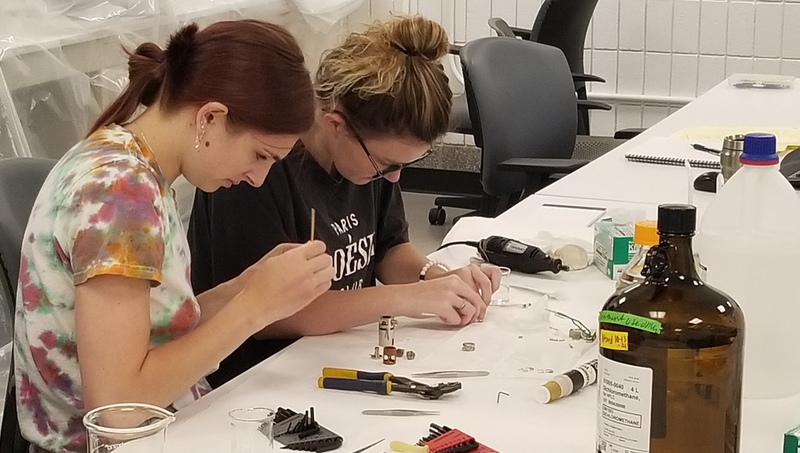
Mackenzie Pavlik ’23 has always been interested in science, and she enjoys learning why and how processes occur. She hopes to use her passion for science – forensic science, in particular – to make the world a better place.
Interested in toxicology, Pavlik took a toxicology course with Robert Powers, Ph.D., F-ABFT, an associate professor of forensic science, last fall. The course furthered her interest so much that she approached Dr. Powers to discuss possible research opportunities, including research she could take part in as part of her Honors thesis.
Dr. Powers introduced Pavlik to Abby Veeser ’23 M.S., a candidate in the University’s graduate program in forensic science. They are now collaborating – Pavlik describes her project as a “smaller portion of Abby’s thesis” – and she spent much of her summer working on it as part in the University’s Summer Undergraduate Research Fellowship (SURF) program.
“I have really enjoyed my SURF experience so far,” said Pavlik, a forensic science major who will also pursue her master’s degree in chemistry as part of the University’s 4+1 program. “I think the most important thing I have learned from this is that I truly love research. I am excited to come into the lab each morning, and I am still thinking about my project when I leave at the end of the day. Through working with Abby and Dr. Powers, I have also learned a lot about what it is like to be a professional in the field and what grad school will be like.”
‘We bounce ideas off each other’
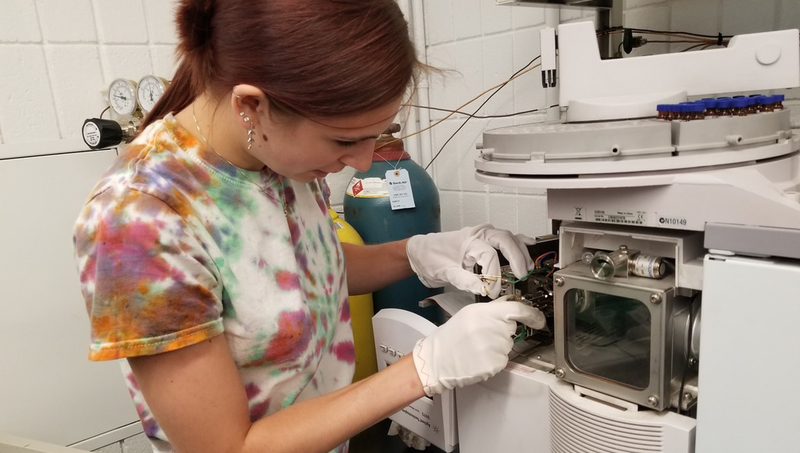
As part of her work, Pavlik is running enzyme assays. Veeser’s thesis focuses on drug testing that can sometimes reveal trace levels of methamphetamine in individuals who are taking amphetamine as a treatment for ADHD.
“This can be interpreted as ‘methamphetamine abuse’ with the potential for significant negative consequences for the patient,” explains Veeser. “I am hoping to learn about the toxicological aspects of certain cases that could make a difference in a person's life. The point of our research is to not, for example, have children be taken away from their parents over a metabolic pathway in our bodies when taking a certain type of drug.”
Like Pavlik, Veeser has always had an interest in science. Growing up, her parents both worked in the criminal justice system, and she wanted to pursue a career in science. Veeser, who hopes to gain experience in the field after earning her master’s degree and then pursue her doctorate in biochemistry, has been enjoying her research experience as well as her collaboration with Pavlik.
“Working with Mackenzie this summer has been great,” she said. “We bounce ideas off each other if something doesn't end up right throughout the research aspect of our project. I learn things from her, and I hope she is able to take things from me as well.”
‘Toxicology is truly what I am passionate about’
They shared a particularly exciting opportunity to learn and collaborate together in the lab when they began to get messy readings using the gas chromatography-mass spectrometry (GC-MS) instrument. After adjusting several different settings, they realized it was an issue with the GC-MS source, which is where the ions are produced. Since it can get oxidized over time, it can eventually affect readings.
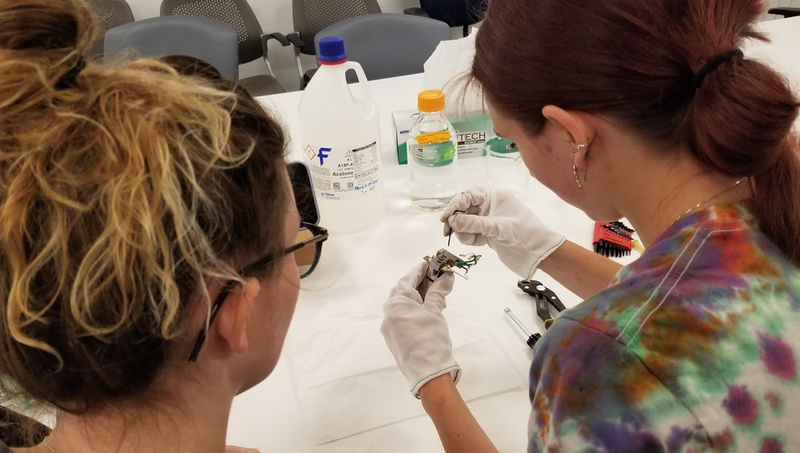
Because they needed the instrument to move forward with the research, Pavlik and Veeser addressed the matter themselves. They took the instrument apart, polished the pieces with zinc oxide, and rinsed them with methanol to ensure there were no residues left behind. They then reassembled the source, which included many small pieces that had to be put back together in exactly the right way.
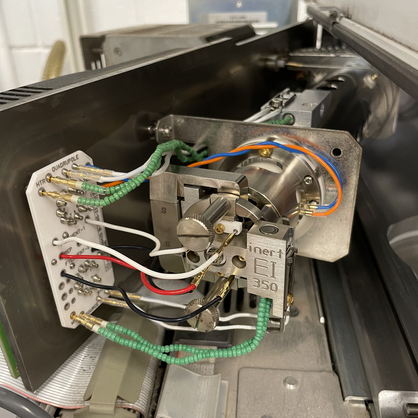
“The cleaning of the GC-MS was a great opportunity for us because not many individuals are taught how to do this while conducting their research,” explains Veeser. “I looked at this process as a ‘life skill’ because in the future, I will be able to step forward and say I have been taught how to clean one. It's a tedious and long process at times, so being able to put it back together and see the great outcome was fulfilling.”
Pavlik, who also hopes to pursue her doctorate in biochemistry, says working with Veeser and Dr. Powers has been an invaluable learning experience. Her time in the lab with them has helped her envision the career path she’d like to pursue.
“It has been interesting to hear about the different cases Dr. Powers has worked on and to hear more about what it is like to be a forensic toxicologist,” she said. “Overall, I have learned that toxicology is truly what I am passionate about, and it is what I want to spend my life doing. I am excited to finish out my time at the University.”
Contact
Get the highlights!
Stay up to date with our weekly e-newsletter, highlighting stories from around the University and media clips featuring our faculty experts.
Recent News
Charger 360
Season 5, Episode 4: Ashley McClain ’07 and Ariana James ’27
In the Media