The Charger Blog
Charger Blogger Looking Forward to New Opportunities as a Senior
Shana-Kay Hyde ’27 is excited to serve as a resident assistant, be part of a research group, and begin her graduate studies as part of her 4+1 program.
The Charger Blog
At the MacDougall–Walker Correctional Institution, graduates of a joint program supported by the University of New Haven’s Prison Education Program and the Yale Prison Education Initiative reflected on the profound power of pursuing higher education behind the walls.
December 17, 2025
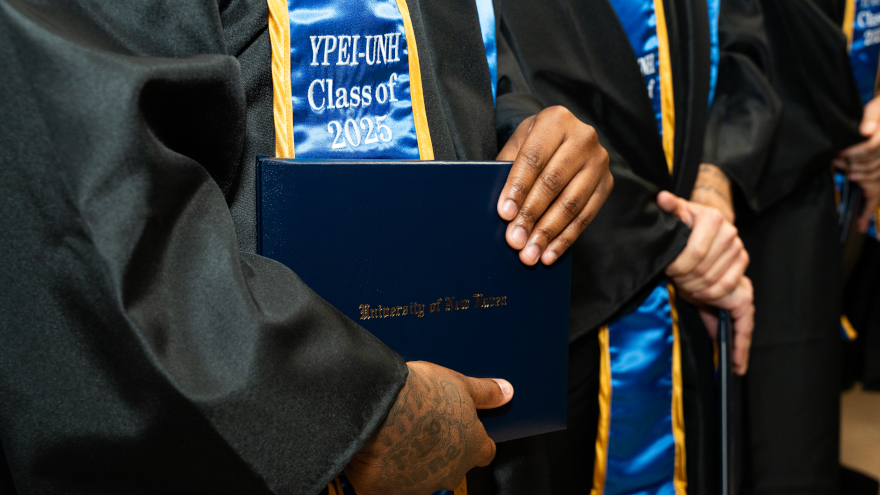
Ten graduates were recently conferred degrees by the University of New Haven at the third commencement held at the MacDougall-Walker Correctional Institution. Zelda Roland, Ph.D., founding director of the University of New Haven Prison Education Program and the Yale Prison Education Initiative (YPEI) at Dwight Hall, opened the ceremony with a reminder of what the day represented. “Today, we celebrate the achievements of our graduates and recognize their years of hard work, self-sacrifice, and, in particular, their incredible resilience and resolve,” she said.
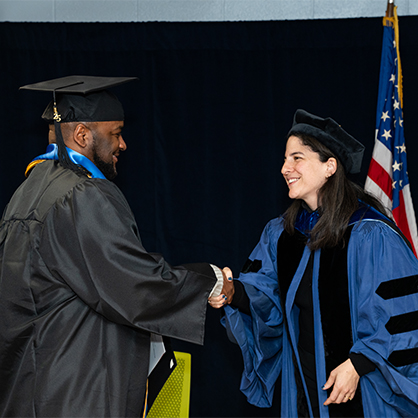
Dr. Roland thanked the families, friends, faculty, Department of Correction partners, and the staff at MacDougall-Walker Correctional Institution. She emphasized how deeply collaborative the work has been from the beginning. “It is my absolute pleasure to welcome everybody here to this joyous occasion,” she said.
This year’s commencement honored the newest group of students who had completed degrees through the partnership, representing the continued evolution of a program that has grown significantly since its creation. To date, the initiative has facilitated more than 1,600 enrollments in credit-bearing courses for more than 150 incarcerated students, supported by more than 180 University of New Haven and Yale faculty, staff, and graduate students who have taught, mentored, or helped extend research opportunities within the prison’s classrooms.
Deputy Warden Kristan Mangiafico also spoke, underscoring how meaningful the moment was not only for the graduates, but for the institution. “Today’s graduation is not just a ceremony,” she said. “It’s a milestone in a journey of personal hope and transformation. Congratulations. You have worked hard to reach this moment.”
Each graduate had a chance to share a few words, with many of them remarking that this milestone began with a moment of reckoning, or a message that had stayed with them for years.
Ricky, one of the graduates, spoke about four words that shaped his journey: “Be better than me.” His late father had repeated this throughout his childhood, though Ricky said he never fully understood what it meant until adulthood.
Growing up where he did in New Haven, he explained, young people often see very few paths forward. “In our communities, to achieve success” he said, “we are expected to be an athlete, a musician, or just hope to be alive on our 18th birthday.”
Ricky entered the carceral system at a young age and, “Immediately I understood this reality was not the one my father had for me.” He shared that when his father passed away, the phrase took on a new meaning. “Be better than myself,” he said.
For Ricky, education became the path that made that possible. “It not only gives us the tools and knowledge to make sure we get home, but make sure we never come back,” he said.
He concluded with a message to his late father. “Look at me now. I am a University of New Haven college graduate.”
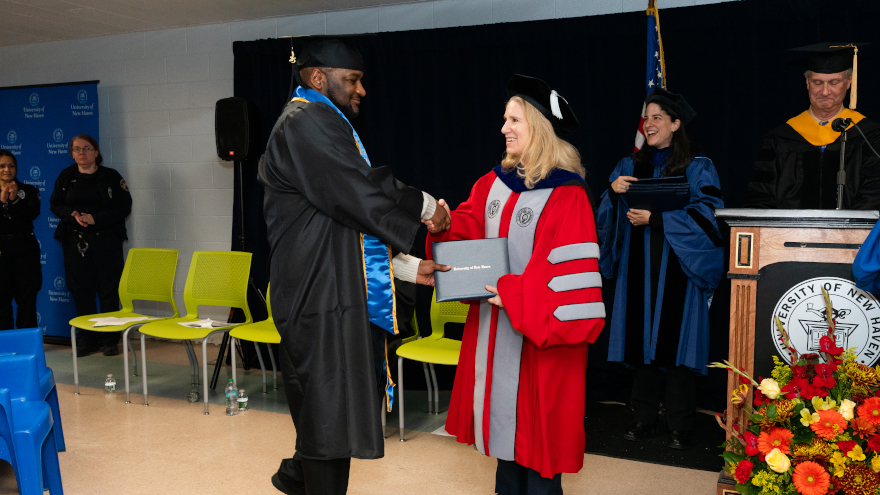
Another graduate, Francis, spoke candidly about the emotional weight of graduating inside a correctional facility. “Getting to this point required every one of us to say no to a lot, and yes to a few things,” he said. The poignancy of celebrating such a significant achievement in, “a place that normally reminds them and us of the realities of our worst decisions,” he added, was not lost on anyone.
His journey toward higher education began with a single conversation with his mother. When he told her that his circumstances felt unfair, she responded with, “Grow up. It’s not unfair. Now you have to figure it out.” This tough honesty stuck with him to this day.
“I realized that I had to own my part,” he said. Over the years that followed, he began saying yes to his faith, to family, to health, and, ultimately, to education.
“I said yes to the opportunity to redeem myself,” he said.
Francis ended with a message to his peers and a reminder of the collective strength in the room. “We said yes to finding a way to be more than our worst decisions.”
As the morning unfolded, what resonated most was the shared sense of purpose among the students, faculty, and community partners of working toward a more just and humane future.
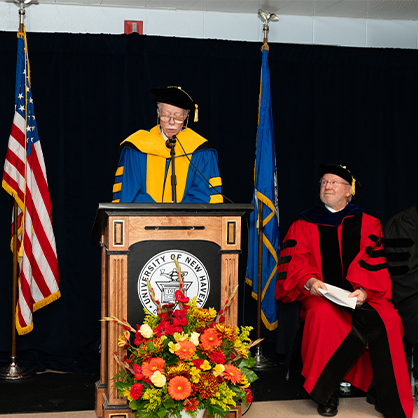
Connecticut State Representative Gregg Haddad, the commencement speaker, reflected on the meaning of education both inside and outside the prison walls. “The degree conferred upon you today is far more important than the piece of paper,” he said. “It is proof of an investment we have made in you and, more importantly, an investment you have made in yourselves.”
He reminded the graduates that the value of a degree is not in the coursework but in the transformation it sparks. “Since the day I graduated, not once has anyone asked me to solve a differential equation. Not once has anyone asked to see my diploma,” he said. “But I use my education every single day. I use it when I deliberate legislation, when I share ideas, when I discuss and debate.
“A degree’s true value,” he continued, “is the internal transformation you undergo — the development of critical thinking, the ability to analyze problems. Education gives you the tools to initiate change.”
The University of New Haven’s Prison Education Initiative continues to expand in scope and impact, driven by students, faculty, and partners who believe in education as a catalyst for change.
For the graduates, the ceremony signified a tangible future, not just academic achievement, and a future filled with possibility, dignity, and purpose.
Rep. Haddad challenged the graduates to recognize their responsibility as leaders. “Leaders use their wisdom to take care of the people around them,” he said. “Your success will inspire others to pick up a book, to enroll in a class, to believe in their own potential.”
The Charger Blog
Shana-Kay Hyde ’27 is excited to serve as a resident assistant, be part of a research group, and begin her graduate studies as part of her 4+1 program.
University News
Master partnership agreements with Sailion, Medtronic, Sheffield Pharmaceuticals, and ARBURG create new gateways for talent, innovation, research, and workforce solutions through the University’s Elevation Center.

The Charger Blog
As a new academic year ramps up at the University of New Haven, Charger Blogger Shana-Kay Hyde ’27 takes a moment to reflect on the past, set new goals, reconnect with the Charger community, and make the most of the opportunities ahead.