Having the chance to find out how the world’s best criminal investigators do what they do while learning how to create a popular true crime podcast is an experience like no other, students say.
On the first day of his Crime Waves Podcast honors course, Declan Hill, D.Phil., asked for a volunteer to take the lead on an episode with Robert Mazur, the undercover agent who helped to take down Pablo Escobar and the Medellin cartel.
“I said, ‘you’ll have to read Robert Mazur’s two books (The Infiltrator and The Betrayal), watch the two films based on the books, and review every interview he has done,’ Dr. Hill recounted. “’And you’ll have three days to do it.’”
Arianna Timmins ’25, a criminal justice major, immediately raised her hand, and, over the next 36 hours, she read Mazur’s books, watched the movies, and pored over the interviews. When the podcast date was postponed to late September, she didn’t miss a beat and was more than ready to co-produce the episode.
“I’ve never had a class like this in my whole academic experience,” Timmins says. “My goal is to be in the FBI one day. To be able to learn from the people who have caught some of the most infamous criminals in the world, to learn their experiences, their techniques, it’s such a great experience.”
‘Everything he said had value to me.’
Producing the episode was everything she’d imagined. “I was nervous going into the interview, but from the moment Mr. Mazur started talking, it felt like I was talking to any normal person, not an undercover DEA agent who took down two cartels,” Timmins says. “Everything he said had value to me, and I will keep all of it in mind as I enter my career. The most interesting part was when he discussed how he creates an undercover identity. It must be solid and unbreakable, or else your cover will be blown in the field.”
The honors course draws criminal justice, forensic science, and communications students who work on Crime Waves, a popular podcast across all platforms, with 12,000 to 15,000 listeners.
"He teaches us how to use the sound board, how to edit audio – everything about podcasting."Arianna Timmins ’25
They learn about criminal investigations from Dr. Hill, one of the world’s foremost experts on match fixing and corruption in international sports, as well as the guests, who’ve included some of the biggest gets in the field – such as Mazur and Donnie Brasco, “the most successful undercover agent in U.S. law enforcement” who infiltrated the Colombo and Bonanno crime families, leading to hundreds of convictions – and from University faculty, renowned experts in criminal investigations and forensic science.
“We’re trying to teach our students to be the best investigators in the world,” Dr. Hill says. “What better way to do that than by bringing in great investigators and saying, ‘here’s how you do undercover work.’”
‘This class is an extremely unique, out-of-the-box experience’
As Olivia Hall, ’25, a criminal justice major with a concentration in investigative services, notes, “This class is an extremely unique, out-of-the-box experience, and, upon starting the class, you immediately get thrown into the deep end of the world of podcasting.”
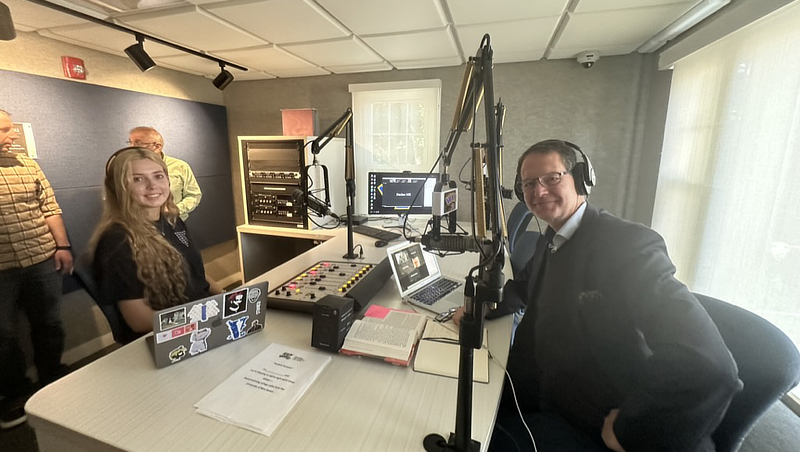
They learn the art of it from Bruce Barber, a professor-in-residence, general manager of 88.7 WNHU, the University’s award-winning radio station, and executive producer of Crime Waves.
“He teaches us how to use the sound board, how to edit audio – everything about podcasting,” Timmins says. She says she loves working in a relatively new medium and in true crime “which my generation is really into.”
‘These are essential communications skills’
Dr. Hill says the students have made an immediate impact on the podcast. For one of the first assignments, he asked them to watch five earlier episodes and present ideas on what could be done better. “Olivia Hall had ideas that we are already incorporating into this season,” Dr. Hill says.
Hall noticed that while the podcasts were gripping and interesting, assumptions were sometimes made regarding the background knowledge listeners might have.
“Dr. Hill is a well-informed expert in this area and, while he has all kinds of previous knowledge about criminal enterprises and cases, the average listener does not,” Hall says. “As an average listener myself, I was sometimes lost in the middle of an episode because I wasn’t sure how the dots connected. It is important to provide the listener with every detail possible, so they can establish an understanding of the case at hand.”
That led to the creation of a “clean ears” producer – a student in the class who doesn’t know “any information about the episode, who the guest is, what the topic is, or the specific case,” Hall explains. That person listens as the podcast is being produced to “make sure that everything is making sense and staying on track.”
As the semester moves on, students are researching criminal investigators and pitching episode ideas to Dr. Hill, and the class and will produce and even host episodes. Says Hall, “These are essential communication skills that I will carry with me throughout my career and life.”
Contact
Get the highlights!
Stay up to date with our weekly e-newsletter, highlighting stories from around the University and media clips featuring our faculty experts.
Recent News
The Charger Blog
University of New Haven Researchers Advance Health Equity and Health-System Transformation
In the Media