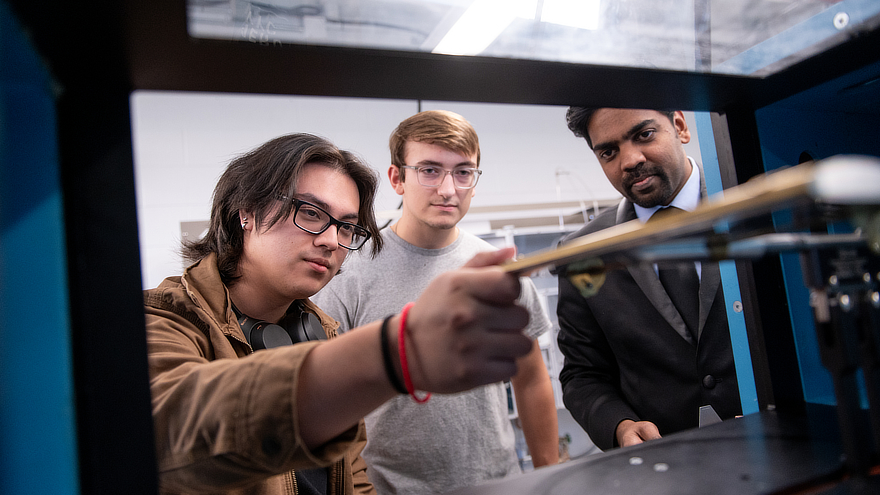
Laura Miller, the University’s director of energy and sustainability, collaborated with an engineering professor to provide students hands-on opportunities to study how to reduce and conserve energy.
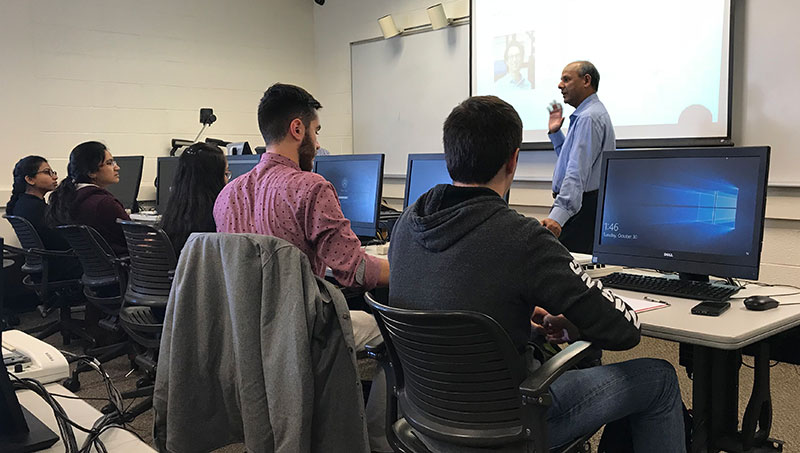
Since joining the University earlier this year, I have had the opportunity to meet with many faculty and staff to learn more about the academic offerings in the fields of energy and sustainability.
One professor I talked with was Ravi Gorthala in the mechanical engineering department in the Tagliatela College of Engineering. Dr. Gorthala was excited for the opportunity to further his relationship with the Office of Facilities by providing hands-on learning opportunities for the students in his "Introduction to Energy Efficiency" course.
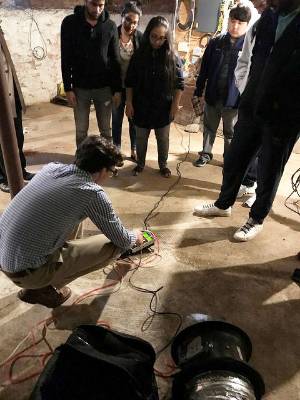
In October, Dr. Gorthala and his students visited 1124 Campbell Avenue, a small residential property on campus used for engineering faculty offices, where the students learned how to conduct a blower-door test, how to ensure heating and cooling systems were properly sealed, and how to identify actions that can be taken to improve the building envelope and enhance energy efficiency.
Also in October, some engineering students had the chance to attend a discussion on campus hosted by the Connecticut Green Building Council and Connecticut Passive House, a nonprofit that promotes energy efficiency in building construction. The event focused on ventilation for high-performance buildings.
This was an excellent opportunity to engage students in an important conversation, and it enabled students to network with potential employers in the field.
This semester, the Office of Facilities also coordinated lighting audits of five main campus buildings that were conducted by students.
Two years ago, our students installed the latest HVAC fault detection and diagnosis system on an air-conditioning system for the university’s Dental Hygiene building on campus, and they have been monitoring it since with an independent instrumentation/data acquisition system. This has been a great opportunity for our students to work on state-of-the art technologies.
Collaborations between the Office of Facilities and academic departments on campus allow students to gain hands-on experience with energy and sustainability projects. These partnerships also foster the development of new ideas for future energy-efficiency projects.
I am excited to continue to develop similar opportunities moving forward. It is important for students to create meaningful connections to the campus on which they spend so much of their time, and it is a bonus when these connections help the University be more environmentally friendly and socially conscious.
Contact
Get the highlights!
Stay up to date with our weekly e-newsletter, highlighting stories from around the University and media clips featuring our faculty experts.
Recent News
University News
University of New Haven Welcomes 15 New Corporate Partners, Doubling Network of Cutting-Edge Industry Collaborators
Charger 360