Jeffrey Hunt, assistant director for the Tutoring and Academic Support Center, reflects on the creation of the University’s Learning Assistant mentor program, its success over the past three years, and the national interest it generated at the International Learning Assistant Conference.
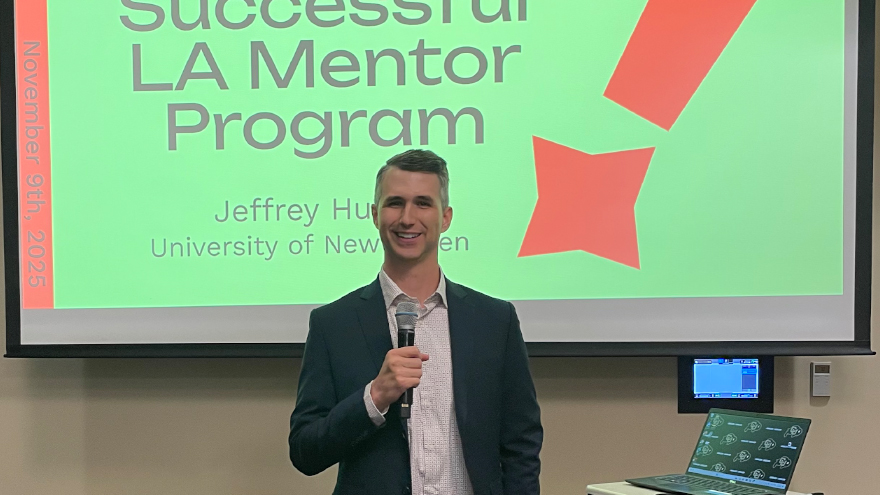
In the Fall of 2022, I posed a question to hundreds of attendees at the International Learning Assistant Conference (ILAC) in Boulder, Colorado: Do you pair returning Learning Assistants (LAs) with newly hired LAs? No one did. Thus, when I returned to the University of New Haven, our LA mentoring program was born.
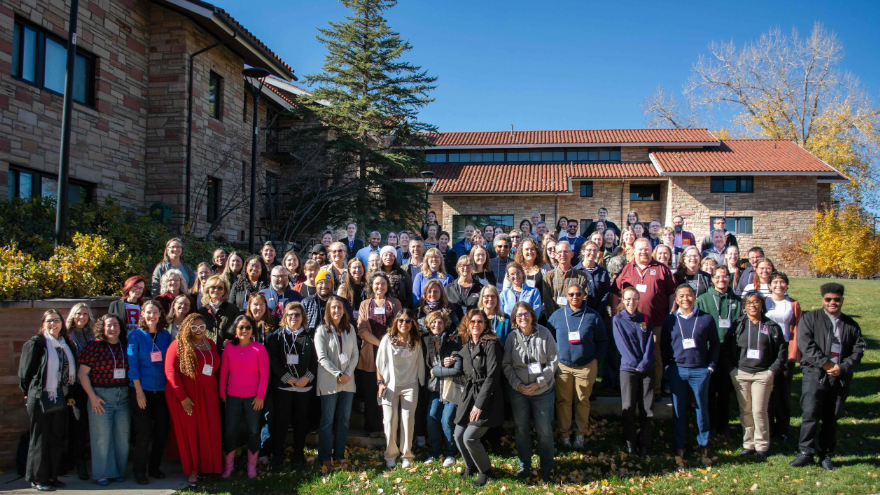
Now, three years later, I was invited back to the same conference to speak on what we’d accomplished, and where our LA mentor program was going. It was a fun opportunity and one we all learned from.
LAs are embedded tutors. The University’s LAs support 60 STEM course sections each semester, from Calculus to Organic Chemistry to Physics. Trained undergraduates work alongside professors to spark active learning in the classroom. They engage with students, run activities, and hold their own office hours. It’s a proven model that works.
Contact
Get the highlights!
Stay up to date with our weekly e-newsletter, highlighting stories from around the University and media clips featuring our faculty experts.
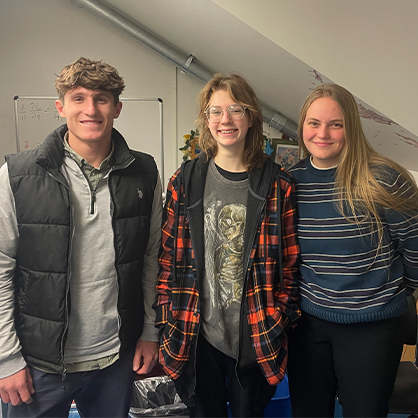
LAs take a university pedagogy course, as well as attend summer and winter trainings. A valuable part of their growth, however, comes from learning from each another. For my recent presentation in Boulder, I wanted to center on the LAs themselves, so I asked them what they gained from their mentors. Monica Kacynski ’25, ’26 M.S. is a 4+1 chemistry student and a six-semester LA. She supports Prof. Nikodem Poplawski, Ph.D. in Physics I and II, and her words kicked off my conference presentation:
“I was first introduced to the LA program when I was a younger student, through Makenzie Pavlik ’23. Her guidance honestly helped shape me into the student I am today. Once I began working as an LA, Makenzie remained a mentor. Over time, I have noticed more and more just what a collaborative and supportive environment we have here at the tutoring center. It’s a space where both professional and peer tutors are not only committed to helping students succeed, but also to uplifting each other.”
Mackenzie Pavlik is now pursuing a Ph.D. at the University of Rhode Island. She was a role model to Monica in the same way course surveys and verbal feedback tell us Monica is a role model to countless Physics students.
‘It’s very helpful for someone who has never tutored before’
Another person core to the presentation was Jack Celebrano ’25, ’26 M.S. He’s a four-semester LA who supports Prof. John Osambo, Ph.D. in two sections of General Chemistry I. Jack wrote the following, illustrating what returning LAs can offer our incoming embedded tutors:
“I think the LA mentor program was great for me when I first started last semester. There is a lot of support at the Tutoring and Academic Support Center (TASC), but I think having someone you can ask questions to as a first-time LA is very helpful because some new people are scared or afraid to ask questions. Also, being able to see how other LAs run study sessions and office hours is very helpful for someone who has never tutored before.”
The TASC is where Jack and his counterparts holds their office hours. We want LAs to support students academically. We also hope these embedded tutors act as a resource when a student is too shy to talk to a professor, ask a question, or just want to learn from someone with a similar background.
‘Our reach extends well beyond our campus’
Now, how did the presentation go? Incredibly well, I think. After speaking for 40 minutes, I fielded questions until we ran out of time, and I got great ideas from the audience regarding how to spur further LA growth. Angela Chu ’26, a four-semester LA who supports Prof. Eddie Luzik, Ph.D. in Organic Chemistry I and II, provided an ending quote:
“I found that my pairing being in the same subject and have the same professor assignment as me was great. This style of mentor/mentee pairing worked, especially since I was a returning LA for the same professor. It was so much more convenient for my mentee, because if she had any specific questions regarding the professor or her specific section, I could answer her directly.”
Also, several schools informed me that they were launching Learning Assistant mentor programs of their own. If my session gave them the final push, it’s another sign that the work we’re doing at the University of New Haven is not just meaningful to our students, but also that our reach extends well beyond our campus.
Recent News
The Charger Blog
University of New Haven Research Team Presents Digital Transformation Study at Major International Conference
The Charger Blog