The University’s Secure and Assured Intelligent Learning (SAIL) lab explores important questions on the leading edge of science – everything from making medical devices safer to the brain-computer interface – offering students opportunities to conduct research that endeavors to make a meaningful impact on society.
Binesh Sadanandan ’27 Ph.D., has been working in the healthcare industry for more than 15 years. The opportunities he has as a student in the University’s Secure and Assured Intelligent Learning (SAIL) lab are a natural expansion of his work – and a way for him to further examine how machine learning can be used in healthcare. He hopes his research will help prevent medical device failures and yield devices that are more effective.
Sadanandan’s work is especially focused on precision oncology. It’s a mission that, for him is personal, as he lost a family member to prostate cancer. He believes it was the treatment that was the most harmful, not the cancer itself, and his mission is to find better and safer ways to treat it.
Because we aren’t yet able to see the effects of treatments on the body in real-time, treatments can end up doing harm. While Sadanandan says that if he had magical powers he’d dissolve the cancer, he’s now developing what he hopes might be the next best thing: a way to predict the effects of treatments and determine what exactly a patient needs.
“Our objective is to prove in a lab that we can find an agent to help oncologists with decision-making,” explains Sadanandan, a candidate in the University’s doctoral program in engineering and applied sciences and a senior principal research engineer at Medtronic, a medical devices manufacturer. “Today, there’s a lot of information for oncologists to process. If you can train an agent, it would be like a ‘superoncologist’ who can look at all these data and adjust what’s being done.”
‘The connection between education and industry’
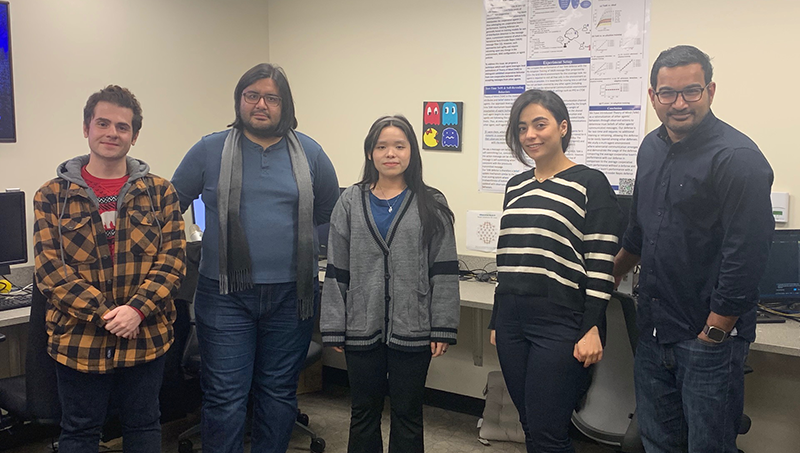
Sadanandan is among the more than half a dozen students who are members of the University’s SAIL lab team. It includes doctoral, graduate, and undergraduate students who are conducting groundbreaking research that endeavors to foster the safety and security of intelligent machines through an engineering and theoretical lens.
Bahareh Arghavani ’24 M.S. began her work in the SAIL lab in 2022. She co-authored a paper with Sadanandan, which is now in submission for publication, exploring fault detection in medical devices. By applying machine-learning techniques in fault detection, they hope to make devices work better. Arghavani is now working on a second project focused on speech.
“As a researcher, I found that this experience makes me very knowledgeable on topics that are timely – especially AI,” said Arghavani, a candidate in the University’s graduate program in data science. “We’re implementing what we’re taught in the real world. This is the connection between education and industry.”
‘An environment where you can search for the truth’
That’s exactly what Vahid Behzadan, Ph.D., director of the SAIL lab and an assistant professor at the University, envisioned when he established the lab. He explains its focus as the “science of making bad decisions,” and the lab’s work encompasses decisions made by humans and machines, including artificial intelligence (AI). He hopes that by helping AI to become better decisionmakers – as humans have become over millennia – that society as a whole will benefit.
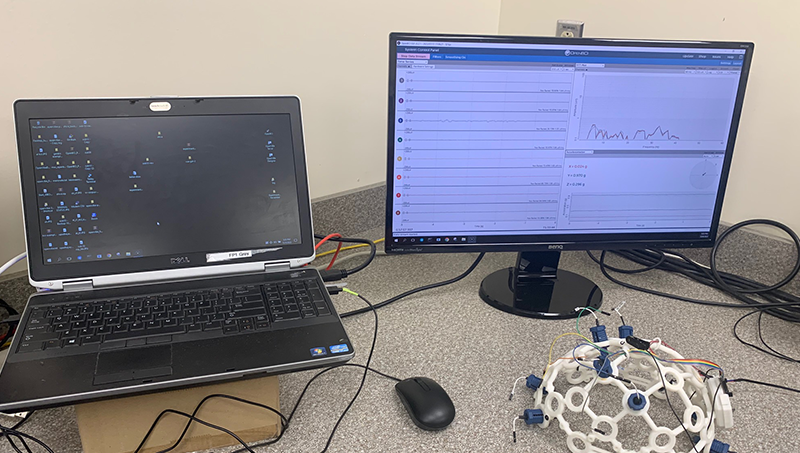
The lab explores questions on the leading edge of science, focusing on topics such as the brain/computer interface, whether human muscle movement can be controlled, and how the brain responds to minor environmental changes.
"We’re going to places where no one has been."Vahid Behzadan, Ph.D., director of the SAIL lab and an assistant professor at the University
The ethics of exploring these topics are an important component of the lab’s work – and a topic Dr. Behzadan is intimately familiar with. He hopes their work will help create societal dynamics that don’t encourage deceptive behavior and help figure out how to create regulations and laws that foster optimal behavior. It’s work he draws on in his role as a member of the Connecticut Artificial Intelligence Working Group, which he was appointed to last year, and that he hopes will prepare his students to be the next leaders in the field.
“We’re going to places where no one has been,” he said. “I’m learning with them and from them. Seeing their autonomous success is so rewarding. They will have their own research labs and teams, and that motivates me.”
‘An environment where you can search for the truth’
Dr. Behzadan’s students have already had the opportunity to pursue publishing their research and to share their work with the University community, industry professionals, and U.S. Senator Richard Blumenthal. Nancirose Piazza ’24 Ph.D., was among the students who met the senator when he visited the University as part of an announcement of federal funding that would support technology-related education.
A candidate in the University’s engineering and applied sciences Ph.D. program, Piazza is focusing on deception and multi-agent systems in her research. She explores how and why deception may come about and how it might be mitigated. She appreciates the mentorship of Dr. Behzadan and the camaraderie of her “SAIL mates,” as well as the collaborative atmosphere in the lab.
“I always think problems we solve in the lab are reflections of problems in the world – even if autonomous systems are not organic,” she said. “I think academia is an environment where you can search for the truth without being penalized. The opportunity to see what comes out of particular experiments is important.”
‘We’re always trying to make someone’s life better’
For Arshad Badfar ’25 M.S., that work is focused on brain signals. Fascinated by the human brain, psychology, and decision-making, Badfar wondered how humans might make better decisions. He’s studying the brain-computer interface (BCI) and how BCIs with various adversaries react. He hopes his research might, for instance, benefit an individual controlling their wheelchair or an artificial limb – as any threats from adversaries could be particularly dangerous.
“It’s about the security of the U.S. at the end of the day,” explains Badfar, who is pursuing a master’s degree in data science. “We have a chance to play an important role in this. It’s also going to help me have a better understanding of what I’m learning in my courses and help me with my job prospects.”
For Sadanandan, the Ph.D. candidate and healthcare professional, the work he’s done in the SAIL lab has been life changing, and he hopes his work will have a positive impact on the lives of others as well. He believes that having a better understanding of machine learning and the role it can play in the healthcare industry will save lives and enhance medical treatment.
“This lab is awesome,” he said. “Dr. Behzadan is a leading researcher in this space and having access to him and the opportunity to bounce ideas off him is great. This lab has become a family, and we’re always trying to make someone’s life better.”
Contact
Get the highlights!
Stay up to date with our weekly e-newsletter, highlighting stories from around the University and media clips featuring our faculty experts.
Recent News
The Charger Blog

Health Sciences and Marine & Environmental Sciences Programs Launch Interdisciplinary Collaboration
University News