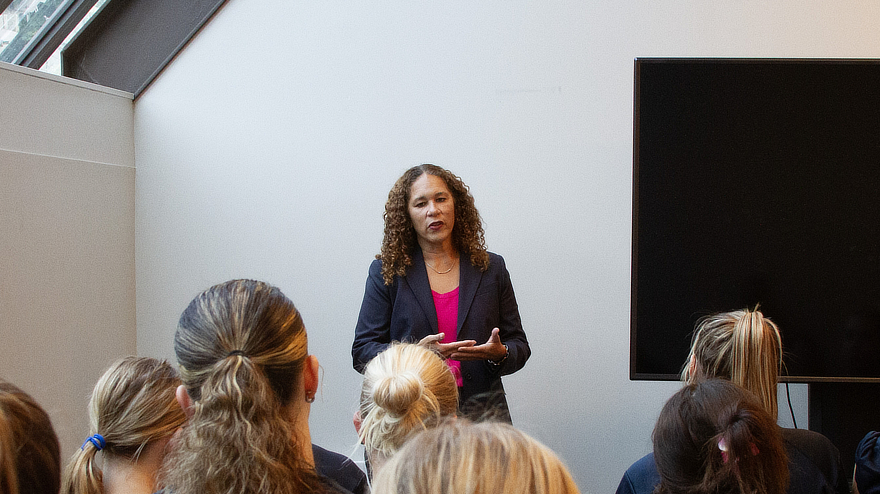
Olena Lennon, Ph.D., who hails from eastern Ukraine, is dedicated to educating students and the public on the war in Ukraine. As part of a recent human rights symposium at the University of Connecticut, she explained the history of Ukraine and the genesis of the conflict.
Olena Lennon, Ph.D., has been closely following the war in her home country of Ukraine. Deeply concerned about her family and friends who remain there, she has a personal concern as well as a professional interest as a scholar.
Since Russia invaded Ukraine in late February, Dr. Lennon has been passionate about promoting education and understanding of the war. She has spoken to members of the University community as part of a panel discussion, to various media outlets, including CNN, and, recently, as part of a symposium held at the University of Connecticut.
“This war is going to be with us for a while, so I’m glad you’re paying attention,” said Dr. Lennon, an adjunct professor of political science, international affairs, and national security at the University of New Haven. “This is a ‘re-invasion’ of Ukraine. The war really started in 2014 when Russia first invaded.”
‘The point of irreconcilable differences’
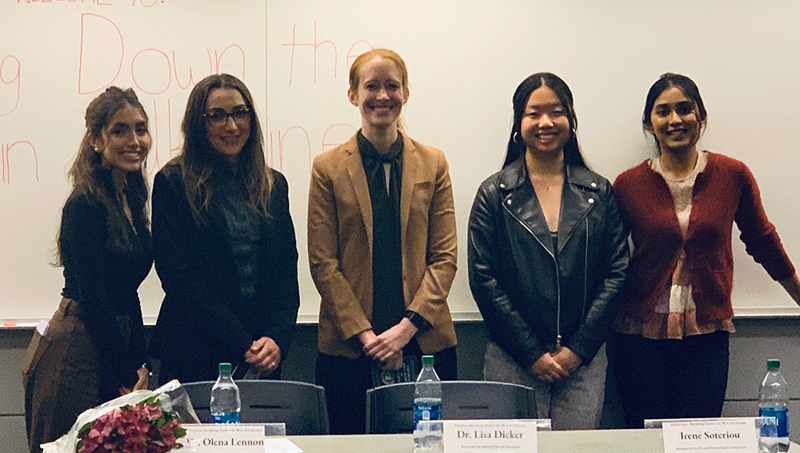
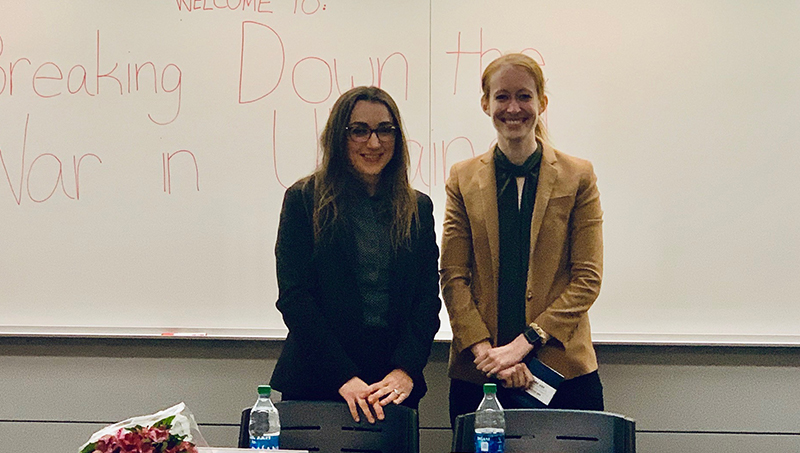
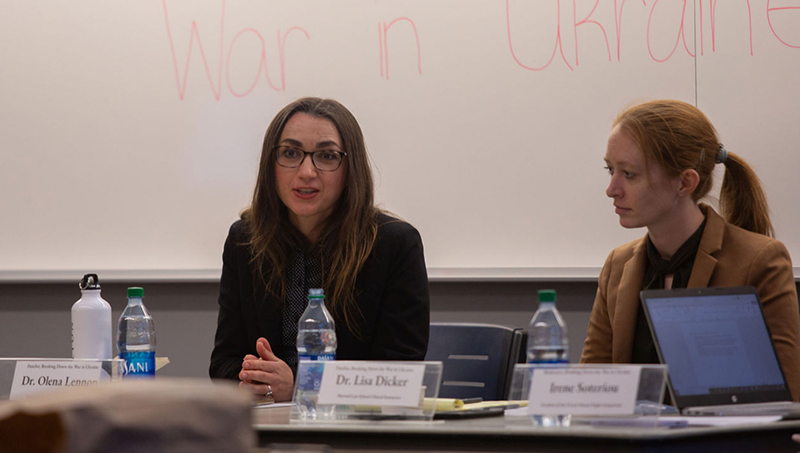
The UConn Human Rights Symposium, which also included Dr. Lisa Dicker, a clinical instructor in the Harvard Negotiation and Mediation Clinical Program, aims to foster education, awareness, and discussion about human rights among students and the public.
Dr. Lennon, who hails from eastern Ukraine, discussed her own background. After coming to the United States in 2004 on a Fulbright Scholarship, she returned to Ukraine, then came back to the U.S. in 2014. She has remained in close contact with her loved ones who remain in Ukraine.
An academic whose research has focused on the politics of Ukraine as well as Eurasian geopolitics and security, Dr. Lennon explained Ukraine’s “complex” history – including with Russia, in particular. Though it became an independent country in the early 1990s after the Soviet Union collapsed, she explained that Russia has had a “deep-seated grievance against Ukraine” ever since.
“Ukraine has a long history of fighting for independence,” she explained. “Russia and Ukraine are at the point of irreconcilable differences. It’s an existential conflict, stemming from how they define themselves in different ways. War is an injection of violence into a relationship with irreconcilable differences."
A war of choice vs. a war of necessity
The relationship between the two countries is particularly complicated, Dr. Lennon explained, because of three different relationship dynamics: the relationship between Russia and Ukraine, Russia’s relationship with the west, and the political dynamics within Ukraine itself, which is a very diverse country with many competing political parties. Because Ukraine's war with Russia is so existential, experts say it is extremely difficult to mediate.
“This is a different type of negotiation than we’ve seen in our lifetime,” said Dr. Dicker, whose work focuses on peace processes. “It is state to state. It’s difficult for parties to assess their options. Negotiations are happening with other countries interested in the outcome, and they’ve been informal – not as part of a peace process.”
“Other countries see this as a war of choice,” added Dr. Lennon. “Russian President Vladimir Putin sees it as a war of necessity.”
‘Elevated the nature of the conversation’
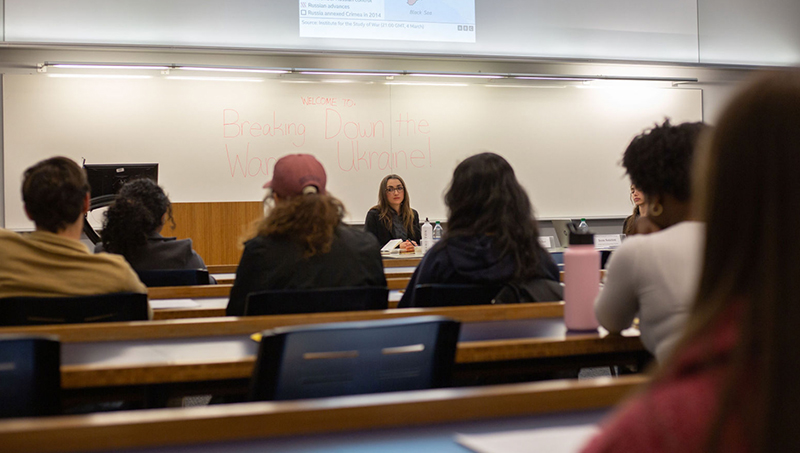
As part of the symposium, Dr. Lennon showed a map of Ukraine and explained where Russian troops have advanced. Attendees had the opportunity to ask her questions, gaining a better understanding of the war and its impact.
“Dr. Lennon's contributions to analysis and understanding of the conflict have been invaluable both in academic and public spaces, and we were honored to have her join us during this year's conference,” said Irene Soteriou, a UConn junior and founding president of the UConn Human Rights Symposium. “The wealth of knowledge that she brought to our discussion about the ongoing developments in Ukraine, combined with the personal significance that the issue holds for her and the dynamic manner in which she articulates her perspectives, elevated the nature of the conversation and encouraged the very intellectual curiosity that we as organizers strive to cultivate throughout the many events of the weeklong symposium.
“Dr. Lennon's contributions at our event allowed students who have been following the conflict closely to receive in-depth responses to complex questions,” Soteriou continued. “This also gave those who have not been studying the developments the opportunity to gain a robust understanding of what may turn out to be one of the year's most severe violations of human rights.”
‘Change the fabric of Europe’
Dr. Lennon told students that while the war has been predicted for some time, no one expected this level of brutality. She believes a peace agreement is still years away, noting that both Russia and Ukraine believe they can win, and that noting that both Russia and Ukraine believe they can win, the military gap between Russia and Ukraine has been closing in Ukraine's favor.
“Ukraine has the home advantage, and they are highly motived,” she said. “I have a friend who refuses to leave Ukraine because she wants to be there when Russia retreats. But neither side believes it’s a lost cause. I think we’re looking at a war of attrition.”
The war’s ripple effects around the world were an important topic of the symposium. Among the consequences is the Ukrainian diaspora, as millions of people are leaving the country. This diaspora will continue to grow, Dr. Lennon predicts, and the individuals leaving Ukraine will have a major impact on Europe, in particular.
“This has the makings of a World War II-like diaspora,” she said. “The first-generation of the diaspora is the most patriotic, the most connected with their country and with the politics. They will be politically active around Europe, and they will run for office. This will change the fabric of Europe.”
‘The best way to help Ukraine is to protect democracy here’
Dr. Lennon is not optimistic that any successor to Putin would be any less brutal, and she describes him as “rational,” not crazy as some have suggested. While she does believe Ukraine can win the war, she expects Russia will need to be dealt a military defeat, since Russia is not likely to self-correct.
Noting that both countries will need help rebuilding when the war does end, Dr. Lennon says that Russia will need to be “rewired.” The process, she says, would have to begin with its educational system and a free media.
Citing a “great sense of insecurity” in Russia, Dr. Lennon believes many Russians are afraid to admit they don’t support the war. She acknowledged there have been many brave Russians and journalists who have spoken out against the war and reported on it.
Dr. Lennon concluded by offering advice to students. She drew from her own personal background – from growing up in Ukraine to taking the naturalization test in the United States – as well as her research and advocacy as she offered an important perspective.
“I encourage you not to take your democracy for granted,” said Dr. Lennon. “Ukrainians are dying to protect their democracy, and what Ukraine is teaching us is that it is worth fighting for – but it shouldn’t get to that point.
“Democracy is like working out,” she continued. “You have to keep it up. You can’t just work out once and expect to run a race. The best way to help Ukraine is to protect democracy here.”
Contact
Get the highlights!
Stay up to date with our weekly e-newsletter, highlighting stories from around the University and media clips featuring our faculty experts.
Recent News
Charger 360
Season 5, Episode 4: Ashley McClain ’07 and Ariana James ’27
In the Media