Four faculty members and one student recently received funding from the NASA Connecticut Space Grant Consortium that will support their cutting-edge research and create exciting opportunities for students to gain immersive hands-on experience.
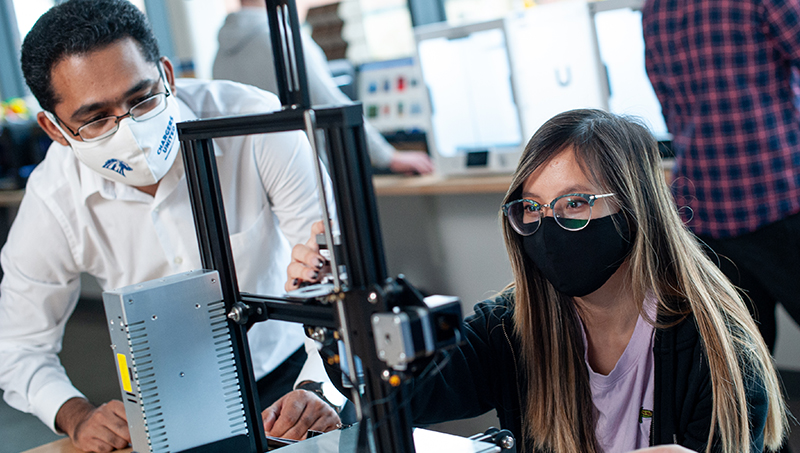
Omar Faruk Emon, Ph.D., is working to develop a 3D printing solution for fabricating polymer-based flexible sensors. The goal, he explains, is to “make what is needed,” rather than working with what is currently available.
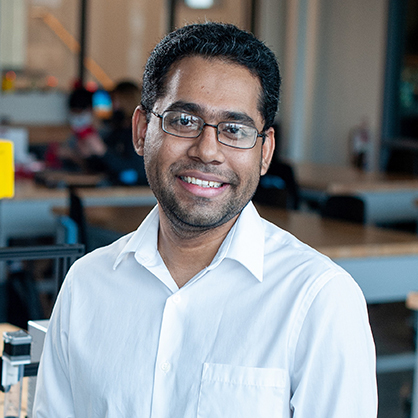
Because standard sensors come with predefined geometries, mechanical properties, and specifications – and because 3D printers often do not support functional polymers for printing electronics – Dr. Emon was inspired to develop something new: a printing system and materials for printing the sensors, which can be employed to measure strain, pressure, and temperature.
Dr. Emon’s work was recently awarded a faculty research grant from NASA Connecticut Space Grant Consortium (CTSGC) – his first external grant since joining the University community last fall.
“This work can be crucial for NASA’s space-related applications by enabling on-demand fabrication, adjustment, and repair of electronics,” said Dr. Emon, an assistant professor of mechanical engineering. “I am super excited and honored to receive this funding. It will give me an opportunity to apply my research to enhance NASA's in-space manufacturing initiatives. This research will create the foundation for me to go for larger research endeavors.”
‘Open the opportunity for more research’
Dr. Emon is one of four faculty members to receive research grants from CTSGC. Derek Gaudino ’22, a fire protection engineering major, also earned a $1,000 grant for his student research project, which he worked on under the mentorship of Jing Li, Ph.D.
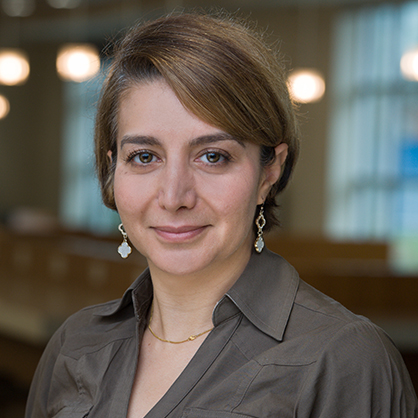
In addition, Goli Nossoni, Ph.D., received a faculty research grant from CTSGC. Her project, “Moonglomerete for Construction on the Moon,” focuses on a new construction material used for manufacturing bricks. “Moonglomerete,” would use rocks already present on the moon. Though very different from concrete, the proposed material, she says, can be classified as a sort of “mooncrete.” Larger and lighter colored moon rocks – anorthosite – will be embedded in a binder made from smaller and darker molten rocks – basalt – to form bricks.
“I am very excited about this grant and the opportunity to work in this new area of construction materials on the moon,” said Dr. Nossoni, an associate professor of civil and environmental engineering whose grant will also enable two undergraduate students to take part in the research. “I am sure it will open the opportunity for more research in this area with my undergraduate and graduate students.”
‘I am very passionate’
Kristine Horvat, Ph.D., an assistant professor of chemical engineering, has her sights set on Mars. Her grant will support her research focused on the red planet’s hospitality to human living – something that presents many challenges, including the need to produce oxygen and fuel.
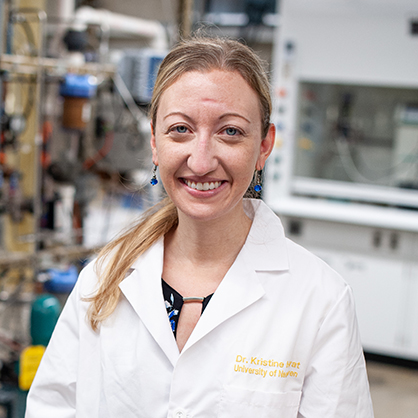
Dr. Horvat is exploring how growing Chlorella algae under various pressure levels, temperatures, and gas-phase composition conditions will affect its oxygen production and algae growth rates, as well as its ability to produce oil under varying conditions. She is interested in monitoring its volume and gas-phase composition over time, as she expects the results will help determine the algae’s feasibility of being a reliable oxygen and fuel source. She is also looking forward to the opportunity to collaborate with an undergraduate student, thanks to the support of the award.
“Mentored research is an excellent way for students to gain experiential education experience and to learn if they enjoy research,” she said. “It can help them as they consider graduate school or additional experiences that will allow them to enter a field in research and development. I am honored to be selected for this grant. I am very passionate about finding low-carbon energy options, whether they are used on Earth or in space.”
‘More hands-on, experiential research’
Dr. Horvat’s colleague and fellow grant recipient Chong Qiu, Ph.D., is exploring the application of ground ozone monitors and high-altitude balloons in ozone detection in Earth’s lower and upper atmosphere. He is already preparing for the upcoming solar eclipse in October 2023 and the total eclipse in April 2024.
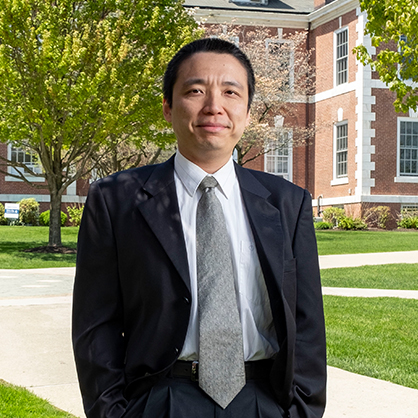
Planning to assemble a high-altitude balloon team to participate in the Nationwide Eclipse Ballooning Project, he hopes to prepare for field measurements of ozone in the lower and upper atmosphere during the eclipses. While he describes himself as a “beginner” when it comes to ballooning, he is excited to learn more about it and to collaborate with his colleagues and his students on the project.
Looking forward to what promises to be a rich learning experience, he will be collaborating with a team at the University of Bridgeport. As part of the grant, he will also be sponsoring a Tagliatela College of Engineering senior design capstone project during the upcoming academic year.
“This grant means more hands-on, experiential research and educational opportunities for faculty and students on campus,” said Dr. Qiu, an associate professor of chemistry. “The students will design the payload, assemble the balloon, and conduct test launches in the field. We warmly invite all faculty, staff, and students who are interested in high-altitude ballooning to participate in the project, especially those from historically underrepresented groups.”
‘Get involved in space-related research’
Dr. Emon, the mechanical engineering professor who is focused on 3D printing research, is excited to collaborate with two or three students as part of his year-long research project. They will then have the opportunity to present their research and network at the NASA CTSGC Grants Expo. Dr. Emon is also creating Smart Fabrication Lab, a research lab at the University focusing on conducting research on 3D printing smart polymers and biomaterials.
“This grant creates opportunities to get students involved and interested in printed-electronics research,” he said. “Students will work on system development and material development under my guidance. This project will expose them to a high-impact application of 3D printing. Working on a NASA-sponsored project will inspire them to get involved in space-related research.”
Contact
Get the highlights!
Stay up to date with our weekly e-newsletter, highlighting stories from around the University and media clips featuring our faculty experts.
Recent News
The Charger Blog
Health Sciences and Marine & Environmental Sciences Programs Launch Interdisciplinary Collaboration
University News