Members of the University of New Haven community joined lawmakers and state leaders to announce the allocation of $2.7 million in funding to launch the Connecticut Campus Mental Health Program and to take part in a discussion about the importance of emotional health and well-being.
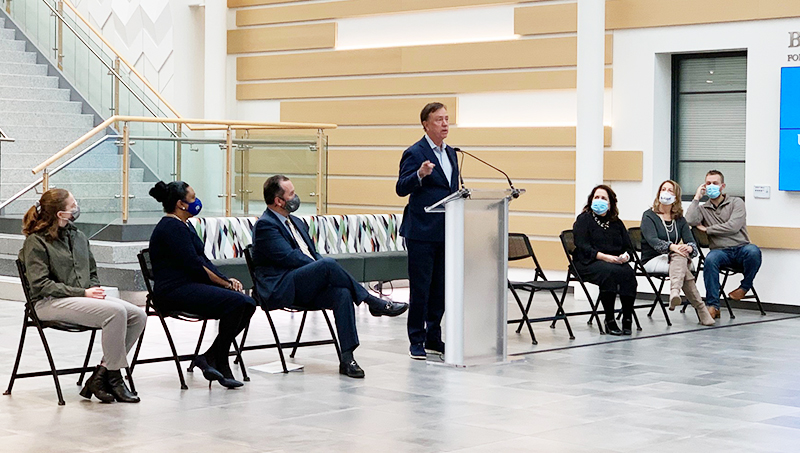
Elizabeth Sirett ’22 is a firm believer in the importance of taking care of one’s mental health. Sirett, who has suffered from anxiety, says “I would not be where I am today without counseling and psychological services.”
Sirett recently spoke at an event held at the University of New Haven during which Governor Ned Lamont announced the launch of a new program that will dedicate up to $2.7 million in Governor’s Emergency Education Relief (GEER) funding to colleges and universities across the state to help them respond to the ongoing student mental health challenges caused by the COVID-19 pandemic.
Likening mental health to the weather, Sirett spoke to attendees about the importance of checking in with one’s “personal weather report.” She says that mental health is “just as important” as physical health, and that the pandemic has only added to students’ mental health challenges.
“I believe our experiences and environment are directly related to our mental health,” said Sirett, a mathematics major. “Take a physical scenario in which a turtle were to be placed in a desert. I think we can agree it would have a difficult time adapting based on what it knows, which may lead to stress. Students entering the new and unfamiliar climate of a college campus can have a similar experience.”
‘Every ounce of support possible to students in need’
The Connecticut Campus Mental Health Program (CCAMHP) will provide awards to higher education institutions to support innovative and evidence-based strategies that expand access to care, increase education and awareness of mental health programs and services, and enhance the knowledge of students and staff to enable them to better support students. It is particularly focused on serving underserved and minority students.
“In particular, Black, Indigenous, people of color (BIPOC), and other underrepresented students are experiencing increasing mental health issues because of the unique barriers and challenges they face,” said Ophelie Rowe-Allen, Ed.D., dean of students at the University. “This initiative will help universities be more progressive in their approach to integrating mental health well-being into the classroom, curriculum, and other academic and co-curricular settings.
“The University of New Haven welcomes this opportunity to explore creating new well-being initiatives,” she continued. “This will help students develop the resilience and coping skills they need to manage the challenges they will encounter now and in the future, and to succeed both personally and academically."
Expected to benefit more than 130,000 undergraduate students at more than two dozen colleges and universities in Connecticut, the program’s funding will be administered by the State Office of Higher Education.
In Fall 2020, more than a third of college students reported symptoms of depression and anxiety. Many institutions of higher education in Connecticut report that counseling centers have seen a significant increase in demand from students.
“The COVID-19 pandemic had a devastating toll on the mental health of college and university students that, left unchecked, could have significant long-term ramifications on their overall well-being,” said Gov. Lamont. “This funding is an important step forward in ensuring our institutions of higher learning are equipped to provide every ounce of support possible to students in need after a distressful school year.”
‘The potential for counseling to better the lives of many more students’
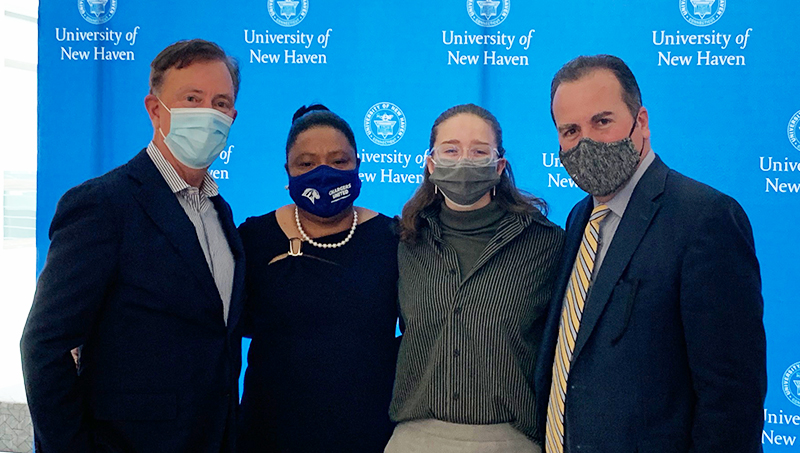
The event, which included local and state leaders, University staff, and representatives from the Connecticut Department of Mental Health and Addiction Services, included a discussion on the prevalence of mental health challenges and the importance of addressing them – particularly among college students. Nearly three out of four college and university presidents have identified student mental health as a pressing issue for the current academic year.
“We recognize that the ongoing impact of COVID-19, unrest and division across our nation, and social media have created challenges and obstacles that, frankly, older generations did not experience as college students,” said Sheahon Zenger, Ph.D., athletics director for the University. “Our continuing charge is ensuring that, as educators, we continue to raise awareness and understanding to the importance of protecting our mental health and the resources that are available to enable all of our students to thrive in and out of the classroom.”
“There are so many social and academic pressures on students,” added Prof. Dorinda Borer, a Connecticut State Representative, an adjunct professor at the University, and the mother of a college student. “We see complications in their education for mental health reasons.”
Sirett, the math major, believes it is critical to prioritize mental health, and that the University’s Counseling and Psychological Services (CAPS) is an “invaluable resource” that has helped her and countless other students.
“We are self-doubtful, insecure, prideful, creative, beautiful people who are still learning,” she said. “Education in college can go far beyond the classroom setting and can involve serious self-growth. I see the potential for counseling to better the lives of many more students. Imagine how impactful it would be to meet more students’ needs and give them the rich soil, sunlight, and water that anything so organically beautiful will need to grow and expand.”
Contact
Get the highlights!
Stay up to date with our weekly e-newsletter, highlighting stories from around the University and media clips featuring our faculty experts.
Recent News
Charger 360

Season 5, Episode 4: Ashley McClain ’07 and Ariana James ’27
In the Media