Students and faculty members are using zebrafish embryos and cutting-edge gene editing technology to study disorders such as autism and diseases including cancer. Their research could inform new treatments and therapies for humans.
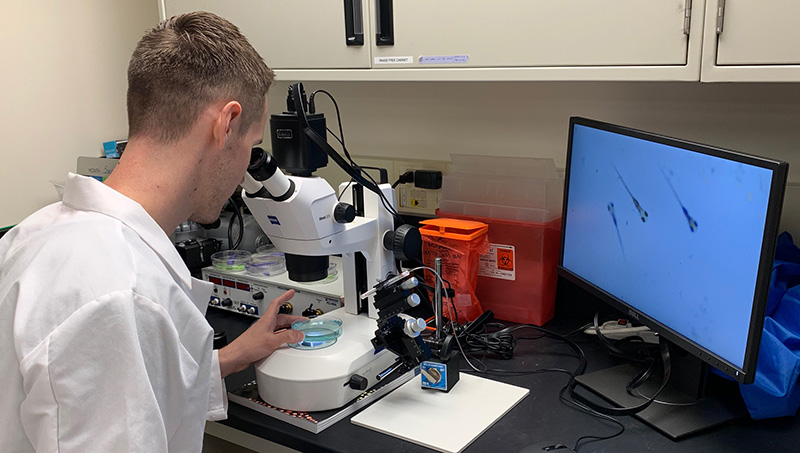
As an undergraduate at the University of New Haven, William Theune '19, '21 M.S. was interested in learning about the potential of CRISPR, a cutting-edge gene-editing technology. As part of his Summer Undergraduate Research Fellowship project, he used CRISPR to insert a gene into a zebrafish genome that would make the fish glow, an action he successfully completed.
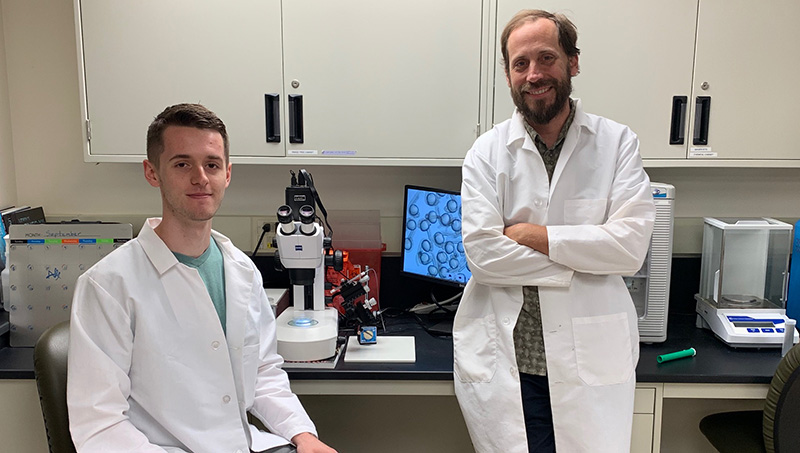
Now a candidate in the University of New Haven's master's degree program in cellular and molecular biology, he is using CRISPR to study one of the most common gene mutations associated with autism. He is also using zebrafish to conduct this research, although this time, he is not adding a gene to their genome.
"My goal is to use CRISPR to remove a gene from the genome of zebrafish and to see how that affects their development," said Theune. "Since this gene is found in humans and in zebrafish, this could, eventually, lead to treatments for patients with autism."
Theune is one of several students at the University using zebrafish embryos in their research. Like humans, zebrafish are vertebrates, and they have a similar genetic structure to humans. They are ideal for research, since embryos don't take long to develop, and they are transparent, enabling researchers to observe them in detail.
"If we're able to make a fish that has a mutation similar to what human patients suffer from, that could potentially be used as a model to study [autism]"William Theune '19, '21 M.S.
Faculty members – including Carter Takacs, Ph.D., an assistant professor of biology and environmental science – are also using zebrafish in their research. An author of a paper that appeared in the widely respected journal Nature this spring, Takacs is focusing his research on genetic compensation, a new area of research that has generated a lot of excitement and interest. As scientists have sequenced the genomes of humans, they have noticed that many individuals have mutations in what scientists believed were important genes – yet, the individuals appeared to be healthy.
"We want to find out why the body tolerates these kinds of mutations to the DNA," he said. "One possibility is that there are other genes that compensate for the loss of the one with the mutation. Our paper looks at one possible way that works, in which the body recognizes the defective gene, and subsequently turns on compensating genes."
Dr. Takacs says that by understanding how this recognition works, scientists may be able to learn how to turn on other compensating genes. His collaborators have used zebrafish in this research as well, "breaking" a gene involved in vascular development. They found that other genes turned on, compensating for the "broken" gene.
Students and faculty members are currently using zebrafish to study a new CRISPR technology that previously has not worked in animals. They have shown that it can work in zebrafish. They've submitted their research for publication, and it is currently in review. They are also using zebrafish to study Lyme disease, cancer, and, as in Theune's research, autism.
"There's very little understood about autism, as far as what is really going on in the brain and where the disorder arises," Dr. Takacs said. "We can look closely at the brain of a zebrafish, and that could, hopefully, inform our understanding of what's happening with human autistic patients."
The importance of this research, said Dr. Takacs, can't be understated, and it is something that is increasingly of interest to students. The University is launching an advanced course in CRISPR technology this spring, enabling every cellular and molecular biology graduate student to work with zebrafish and design strategies to study different types of genes.
Theune plans to continue conducting research, and he is especially interested in focusing on genetic disorders and cancer research.
"This research is important because if we're able to make a fish that has a mutation similar to what human patients suffer from, that could potentially be used as a model to study the disease," said Theune, who plans to pursue his doctorate. "This could help us explore many treatment options."
Contact
Get the highlights!
Stay up to date with our weekly e-newsletter, highlighting stories from around the University and media clips featuring our faculty experts.
Recent News
University News
University of New Haven Welcomes 15 New Corporate Partners, Doubling Network of Cutting-Edge Industry Collaborators
Charger 360