Stephanie Bonnes, Ph.D., assistant professor of criminal justice, has written a highly regarded book, shared her findings at a national military conference, and received new grant funding that will enable her to work closely with her students to expand her research.
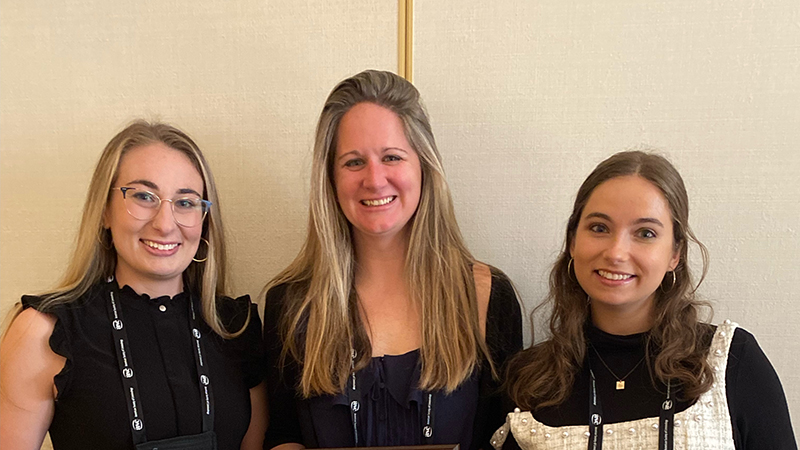
For years, Stephanie Bonnes, Ph.D., has studied organizations at the intersections of gender, inequality, identity, and victimization. When she began work on a book about sexual assault and harassment in the military, she took a qualitative research approach, interviewing 50 servicewomen. She began simply by asking them to share moments – the ones that really stayed with them during their service.
As they told their stories, she discovered that 19 of the 50 women had been sexually assaulted during their service and all but three women had been subject to “an environment of pervasive sexual harassment.”
Her book Hardship Duty: Women’s Experiences with Sexual Harassment, Sexual Assault, and Discrimination in the U.S. Military asked why if the military “has some of the most comprehensive polices in our country to target sexual assault, the number of incidents hasn’t declined. How can they create a culture where this doesn’t happen or happens far less?”
Her book received much notice, and her scholarly papers have won awards from the Sociologists for Women in Society and the Sex and Gender and the Peace, War, and Social Conflict sections of the American Sociological Association, as well as from the Division of Feminist Criminology and the Division of Victimology of the American Society of Criminology. This year she was also nominated for a University faculty award for Excellence in Research.

In 2024, Dr. Bonnes was invited to be the keynote speaker at the National Discussion on Sexual Assault and Sexual Harassment at America’s Colleges, Universities and Service Academies, hosted at the U.S. Air Force Academy.
“I really like speaking to military communities,” she said. “The Superintendent introduced me, and I was able to talk about what’s wrong, using the voices of servicewomen who were silenced. Getting that kind of buy-in from those who are highest up – this is how change is going to happen.”
‘Something we can leverage’
Dr. Bonnes’ research and similar high-impact research being conducted by her colleagues across a variety of disciplines has played a key role in the University of New Haven being elevated in the latest research designations released by the Carnegie Classification of Institutions of Higher Education. The University is included in a new list of Research Colleges and Universities, that recognizes higher education institutions that spend at least $2.5 million annually on research and development.
Dr. Bonnes, who recently received an American Council of Learned Societies grant to expand her research, had already begun interviewing 23 military lawyers who prosecute sexual assault. With the grant, she will be able to further expand her research to interview victim advocates and judges to determine where problems lie and to find ways to make systemic, cultural change. She will work closely with University of New Haven graduate students who will analyze the data and co-write papers with her.
“Mentoring future researchers is my favorite part of my job,” she said. “I brought a qualitative methods course to the Criminal Justice Ph.D. program, and we now have several students doing qualitative research for their dissertations. Seeing them go on to do great work is so rewarding.”
Ultimately, Dr. Bonnes said the new Carnegie classification illustrates how students at the University of New Haven experience the best of both worlds.
“Typically, you don’t get to call yourself a research institution when you have most classes capped at 19 to 25 students, and we do, and that’s very special,” she said. “In classes that small, professors know their students and what their individual interests are. So, they can alert them to research opportunities. Having the prestige of being known as a research university while having small class sizes – that’s something we can leverage.”
Contact
Get the highlights!
Stay up to date with our weekly e-newsletter, highlighting stories from around the University and media clips featuring our faculty experts.
Recent News
In the Media

Westchester and Fairfield Business Journals: Top Colleges and Universities in Greater Fairfield and Westchester Counties 2026
In the Media