
Sumbul Yousafi, DHSc '24, and Jordan Schweidenback, DHSc '24 achieved being the first graduates of the Doctor of Health Sciences program, launched in 2021, to have their thesis research published in the Journal of Healthcare Leadership (JHL), highlighting the University’s expanding contributions to the health sciences.
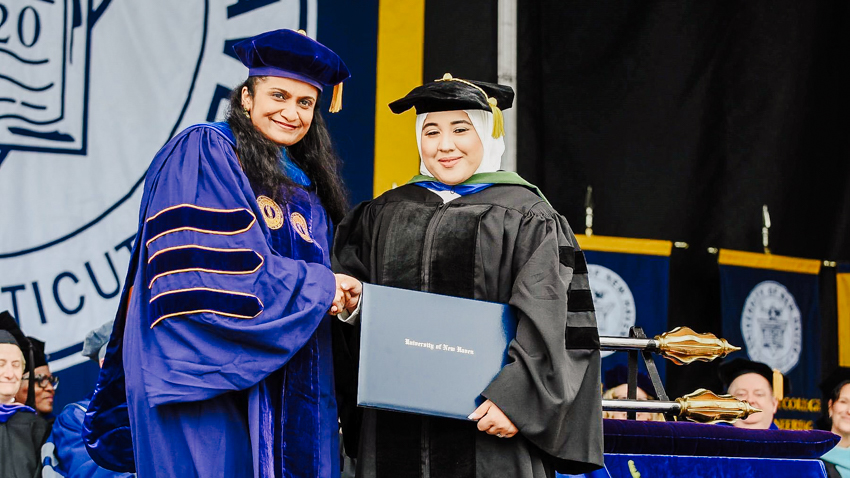
For the first time, theses written by recent graduates of the University of New Haven's Doctor of Health Sciences (DHSc) program, launched in 2021, have been published in the Journal of Healthcare Leadership (JHL), a highly respected peer-reviewed journal indexed in PubMed and the Web of Science.
This distinction underscores the academic rigor of their work and the University's commitment to advancing health sciences research.
“These publications mark significant milestones not only for Sumbul and Jordan but for our DHSc program and the University,” said Pavani Rangachari, Ph.D., professor of healthcare administration and public health and public health, who served as a mentor for both students. “By sharing their thesis-to-publication stories, we hope to inspire and support doctoral students in navigating this rewarding path.”
Below, Yousafi and Schweidenback share their journeys, in their own words, offering insight into the process of transforming their theses into published manuscripts and the impact of this transformative experience.
Contact
Get the highlights!
Stay up to date with our weekly enewsletter, highlighting stories from around the University and media clips featuring our faculty experts.
Sumbul Yousafi ‘24 DHSc
Pursuing my thesis was a journey of discovery and growth, culminating in the publication of the article “Barriers to Recruitment and Retention Among Underrepresented Populations in Cancer Clinical Trials” in JHL. This journey offered invaluable lessons in research, collaboration, and perseverance, solidifying my commitment to advancing healthcare equity. The research addressed a critical issue: ensuring diversity in clinical trial participation is essential for the generalizability of findings, which, in turn, is crucial for delivering high-quality care that benefits all populations.
My research focused on understanding barriers to recruiting and retaining underrepresented populations in cancer clinical trials, an issue that undermines health equity and the inclusivity of clinical research findings. Through interviews with clinical trial coordinating staff, I identified key barriers, including insufficient leadership support, staff shortages, financial constraints, and a lack of systems for implementing effective recruitment and retention practices. These findings underscored the need for coordinated efforts to address these systemic challenges.
The process began with a deep dive into existing literature, followed by fieldwork that required careful planning and adaptability. I am deeply grateful for the guidance of my committee chair, Dr. Rangachari, and committee members Maggie Holland Ph.D., MPH, and Mary Lamothe, Ph.D., In addition, support from the University’s Writing Center was instrumental in refining drafts and enhancing clarity.
The shift from thesis to manuscript marked a new phase in my academic journey, characterized by collaboration and rigorous refinement based on comments from peer reviewers. Dr. Rangachari took on the role of senior corresponding author, and Dr. Holland became senior co-author. Together, we restructured the manuscript to situate our findings within the broader context of national efforts by the National Institutes of Health, Food and Drug Administration, and Centers for Disease Control and Prevention to increase diversity in clinical trials. Our work highlighted how these initiatives have struggled due to a lack of systems for implementing effective recruitment and retention practices at cancer centers and the need for shared accountability between sponsoring agencies and healthcare institutions.
One of the most nuanced aspects of this transition was explaining to reviewers our preference for the term “underrepresented populations” as opposed to “minority populations.” While the latter term typically refers to specific racial or ethnic groups, “underrepresented populations” captures a broader intersection of factors, such as race, income, and geographic location. This distinction is crucial for addressing the multifaceted challenges of diversity in clinical trials, ensuring that strategies are tailored to meet the varied needs of these groups effectively.
Reviewer feedback led to key refinements, such as the development of a visual dashboard to contextualize our study. Dr. Rangachari’s leadership and Dr. Holland’s analytical expertise were pivotal in addressing these challenges, elevating the manuscript to publication standards.
Receiving the acceptance email was a moment of immense pride. Our publication not only reflects the culmination of my research but also showcases the power of mentorship and collaboration. As a PubMed-indexed author, I am proud to have contributed to the dialogue on healthcare equity and diversity in clinical trials.
This experience has been transformative, reaffirming my passion for research and advocacy. My advice to future students is to embrace the collaborative nature of publication, leverage institutional resources, and view challenges as opportunities. The transition from thesis to publication is demanding, but the reward of contributing to meaningful scholarship is unparalleled.
Moving forward, I am committed to advancing research and implementing systems that address recruitment and retention barriers to diversity in clinical trials. Together, we can pave the way for more inclusive and equitable healthcare practices.
Jordan Schweidenback ’24 DHSc
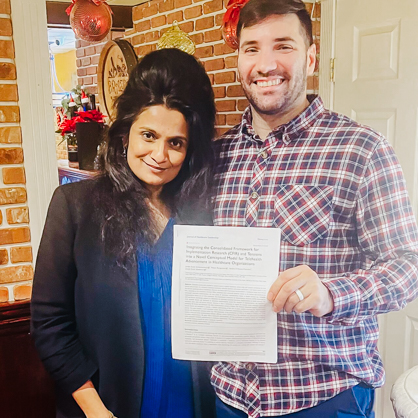
The research underpinning my thesis addressed the critical challenge of advancing telehealth innovations in healthcare organizations. Using the Consolidated Framework for Implementation Research (CFIR) and the Tensions framework, my study integrated these approaches into a novel conceptual model for examining barriers and facilitators to telehealth adoption and integration within clinical practice. This work is particularly significant as telehealth continues to transform healthcare delivery by improving access, enhancing patient outcomes, and addressing disparities in underserved populations. The culmination of this journey was the publication of my article “Integrating the Consolidated Framework for Implementation Research (CFIR) and Tensions into a Novel Conceptual Model for Telehealth Advancement in Healthcare Organizations” in JHL.
The journey from thesis to publication reaffirmed a profound truth I had come to appreciate: the true value of research lies not in definitive answers but in the power of the questions we ask and the dialogues we foster. My thesis began as a deeply personal exploration, a question I felt compelled to pursue. However, as the research unfolded, I discovered that the act of questioning—embracing uncertainty and probing deeper—was the most transformative part of the process. In the early stages, my research often led to unexpected directions, with data presenting more questions than answers. These moments, far from being discouraging, became opportunities for growth and reflection. I realized that research was not about finding the perfect solution but about pushing boundaries and generating inquiries that challenge conventional thinking. Each unanswered question became a spark for further exploration and discovery.
As I transitioned from thesis to manuscript, the focus shifted from answering questions to framing them in ways that would resonate with the broader academic community. It was about shaping my work to invite dialogue, inspire curiosity, and challenge prevailing ideas within the field. This perspective was a turning point, helping me see my work as a conversation starter rather than a conclusive endpoint. My manuscript became an opportunity to position my work as part of a larger, ongoing conversation within my field of study.
While my thesis was a solitary endeavor, transforming it into a manuscript became a collaborative process enriched by the insights of colleagues, mentors, and peer reviewers. Each round of feedback added a new dimension to my work, challenging me to think critically and expand the scope of my ideas. What began as a personal project evolved into a collective effort. The manuscript became a dialogue between my initial questions and the voices that helped refine and elevate my work.
The process reaffirmed that while answers hold value, they are not the ultimate goal of research. My work was never about offering the final word but about opening doors to future inquiry and broader conversations. I now view research not as a solitary pursuit of truth but as a collaborative process of discovery and growth. My thesis-to-publication experience has left me inspired to continue asking questions, sharing ideas, and contributing to the ever-evolving dialogue that defines academic inquiry.
Sumbul Yousafi '24 DHSc, is a cancer clinical research coordinator for Stony Brook Medicine, and Jordan Schweidenback '20 MHA, '24 DHSc is director of strategic sourcing for the Blackmaple Group and a lecturer in the University of New Haven's Master of Healthcare Administration program.
Recent News
University News
University of New Haven Achieves First-Ever National Ranking from U.S. News
University News