A two-day workshop at the University of New Haven brought together experts, students, and faculty for practical training in open-source investigations and digital verification.
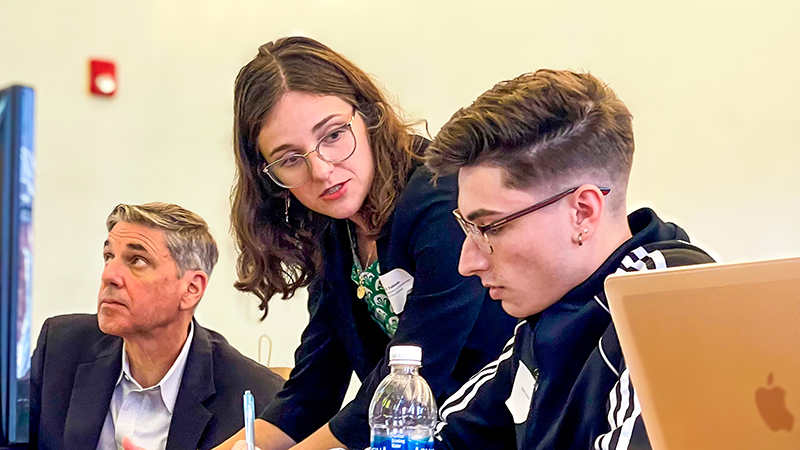
The University of New Haven recently hosted a two-day workshop on Open-Source Investigations for Cultural Heritage. Hosted by Michelle Fabiani, Ph.D. of CURIA Lab, in collaboration with the University’s Connecticut Institute of Technology and its Henry C. Lee College of Criminal Justice and Forensic Sciences, this workshop brought together 17 national and international experts in cultural heritage alongside University of New Haven students and faculty to explore the interdisciplinary area and foster new collaborations and connections.
Open-source investigation techniques are increasingly relevant across fields and particularly relevant for studying and mitigating cultural heritage crimes. This event provided a unique opportunity for upskilling professionals and introducing students and faculty to a new area and novel methodologies.
Michelle Fabiani, Ph.D., assistant professor of criminal justice
A core value of CURIA is to help new and existing professionals studying broad-scale changes to material cultural heritage to stay up to date on the most cutting-edge skills and technology available, and to serve as a connection point between experts across fields. Here, participants received a combination of guided learning and hands-on scenario work, from geolocating events in video and imagery to hands-on practice creating and debunking AI-generated media, to applying evidence collected to evaluate competing claims by governments locked in a conflict.
By the end of the second day, everyone had completed an OSINT (Open-Source Intelligence) investigation and practiced communicating their findings to different audiences. We were thrilled with the response to this workshop and look forward to providing more!
Contact
Get the highlights!
Stay up to date with our weekly e-newsletter, highlighting stories from around the University and media clips featuring our faculty experts.
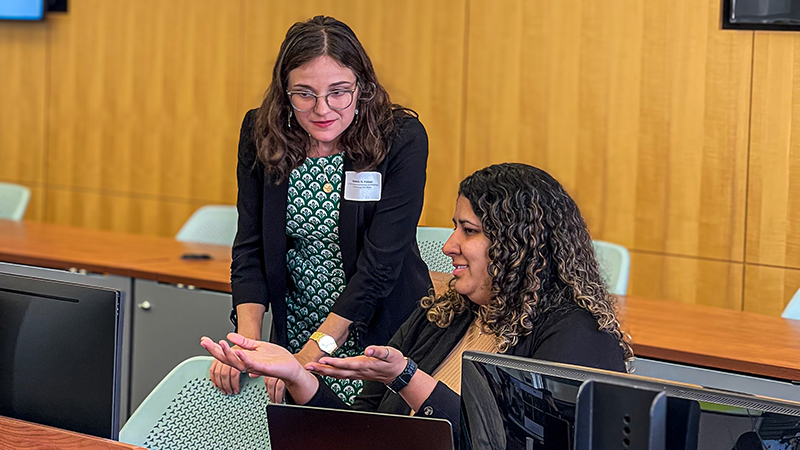
Monique Golden, Ph.D., project and lab manager for the Connecticut Institute of Technology
I attended the two-day workshop to gain a better understanding of what OSINT entails. I enjoyed the Open-Source Intelligence workshop led by Drs. Fabiani, Greenland and Jasparro; they were an extremely knowledgeable team, and their passion for the subject was infectious. I was very fortunate to connect with participants of diverse backgrounds and careers from inside and outside of the U.S. who were equally curious and excited to learn about OSINT.
I was particularly impressed by the hands-on exercises, which allowed us to examine incidents from real- world conflict and demonstrate how the principles are applied in practice. Verifying whether events have occurred by analyzing changes in satellite imagery is an intriguing way to learn this process. This allowed for incredibly insightful discussions on information-verification strategies, ethics, risk, and personal safety. I believe attendees left the workshop feeling more knowledgeable and informed about OSINT, and, as a result, will apply it to their professional practice, projects or research!
Haneen Alani (Ph.D. candidate)
Attending the Open-Source Investigations for Cultural Heritage workshop was an intellectually engaging and professionally enriching experience. As a Ph.D. student in the Henry C. Lee College of Criminal Justice and Forensic Sciences, I had the opportunity to explore how open-source intelligence (OSINT) methods can be applied to pressing global issues, specifically the protection of cultural heritage in conflict zones.
Over the course of two days, I gained hands-on experience with investigative tools such as satellite imagery analysis, video authentication, and digital verification techniques. These are the same tools investigators, journalists, and human rights organizations use to document crimes and preserve evidence for future accountability. Being guided step by step by experts in the field allowed me to practice these methods in real time, reinforcing my technical skills and demonstrating the practical impact of open-source research in global justice efforts.
For me, the workshop also resonated with my own dissertation project, which is examining hostile architecture and crime prevention through environmental design (CPTED) interventions in urban spaces. My research uses open-source data such as city records, crime reports, and zoning permits to evaluate how design choices regulate public space and impact marginalized communities.
Learning OSINT tools such as geolocation, chronolocation, and satellite-change detection gave me new ways to think about documenting spatial exclusion and contested environments. The parallels between protecting cultural heritage from looting and documenting the social consequences of hostile urban design were striking, as both require careful verification, transparent methods, and ethical sensitivity in preserving and sharing information.
I am especially grateful to Dr. Fabiani, whose leadership and instruction made this workshop an invaluable experience. Her expertise and guidance emphasized the University of New Haven’s excellence in connecting theory with practice, preparing students to apply advanced investigative skills across multiple domains, and engaging in globally relevant, interdisciplinary investigations. These methods align closely with high-demand academic, government, and NGO skills. OSINT techniques are increasingly central to investigations of war crimes, human-rights abuses, and urban-governance challenges, and the University of New Haven is ensuring its students are equipped with cutting-edge expertise. Overall, the workshop exemplified the University’s strength in combining rigorous academic instruction with applied training.
Recent News
The Charger Blog
University of New Haven Research Team Presents Digital Transformation Study at Major International Conference
The Charger Blog