As part of the University’s 18th annual Holocaust Remembrance ceremony, members of the University community honored and remembered the millions who perished, including six million Jewish people. A survivor from Budapest described how she and her family endured the Holocaust, discussing why it is so critical to share stories like hers.
Elle Clark ’25 was one of the many students and members of the University community who attended the recent Holocaust Remembrance Ceremony. It solemnly honors with dignity the millions of people who were killed in the Holocaust.
“A lot of young people tend to forget how important this is,” said Clark, a member of the ROTC program. “It is so important to remember the Holocaust.”
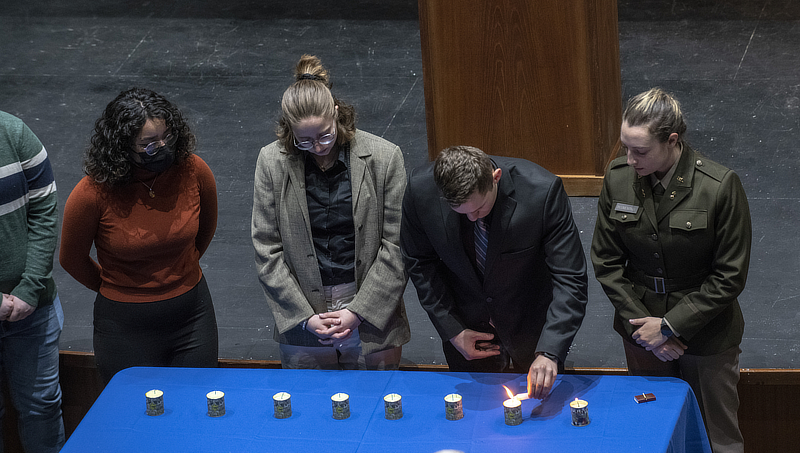
The University’s 18th annual ceremony closely coincided with other ceremonies and remembrances around the world. Held in Bucknall Theater, it began with a solemn candle lighting. Students lit eight candles – six in recognition of each of the six million Jewish people killed, one to remember the millions of other individuals who were murdered because of their identity and/or beliefs, and one to honor the brave people who offered aid or assistance to others at great risk to themselves and their families.
“The Holocaust was so immense in the magnitude of its horror that it commands us as teachers and students to cultivate tolerance and empathy that must be the hallmark of our humanity,” said Danielle Wozniak, MSW, Ph.D., provost and vice president for academic affairs. “Also motivating our observance is the lesson on ethical behavior, especially with respect to honoring human life.”
‘Our shared humanity’
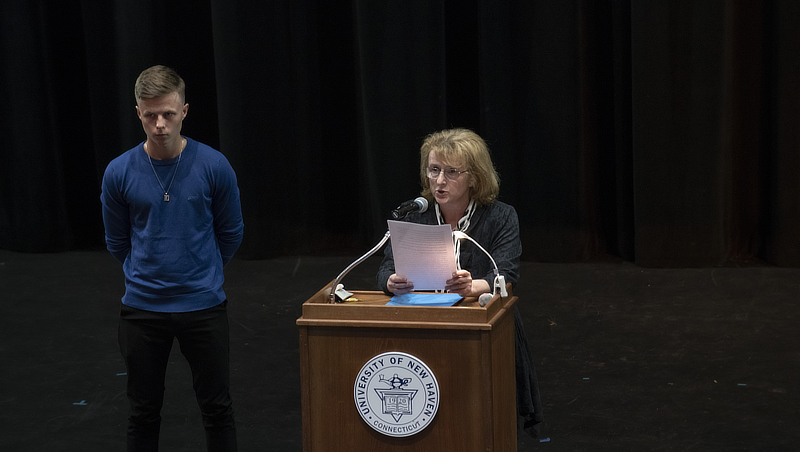
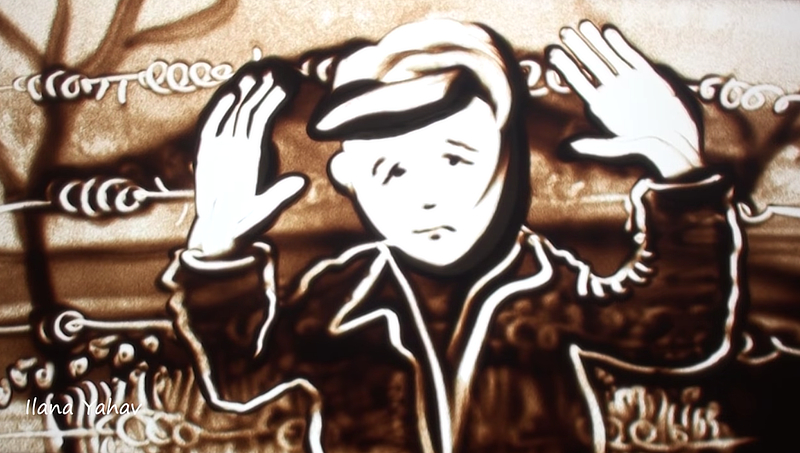
Ira Kleinfeld, professor emeritus who served as master of ceremonies, showed a “sand art” video by Ilana Yahav, an Israeli artist. She created a sequence of images in sand, and, among them, was an image of a boy with his hands raised, which represented a well-known photograph taken in Warsaw.
Prof. Kleinfeld emphasized the importance of reflection and education, key themes of the remembrance. He noted other premeditated and organized genocides that have occurred since the Holocaust, such as those in Cambodia and Syria.
“We have hate even in our own country,” he said. “We see antisemitism and racism. It is imperative to teach students about our shared humanity.”
‘Make the world better’
As part of the ceremony, those who helped assist others during the Holocaust, risking their own lives, were also recognized. Eva Sapi, Ph.D., a biology professor and a native of Hungary, and Adam Lindstrom ’25, a national security major who hails from Sweden, read a tribute to Raoul Wallenberg, a Swedish diplomat who led a successful rescue effort in Budapest.
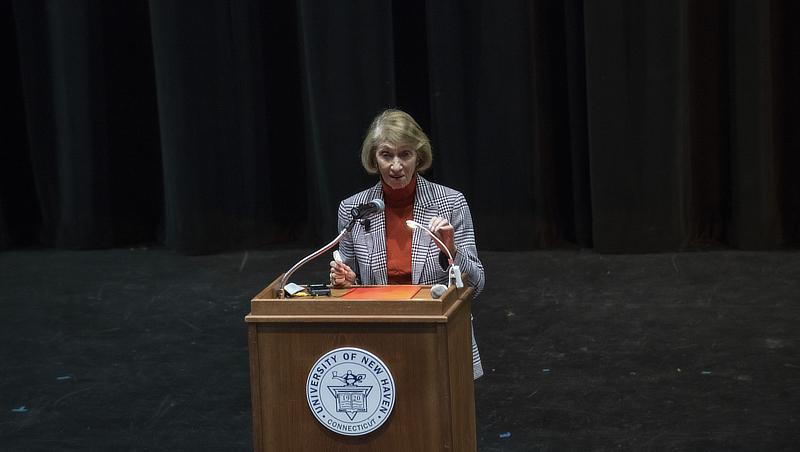
Among the Jewish families Wallenberg helped protect was that of Eva Brust Cooper, the ceremony’s keynote speaker. Cooper, who was born in Budapest and whose father was a prominent member of the Jewish community, was not greatly affected by the war until the German occupation of Budapest in 1944.
“At my tenth birthday party in 1944, we were eating hot dogs, my favorite food, when we heard a noise that grew louder,” she said. “The adults went to the window, and it was Germans marching into Budapest.”
Initially able to remain in their apartment in a house designated for Jewish families, Cooper saw people living in close quarters and food becoming scarce. Her parents were able to get protective papers from Wallenberg, and they left their apartment, which had bullet holes in it when they later returned to it. They were able to survive the war, though many members of their extended family perished. Cooper and her family moved to the United States in 1947.
For Cooper, it is important to share her story, and she regularly speaks to audiences at schools and civic groups. She hopes it will continue to inform them and inspire them to make ethical choices.
“I am among those who remember what happened and can speak about the experience,” she said. “I never thought something like this would happen again. See what you can do to make the world better.”
‘It is amazing’
Lauren Kempton, Ed.D., a practitioner in residence of sociology, shared several poignant quotes, including a particularly meaningful one from Elie Wiesel, a Holocaust survivor, writer, activist, and Nobel laureate who died in 2016.
“He said, ‘When you hear a witness, you become a witness,’” she said. “We’ve just become a witness to Eva Cooper, who encouraged us to share her story. We’ve just heard an amazing memory, and we must tell her story.”
Cooper inspired the members of her audience, including Clark, the ROTC cadet, who was also the student who brought her to the University from the train station.
“It is amazing that she is a Holocaust survivor,” said Clark. “This was a great opportunity to meet her and to listen to her story.”
Contact
Get the highlights!
Stay up to date with our weekly e-newsletter, highlighting stories from around the University and media clips featuring our faculty experts.
Recent News
The Charger Blog
University of New Haven Research Team Presents Digital Transformation Study at Major International Conference
The Charger Blog