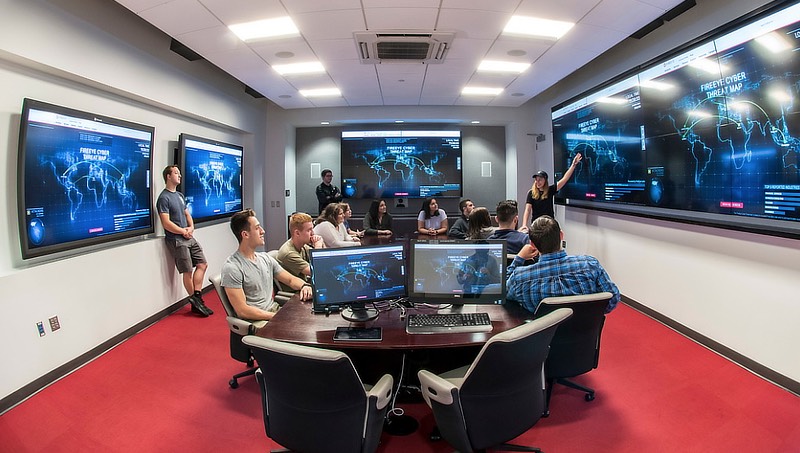
The four-course program enables students and professionals to explore national security in the transnational cyber realm – an area that experts say is increasingly critical to protecting public safety, our economy, and our democracy.
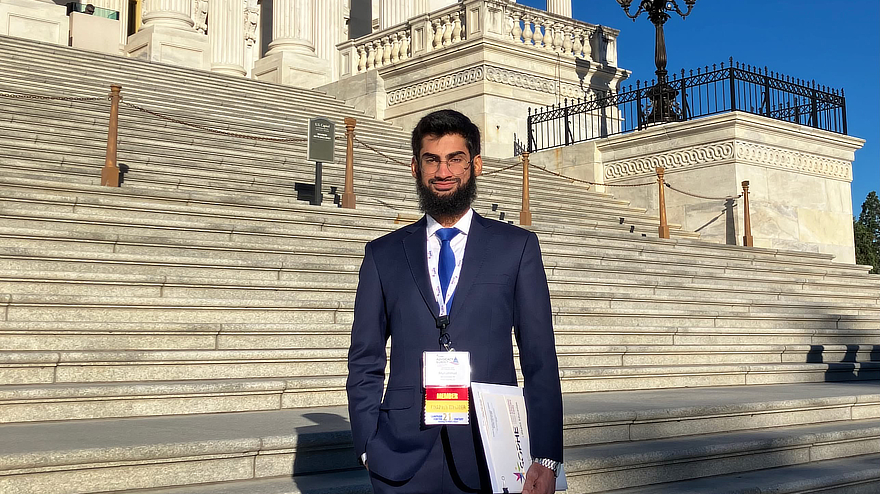
Since he was in high school, Shayn Donaldson ’23 has believed strongly that his purpose is to help others. He is especially interested in the military, and he believes intelligence is his calling.
A national security major with a concentration in intelligence analysis, Donaldson recently completed his transnational cybersecurity certificate at the University – making him the first undergraduate student to do so.
“One of the most notable things about this certificate program was that it had tied into my other coursework as a national security major,” he said. “I gained a broader understanding of the cyber domain, how investigations were handled in this domain, the history and utility of the dark web, and much more. It was all information I could apply to other projects and assignments, and it allowed me to think in a way that I felt improved the quality of my work.”
The 12-credit certificate explores the dynamic area between physical security and cybersecurity, which is quickly becoming one of our greatest national security vulnerabilities and emerging threats. Students take courses such as “Securing National Security Information Systems” and “Contemporary Topics in Dark Web Investigations” – which Donaldson says was “one of the most interesting topics” he has explored during his studies at the University.
“The certificate program had so much to it that I enjoyed,” he said. “The information from the courses themselves, the extensive knowledge of the professors, and the discussions that took place during the courses were invaluable. If I had to state what I had liked the best about the program, I would have to say that it was the professors – especially Professor Angelo Florian. He was one of the best resources I had.”
‘National security experts need to address this threat’
Robert Sanders, LP.D., J.D., LLM, chair of the University’s national security program and a retired U.S. Navy Judge Advocate General’s Corps Captain, says the need for professionals trained in transnational cybersecurity is becoming increasingly critical. Security breaches have already impacted Americans in a variety of ways. He cites recent ransomware attacks on JBS Foods and the Colonial Pipeline earlier this year, impacting people at the grocery store and the gas pump, respectively, as well as attacks on our electoral systems.
“In the interest of continuing to keep the National Security Department in step with the real world that our students are destined for, we have been enriching our teaching and integrating cyber dimension and cyber conflict, from both the potentially kinetic (physical effects) and non-kinetic positions, into our curriculum,” said Dr. Sanders. “National security experts need to address this threat from technical and non-technical directions, they need to understand the cyber threat as well as how the cyber threat operates to undermine our democracy.”
‘I believe this certificate will serve me well’
The certificate program will enable students to develop an understanding of issues related to cybersecurity and information protection, as well as the national security enterprise of the United States. Students will generate original graduate-level cyber problem-solving hypotheses and evaluate and design cyber policy solutions to contemporary national security problems.
Donaldson aspires to work for a government agency such as the CIA or the Defense Intelligence Agency. He says the certificate program was a “great experience,” and he expects to continue to draw on what he learned.
“I believe this certificate will serve me well, both through my application process and in the field,” he said. “It provided me with a great deal of useful information and a greater understanding of cybersecurity. I hope to apply this information while working at a government agency.”
Contact
Get the highlights!
Stay up to date with our weekly e-newsletter, highlighting stories from around the University and media clips featuring our faculty experts.
Recent News
Charger 360

Season 5, Episode 4: Ashley McClain ’07 and Ariana James ’27
In the Media