As a member of the University’s Summer Undergraduate Research Fellowship program and a 2021 McHale Fellow, I am conducting theoretical research on how the shape of the universe can explain dark matter and dark energy. The findings of this research may have further implications in the future survey of the universe, informing us of what to expect at the edge of the observable cosmos.
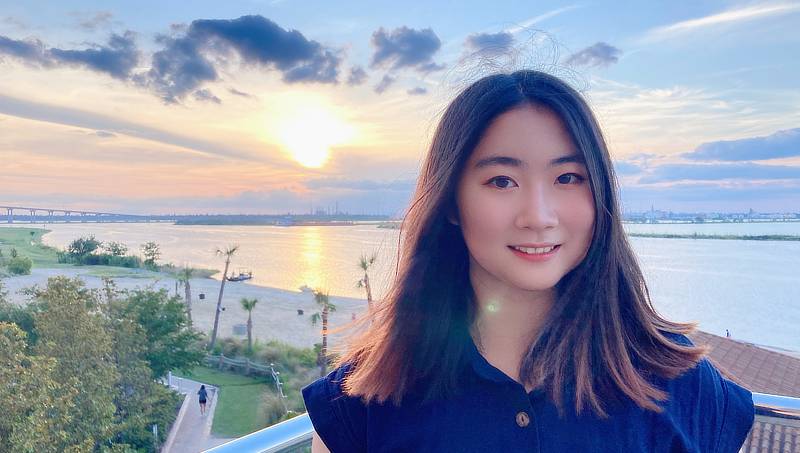
As an international student from China, I am currently a junior majoring in mathematics and minoring in physics. I wish to build a career as a researcher to study cosmology-related topics in the future. The Summer Undergraduate Research Fellowship (SURF) program provided me with an invaluable opportunity to have hands-on experience in research and encouraged me to challenge the limit of my knowledge base.
I have always been fascinated by how mathematics can describe the distant universe. Upon finding my true passion in mathematics and physics, I reached out to Dr. Poplawski and Dr. Green for a potential SURF research topic. Our research challenges the particle-based theories and expands on how a 5-dimensional (5D) hypersphere embodies the properties of dark matter and dark energy.
Dark energy denotes the force driving the accelerating expansion of the universe, while dark matter describes the unknown matter that interacts gravitationally. They together constitute 95 percent of the universe. There has been no theory or hypothesized particle that can fully explain their existence.
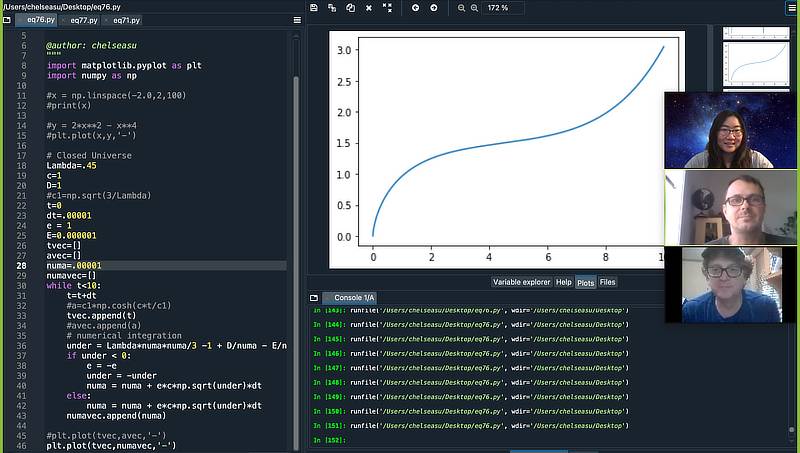
We first constructed 5D formalism using the same strategy of constructing a 3D sphere, and we established the coordinates of stereographic projection. After applying the 5D geometry, we resolved the relationship between the radius of the 5D sphere and the dark energy. Currently we are using phenomenology (trial and error) to identify a correction term that includes dark matter. We will compare the phenomenology term with the correction term derived from stereographic projection in the end.
Working on this project has opened my eyes to how complicated and indicative mathematic equations can be. There have been times that math equations are too complicated for me to follow. I took time and wrote in a notebook all the derivations and looked through them regularly. I am also amazed at how different aspects of physics play roles within one topic.
Dr. Poplawski has helped lead me into the logical and mathematical interpretation of the topic, and Dr. Green has engaged me in various ways to graph and integrate equations. With all the help from my mentors and the SURF team, I was able to understand and develop research that, we believe, is both intriguing and comprehensive. I look forward to my future research experience and developing a further understanding of the universe.
Hang Su ’23, a mathematics major and physics minor at the University of New Haven, is working under the mentorship of Nikodem Poplawski, Ph.D. and Kevin Green, Ph.D.
Contact
Get the highlights!
Stay up to date with our weekly e-newsletter, highlighting stories from around the University and media clips featuring our faculty experts.
Recent News
Charger 360

Season 5, Episode 4: Ashley McClain ’07 and Ariana James ’27
The Charger Blog