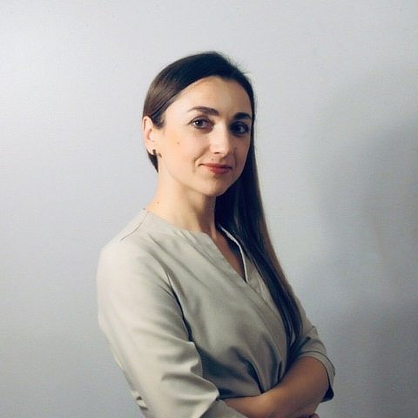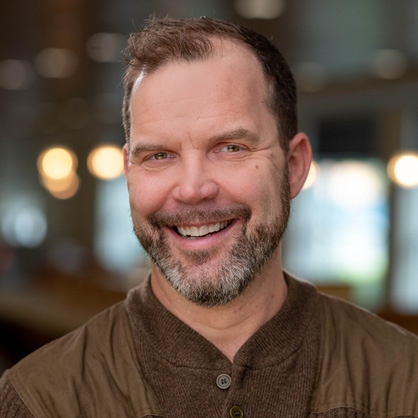
Trevor Dykas ’21 and Jeffrey Treistman, Ph.D. have collaborated on research that has already been recognized by a prestigious association of professional scholars and has the potential to provide new insights into political and national security issues worldwide.
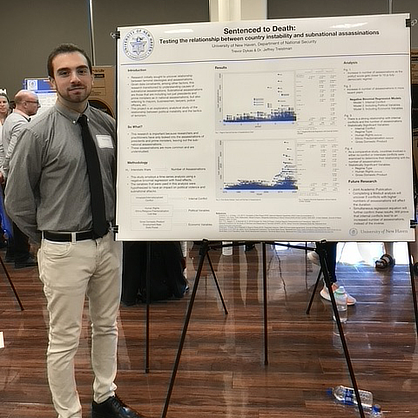
When Trevor Dykas ’21 attended an Accepted Students Day event at the University of New Haven, he was still deciding what he wanted to study. When he heard one of the professors in the University’s National Security Department give a "mock lecture" on counterterrorism, he knew he’d found his calling.
Dykas went on to spend the fall of his sophomore year studying at the University’s Tuscany Campus, and his semester abroad coincided with Jeffrey Treistman's time teaching in Prato. Taking "Quantitative Applications in National Security" last spring with Dr. Treistman gave Dykas an idea for a Summer Undergraduate Research Fellowship (SURF) project that he pursued last summer, with Dr. Treistman serving as his adviser.
"I was extremely interested in datasets, and we realized there were no known datasets that included the ideologies of terrorist groups that are linked to their attacks," said Dykas. "After more refinement, we knew this tool could be very useful for our research."
"I never thought that I would be able to do something like this at such a young age, and I couldn’t be happier."Trevor Dykas ’21
Researching the ideologies of known terrorist groups, Dykas found that there was a lack of compelling and conclusive data on the groups’ ideologies. They focused their examination on understanding the causes of subnational assassinations. Their research became an exploratory analytical study of the relationship between country instability and terrorism tactics, and they created a dataset that included subnational assassinations and the ideologies of the groups that committed the attacks.
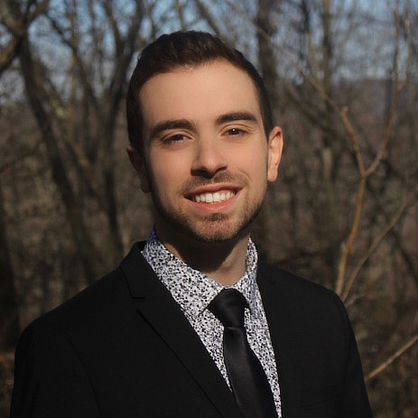
"Trevor worked with me to create the first known dataset on subnational assassinations," said Dr. Treistman. "Together we have made several novel discoveries. This has been an unprecedented student research experience that embodies the University of New Haven’s mission of experiential education."
Specifically, Dykas and Dr. Treistman discovered that the closer a country was to implementing a government based on democracy, the higher the number of subnational assassinations. They also found that internal conflicts in a country lead to more subnational assassinations.
Their work has been recognized by the Midwest Political Science Association (MPSA), a professional association of political science scholars and students, which invited them to present their findings during their annual conference. Although the conference was canceled because of the global coronavirus pandemic, they have been invited to submit their manuscript to MPSA's upcoming virtual conference, and they are endeavoring to publish their findings in a peer-reviewed journal. They are continuing to conduct more research on how subnational assassinations impact conflicts, particularly the duration and outcome of wars.
"I hope this project encourages students at the University of New Haven to get involved in research and present their findings at conferences," said Dykas. "I never thought that I would be able to do something like this at such a young age, and I couldn’t be happier."
Help University of New Haven Students Charge Ahead
We've launched the Charge Ahead Student Support Fund in an effort to raise financial assistance for our students for such necessities as remote learning technology, food, housing, medical expenses, and other emergency needs. Please click here to make a contribution that will assist those in our University community who need our support.
Contact
Get the highlights!
Stay up to date with our weekly e-newsletter, highlighting stories from around the University and media clips featuring our faculty experts.
Recent News
University News
University of New Haven Community Mourns Tragic Loss of Senior who ‘Embodied Everything That Is Good About Being a Charger’
In the Media