Through her work with the Connecticut State Police’s K9 Training Unit, Meredith Narowski '18, '20 M.S. has helped create a groundbreaking training program that can help police train dogs to detect guns and spent shell casings. Her work has now been shared with forensic science professionals around the world.
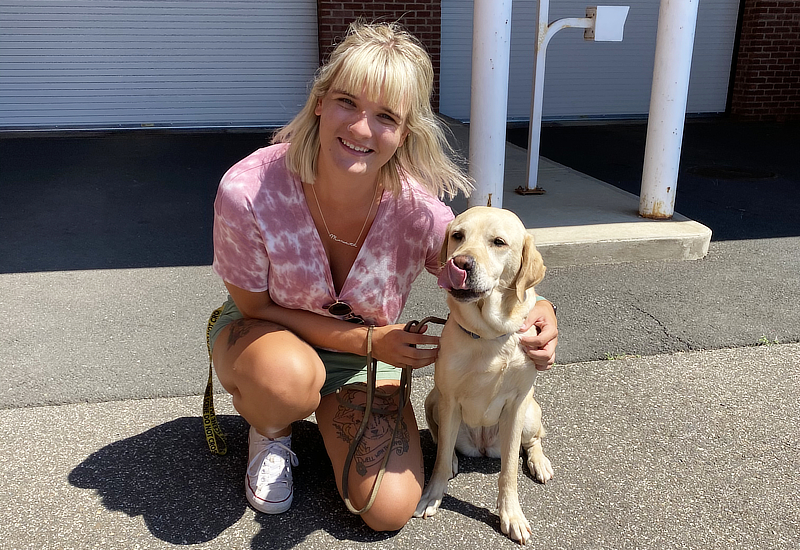
While completing an internship with the Connecticut State Police last summer, Meredith Narowski '18, '20 M.S. focused on the K9 Training Unit, studying how police canines learn. She attended a variety of canine training sessions, including arson investigation, search and rescue, and narcotics detection, learning about the dogs’ imprinting process.
Since firearms are involved in many crimes, the Connecticut State Police wanted to also be able to train dogs to detect firearms and gunshot residue after a shot is fired. Narowski focused her research on developing a new protocol to train police canines to do just that. Her goal was to determine which post-discharge organic compounds should be chosen to train the dogs.
“I think this research will make a huge impact on canine training,” said Narowski, who earned her master’s degree in forensic technology. “These dogs will aid in the search and discovery of gunshot residue and firearms, and they can help solve cases and locate suspects. This research can also be used as a basis for further canine training that might utilize organic compounds.”
Narowski researched the organic compounds found in gunshot residue, including those that are unique to gunshot residue when they are paired together. She determined each compound’s vapor pressure, noting those that would provide a higher scent profile. Since canines are trained to detect specific scents, the higher the vapor pressure, the stronger the scent and the better for training.
“I learned so many things from this research project, but one of the biggest things was how unique every sample of gunshot residue is,” she said. “Each type of gunpowder that can be used in firearms will produce different organic compound profiles of gunshot residue once the weapon is fired, and it is truly fascinating.”
'This research is crucial'
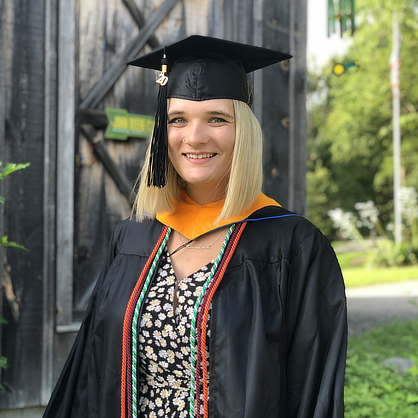
Prof. Lisa Dadio M.S., M.S.W., coordinator of the University’s M.S. in Forensic Technology program and Narowski’s internship adviser, says when the first class of gunshot detection canines graduated from the Connecticut State Police Training Unit last October, it opened the door for other agencies to train police dogs to detect gunshot residue.
“This research is crucial to the work that law enforcement does, as it allows the possibility of police canines and their handlers to locate evidence related to crimes of violence involving a firearm that may go undetected with the naked eye,” said Prof. Dadio, a retired New Haven Police Department lieutenant. “The work that Meredith and the Connecticut State Troopers completed can be shared with other agencies throughout the country. This was incredible work by a dedicated and hardworking student. The energy, passion, and dedication that Meredith put into this project was inspiring.”
The first class of four canines who graduated last fall are now working in the field, and the Connecticut State Police say the training program is the first of its kind in New England. The dogs can detect and alert their handlers to firearms and spent shell casings.
Brooke Kammrath, Ph.D., D-ABC, an associate professor of forensic science, served as Narowski’s research adviser. She says Narowski’s research has already been making a meaningful impact in the field.
“Meredith’s internship focused on the development of a scientifically-based protocol for training police dogs in the detection of firearms pre- and post-discharge, which has already been successfully implemented to train several classes of K9s,” said Dr. Kammrath, who also serves as assistant director of the Henry C. Lee Institute of Forensic Science. “Meredith surpassed all expectations for this internship, not only through her hard work and intelligence, but also with her enthusiasm and the positivity she brings to every endeavor.”
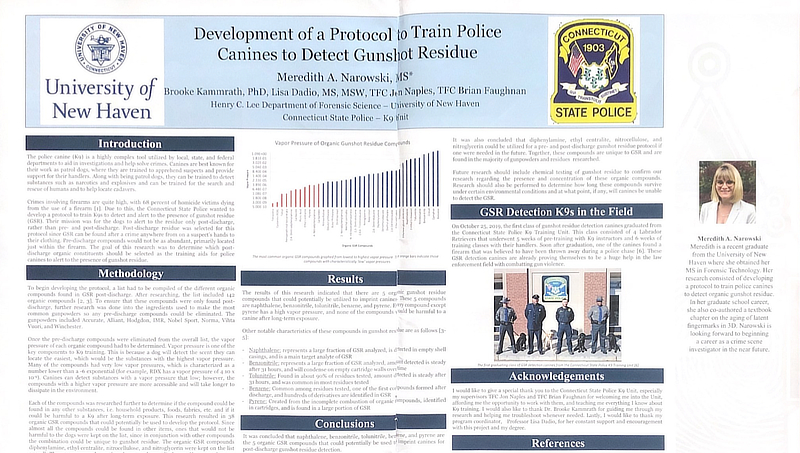
Narowski’s work has now been published and shared with forensic science professionals around the world. Her research poster was published in a recent International Association for Identification’s Identification News publication, which is sent to the forensic association’s members.
“I was so excited,” said Narowski. “I think the project is groundbreaking in the canine training field, and this meant that the research was not only noticed by the editors at the IAI, but now it can also be noticed by a whole community of people in the forensic science field. I was truly honored.”
Contact
Get the highlights!
Stay up to date with our weekly e-newsletter, highlighting stories from around the University and media clips featuring our faculty experts.
Recent News
Charger 360

Season 5, Episode 4: Ashley McClain ’07 and Ariana James ’27
In the Media