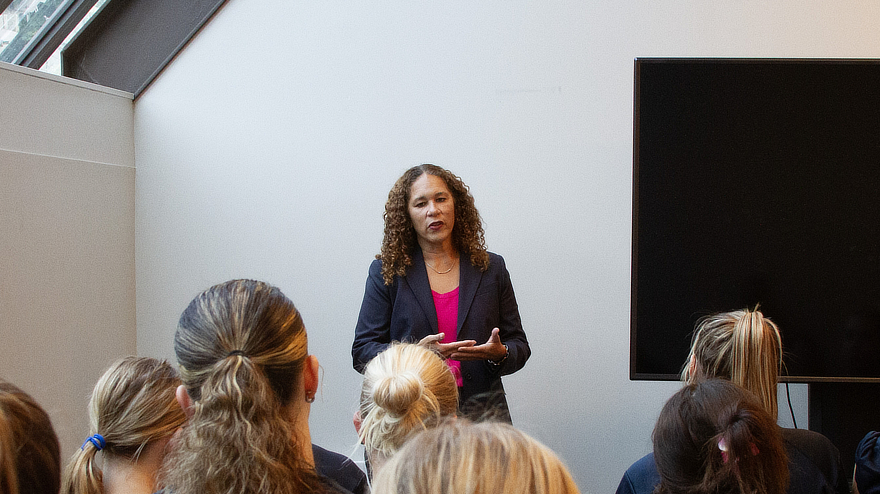
The lead forensic DNA consultant on the case of a Texas man who spent nearly a decade in prison for a crime he did not commit, Angie Ambers, Ph.D., says the cutting-edge DNA technology she applied to set him free could lead to many more people who have been wrongly convicted being released from prison.
When Angie Ambers, Ph.D., discussed the basics of forensic DNA at a Texas Criminal Defense Lawyers Association conference several years ago, she met Mike Ware, an attorney and the director of the Innocence Project of Texas. As part of her presentation, she highlighted some of the challenges and limitations in current technology, as well as in the way DNA results are interpreted and applied to criminal cases.
Her lecture proved to be a foreshadowing, of sorts, for a case that she and Ware would later collaborate on.
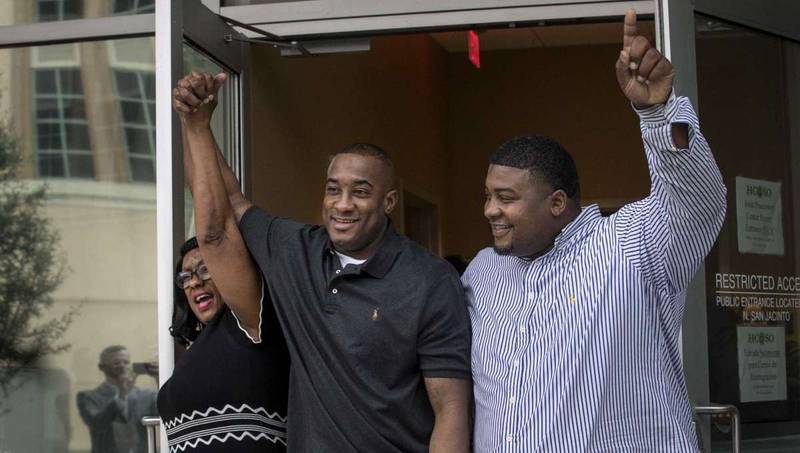
Ware and the Innocence Project of Texas are representing Lydell Grant, who was wrongly convicted of the 2010 murder of Aaron Scheerhoorn and sentenced to life in prison. Late last year – nearly a decade into his sentence, he was released from prison on bail and is awaiting official exoneration, thanks, in part, to Dr. Ambers’s work.
The lead forensic DNA consultant on the case, Dr. Ambers, an associate professor of forensic science at the University of New Haven and assistant director of the Henry C. Lee Institute of Forensic Science, used a cutting-edge software program to reexamine the DNA evidence in the case – something that, she says, has increasingly been used in criminal casework instead of turning to human analysts.
“In the past, different qualified DNA analysts could independently review the same DNA mixture and arrive at a different conclusion,” she explains. “This could ultimately result in a wrongful conviction or, alternatively, a false exclusion and acquittal, and it prompted experts to seek a more objective methodology.”
Companies can screen DNA mixtures and determine whether or not a suspect’s DNA is present. Dr. Ambers worked with Cybergenetics, the developer of the leading software program TrueAllele, submitting a DNA mixture that contained Scheerhoorn’s DNA, as well as that of another male. The analysis found alleles that did not match Scheerhoorn nor Grant.
After deducing the profile of the unknown DNA contributor, they worked with a crime lab in South Carolina to search the profile against the Combined DNA Index System (CODIS), an FBI database. They found a match: The DNA profile belonged to an Atlanta man, Jermarico Carter who has a lengthy criminal record, and has since confessed to Scheerhoorn’s murder.
“The use of a probabilistic genotyping software's findings in CODIS is significant,” explained Dr. Ambers. “This case was the first time it was attempted because an independent party – the Innocence Project of Texas – requested it, as opposed to law enforcement.”
“The entire reason the Innocence Project of Texas was able to get Lydell Grant, a completely innocent man, exonerated was because of the cutting-edge forensic analysis and the work of Dr. Angie Ambers,” added Ware. “She conceptualized what needed to be done with the DNA mixture and put the plan into action.
“She understood probabilistic genotyping and knew the right people to reach out to,” he continued. “Her work was brilliant. The result was that Mr. Grant was able to walk out of prison, where he was serving a life sentence, and the actual perpetrator of this murder was identified, arrested, and charged, and has actually confessed.”
Now awaiting official exoneration, Grant has maintained his innocence. Dr. Ambers says that the technology that set him free could be a game changer.
“The technology used in Lydell Grant’s appeal has enormous potential to solve cold cases and lead to reevaluations of prior convictions that were based on using the older, more traditional approach,” said Dr. Ambers. “I continue to provide expert consultation to the Innocence Project because I believe in fairness and justice.”
Contact
Get the highlights!
Stay up to date with our weekly e-newsletter, highlighting stories from around the University and media clips featuring our faculty experts.
Recent News
Charger 360
Season 5, Episode 4: Ashley McClain ’07 and Ariana James ’27
In the Media