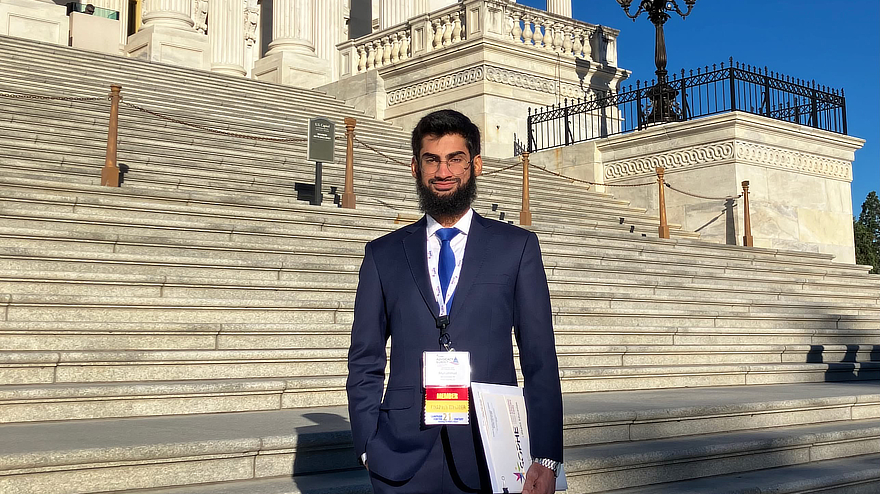
An internationally recognized expert in cybersecurity and digital forensics, Ibrahim "Abe" Baggili believes that virtual reality is a growing arena for both gamers and hackers, and his warning is now reaching consumers nationwide.

The founder and co-director of the University of New Haven’s Cyber Forensics Research and Education Group, Ibrahim "Abe" Baggili and his research team have found vulnerabilities in popular virtual reality systems that give hackers opportunities they have never had before.
When using these systems, gamers are immersed in a virtual world, seeing, hearing, and interacting with the game in ways that can temporarily disconnect them from reality. Baggili warns that hackers can take advantage of this, and his warning has been reported to consumers across the country.
"I think what’s really interesting in VR is for the first time we have a technology that takes over your complete sight and your complete vision, and now also, slowly, is taking over your hearing."Abe Baggili, Ph.D.
In Baggili’s lab, researchers were indeed able to take over the gaming systems and physically manipulate the user. Researcher Peter Casey ’19 M.S. was able to show how a hacker would move gamers across a room without them realizing it, and illustrated how a hacker can manipulate the game’s safety settings.
"A chaperone attack is when we either disable or expand the safety boundaries that are keeping the player from moving into any obstacles in the room," said Casey, who is pursuing a master’s degree in computer science.
Hackers could directly harm gamers by walking them down stairs, and they could also turn on cameras or insert images into the gamer’s virtual reality.
Baggili, the Elder Family Endowed Chair and assistant dean of engineering at the University, has led efforts to expose vulnerabilities in other technologies, including apps such as WhatsApp and Viber. He assists law enforcement with digital forensics to help solve crimes, and he created the Artifact Genome Project, a digital information resource for law enforcement.
Baggili says that not all virtual reality brands have been found to be vulnerable to the hacks.
"Though these hacks have not yet made headlines, it is important to expose potential issues before they become major problems," he says.
Contact
Get the highlights!
Stay up to date with our weekly e-newsletter, highlighting stories from around the University and media clips featuring our faculty experts.
Recent News
Charger 360

Season 5, Episode 4: Ashley McClain ’07 and Ariana James ’27
In the Media