
University of New Haven economist Armando Rodriguez has correctly predicted the last four Super Bowl winners. His pick for this year is in, and the numbers say the margin of victory will be razor thin.
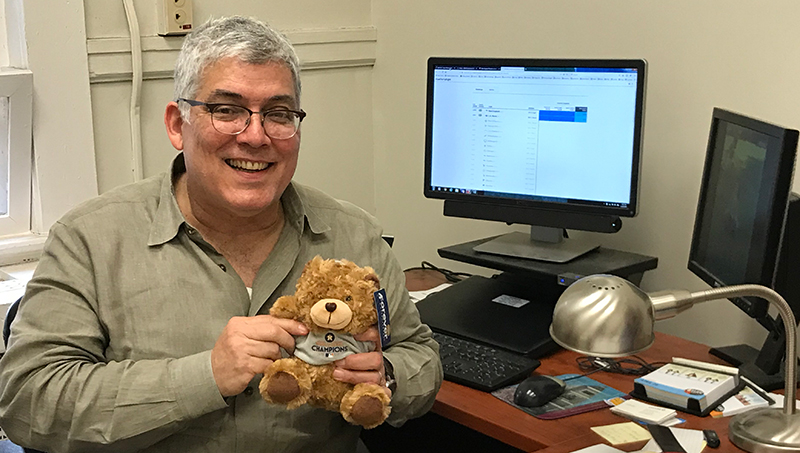
Like hundreds of millions of sports fans around the world, Armando Rodriguez, professor and chair of the University of New Haven’s economics and business analytics department, will be watching the Super Bowl.
Unlike some fans, his prediction of the game’s outcome comes not from emotion, but from crunching the numbers. Using a model that factors in each team’s offense and defense, Rodriguez expects the Patriots to beat the Rams 33-32, and gives the Patriots a 56 percent chance to win. As a point of reference, FiveThirtyEight, the popular polling analysis website created by Nate Silver, predicts the Patriots have 53 percent chance of winning.
Rodriguez’s model is an adaptation of one developed by a statistics professor in the United Kingdom that was created to predict the outcomes of soccer games. Unlike many other prediction tools that involve inputting a great deal of data, Rodriguez says his is very simple.
"It measures offensive performance relative to the average and defensive capability relative to the average," said Rodriguez, a former U.S. Federal Trade Commission economist. "It’s a matter of combining those two – that’s it. After that, it’s just traditional statistics – how likely is that result relative to a different result."
"Once is a fluke, but we’ve got a pretty good record."Armando Rodriguez, Ph.D.
Relying solely on numbers, however, can’t take all of the emotion out of predicting the outcome of the game. Before last year’s Super Bowl, Rodriguez’s model, much to his chagrin, predicted that the Eagles would win, and friends and colleagues heckled him for predicting a Patriots loss. He was correct about the Eagles’ victory – even if he predicted that they would win by three instead of eight.
He says that although he’s correctly predicted each winner of the last four Super Bowls, he has not accurately predicted the score, which is, of course, much more difficult. But, he says, he’s been in the right ballpark, and he has confidence in the system overall.
"Once is a fluke, but we’ve got a pretty good record," Rodriguez said. "The idea is to create a little buzz at the University."
The system has indeed created a buzz – and not just in the lead up to the Super Bowl. Rodriguez and his students have used the system to accurately predict the winners of other contests, from the 2017 World Series (they correctly predicted the Houston Astros’ victory) to the Oscars.
Using the model, Rodriguez predicted that Moonlight would narrowly beat La La Land to win the award for best picture. When the presenters announced that La La Land had won, Rodriguez thought his system hadn’t worked. However, there had been a mistake, and Moonlight was declared the rightful winner minutes later.
"I’m inviting my students to look beyond their instincts, their heuristics."Armando Rodriguez, Ph.D.
After the Super Bowl is over, Rodriguez will be turning his attention to college basketball, using his model to predict the outcome of the NCAA tournament. Though he may not be winning any trophies or gold statues for correctly predicting these contests, he is having fun doing it, and it serves as a teaching tool in his classes.
The Super Bowl predictions have been an engaging and relevant way for the students in his introductory business analytics class to apply what they are learning.
"Everybody has an opinion," said Rodriguez. "I’m inviting my students to look beyond their instincts, their heuristics. The philosophical message is that the numbers are another important input into their decision making."
Contact
Get the highlights!
Stay up to date with our weekly e-newsletter, highlighting stories from around the University and media clips featuring our faculty experts.
Recent News
The Charger Blog

University of New Haven Research Team Presents Digital Transformation Study at Major International Conference
The Charger Blog