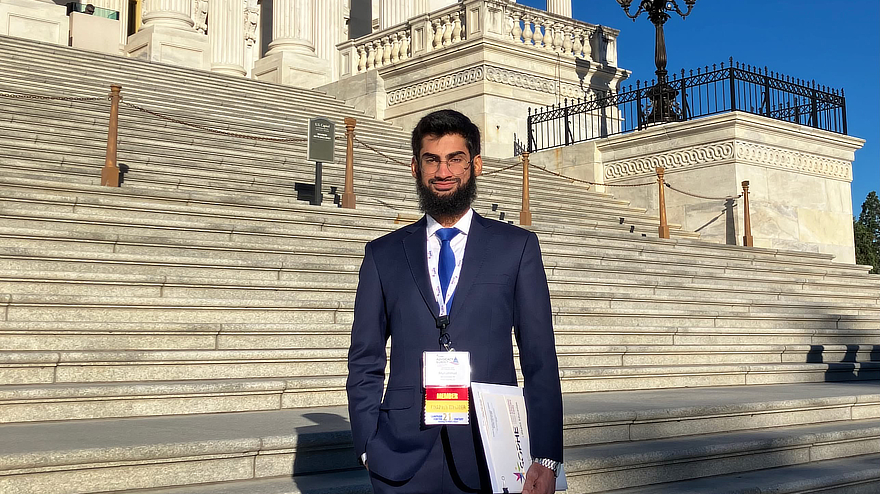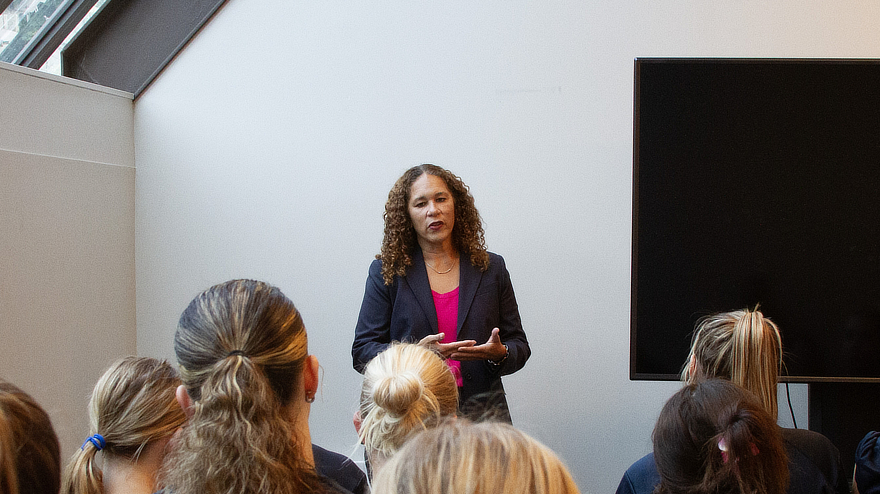
"Framing Immigrants," a book by University of New Haven professor Chris Haynes that explored the roles that news coverage and language have on shaping immigration public opinion and policy, received the Distinguished Book Award from the Western Social Science Association.

Chris Haynes, assistant professor and coordinator of political science, has dedicated untold hours to studying immigration policy and how it is discussed by politicians and covered in the media.
The years of work resulted in a book Haynes co-authored titled "Framing Immigrants: News Coverage, Public Opinion, and Policy" that one reviewer predicts will "inspire future generations of immigration researchers." In recognition of the contributions the book has made to the ongoing discussion about immigration, it received the 2019 "Best Book Award" from the West Social Science Association.
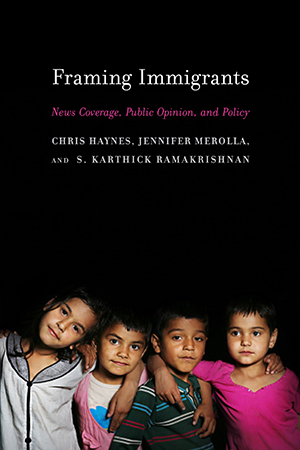
"I was very appreciative of the fact that our work, which took about seven or eight years to compile, was recognized in that way by fellow scholars," said Haynes, who co-wrote the book with Jennifer Merolla and S. Karthick Ramakrishnan. "We’re humbled. It was validation for the work we put into it."
When they set out to write the book, Haynes and his colleagues were specifically interested in examining the language around immigration and policy. He read "a few thousand" news articles and transcripts, and the group conducted several survey experiments to collect data on the impact of how the media and politicians refer to immigrants and immigration policy.
"We’d noticed in a lot of different news accounts that immigrants were being called different names – illegal immigrants, illegal aliens, undocumented immigrants – and no one had really looked into whether or not that had any impact on the way that people thought about them or the policies themselves," Haynes said.
In "Framing Immigrants," the researchers discuss the effects that conservative, liberal, and mainstream media outlets have in shaping the public debate on immigration. They found that words do matter. For example, Haynes says that the word an outlet used for "immigrants" was less important than how it framed the policies.
Certain words, such as "children" or "young person," tended to have a positive impact on support for policies like the DREAM Act. Conversely, the word "amnesty" had an overwhelmingly negative impact on support for such policies – even when paired with language describing children.
"The way that messages or questions are worded matters because the words that you use can completely change the reaction from the person receiving that question or message."Chris Haynes, Ph.D.
Haynes says that the researchers’ main message is that framing matters.
"Journalists, pollsters, and politicians must be prudent in the way they word messages, coverage, and questions, since the words they use can completely change the audience’s reaction," said Haynes.
The researchers’ conclusions have helped to frame some of the work that Haynes and his students are doing, and he believes that their findings extend beyond immigration. He and his students recently conducted a poll in West Haven that addressed the community’s trust in government and political efficacy. They presented their results to Mayor Nancy Rossi. He impressed upon his students the importance of using carefully worded questions and response choices in order to get the most accurate results.
"The way that messages or questions are worded matters because the words that you use can completely change the reaction from the person receiving that question or message," Haynes said. "This project got students to think that these polls are not all the same. It really depends on how you ask the question, who you ask the question to, and also the response choices that one is given."
Contact
Get the highlights!
Stay up to date with our weekly e-newsletter, highlighting stories from around the University and media clips featuring our faculty experts.
Recent News
Charger 360

Season 5, Episode 4: Ashley McClain ’07 and Ariana James ’27
In the Media