University of New Haven professor Chong Qiu is incorporating undergraduate and graduate students, as well as middle and high school students from the region, into his research as he seeks to secure a National Science Foundation grant.
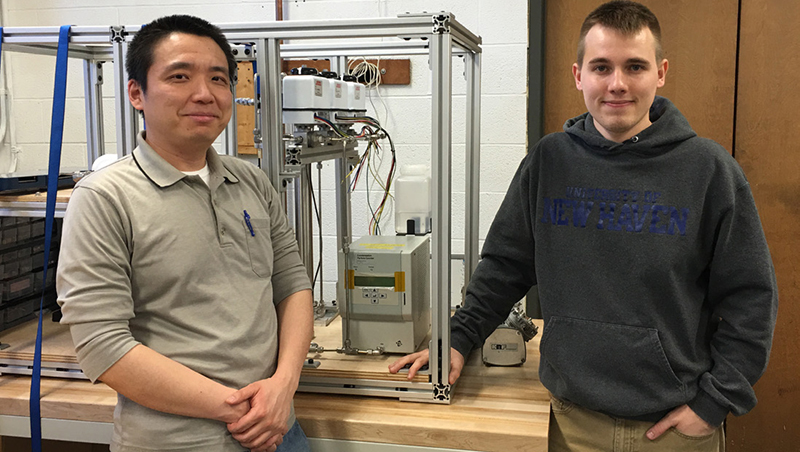
Chong Qiu believes in citizen science and that both longtime scholars and beginners can help move scientific research forward and "add knowledge to the library of mankind."
The assistant professor of Chemistry is at work on a complex research program and pursuing a significant National Science Foundation research grant to study the properties of aerosols (also known as particulate matters) in the atmosphere and delving into "the chemistry and physics of aerosol, which exists in the air we breathe in every day."
His collaborators are graduates and undergraduates from Chemistry, Biology and across the fields of the Tagliatela College of Engineering. They also include high school and middle school students from around the region, as young as 12, who are collecting micrometeorites from rainwater "using tools designed from simple plumbing parts."
"One of the goals is to move aerosol research forward by investigating chemicals, such as amines, that were previously not thought to be important and our discovery indicated otherwise," Qiu said.
"We are trying to contribute a piece to the larger puzzle."Chong Qiu, Ph.D.
The research hones in on aerosols – tiny particles suspended in the air, with sizes ranging from a few nanometers to a few micrometers. "These are very important to us, without them we wouldn’t have precipitation but, on the other hand, having too much in the atmosphere can be toxic," he said.
The study could help to shape understanding of the impact of air quality on climate change, weather forecasting and human health. "We are trying to contribute a piece to the larger puzzle," Qiu said.
Graduate and undergraduate students are conducting laboratory experiments, doing computer modeling and field work, using and testing low-cost devices that measure pollutant levels in the atmosphere. "Traditionally you had to pay tens of thousands of dollars to measure those levels, but we are trying to test portable devices that are a fraction of the cost," Qiu noted.
Meanwhile, teams of engineering seniors will design and construct equipment and instruments, such as a thermal denuder that determines the volatiles in ambient aerosol for their Senior Design project. "The engineering students are perfectly positioned to construct such a device," Qiu said. "It’s mutually beneficial, giving them the chance to do research and build the instrument. It will cost 10 times less than a commercially available instrument and it can be customized to specifically suit our research."
"I couldn’t wait to become part of the chemistry program because of the faculty in the program and because chemistry is so uniquely positioned in the Tagliatela College of Engineering."Chong Qiu, Ph.D.
Qiu was drawn to the University of New Haven because of this kind of collaborative possibility. He arrived in 2016, setting out immediately to work with faculty and students across the disciplines. "I couldn’t wait to become part of the chemistry program because of the faculty in the program and because chemistry is so uniquely positioned in the Tagliatela College of Engineering," he said. Qiu teaches analytical chemistry courses, including Quantitative Analysis and Instrumental Methods.
Qiu grew up in Central China, the son of two blue collar workers who encouraged his love of science. He pursued a Bachelors in Chemistry in China and his Ph.D. at Texas A & M. As an assistant professor at the University of Northern Alabama, Qiu received a National Science Foundation-Atmospheric Geospace Science grant to investigate "Kinetics and Mechanism of Restructuring of Atmospheric Soot and Associated Impact on Light Absorption." It was there that he began to wonder about the role amines play in the atmosphere.
Qiu says he’s energized daily by his teaching and research, having the opportunity to look closely at minute particles that may have a very large impact on environmental and human health.
By involving middle and high school students in research, he said he hopes they discover the magic and power of science and engineering and consider making it their life’s work. "We need to continue to encourage talented students to pursue STEM fields," he said. "And I hope we can galvanize support for science and discovery."
Contact
Get the highlights!
Stay up to date with our weekly e-newsletter, highlighting stories from around the University and media clips featuring our faculty experts.
Recent News
The Charger Blog
University of New Haven Research Team Presents Digital Transformation Study at Major International Conference
The Charger Blog