Widely Published Author Discusses Art of Writing the ‘Tiny Story’
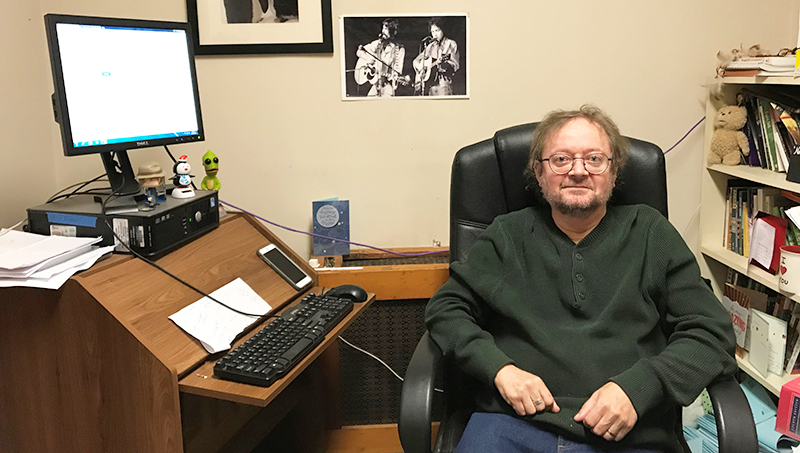
Jeffrey Foster, a lecturer in the University of New Haven’s English department who has written more than 25 "flash fiction" stories, shows his students the power that comes from being concise.
December 7, 2018
By Jackie Hennessey, contributing writer
Jeffrey Foster, Ph.D.
Jeff Foster is the master of the tiny story. Give him just 200 words – 300 tops – and he’ll fashion characters, a plot, and everything that lives within the landscape of a short story.
He’ll take an iconic figure and place him in an unusual setting "to humanize him" – like the Dalai Lama at a drive-thru picking up some coffee. "My stories pivot on character," he says.
A lecturer in the University of New Haven’s English Department, Foster has published more than 25 flash fiction stories – fictional works of extreme brevity that still offer character and plot development – in highly regarded nanofiction journals and online magazines.
His process often starts with a long drive. A snippet of a song lyric can lead to an idea for a story, and he tucks it away until he can get to a computer. He usually writes the story, start to finish, in one sitting.
"The ability to write succinctly and articulate ideas clearly and effectively are skills that span all fields."Jeffrey Foster, Ph.D.
The construction of a micro fiction piece appeals to him. "There’s a circular nature to it," he says. "You have to return to the beginning, using a line or repeating a word or a phrase." A Foster-esque story often features a "plot that sneaks up on the reader…and some dark humor."
He crafts titles to draw the reader in. There’s "Why is Keith Richards Living in My Bathroom?" in Sawmill Magazine, "Sinners in the Hands of an Amphibious God" in Splash of Red, and Lemmings, Hemingway, and Solving for X for Wordpool Press. He likes knowing his readers can read the whole story "on the bus or their lunch break or even walking down the hallway," he says.
With the emphasis on brevity on Twitter and other social media, and with an ever-growing market of microfiction journals, "flash fiction has never been hotter," writes Jack Smith in The Writer magazine.
Foster started writing in high school. While he and his buddies were supposed to be "listening intently in class," they were writing stories they dubbed "jottings."
"They were random stories, almost nonsensical," he says. "They got our imaginations going."
"Flash fiction has never been hotter."Jack Smith, The Writer magazine
There was an unfettered, unfiltered nature to it and, even then, he knew he wanted to write – and teach writing. He attended Middlebury College and pursued his Ph.D. at the University of Rhode Island, working full time and writing.
When teaching academic writing, he imbues each course with a bit of creative writing, and he talks with his students about the importance of choosing words well.
"The ability to write succinctly and articulate ideas clearly and effectively are skills that span all fields," he says. "I get so excited about a word or a phrase, and I love it when they do too."