University’s Robotics Team Rises to the Challenge at International Rover Competition
A dedicated group of students from the University of New Haven Robotics Club placed 13th in the world at the 2025 University Rover Challenge—outperforming teams from some of the top engineering schools in the country.
July 22, 2025
By Caitlin Truesdale, Office of Marketing and Communications
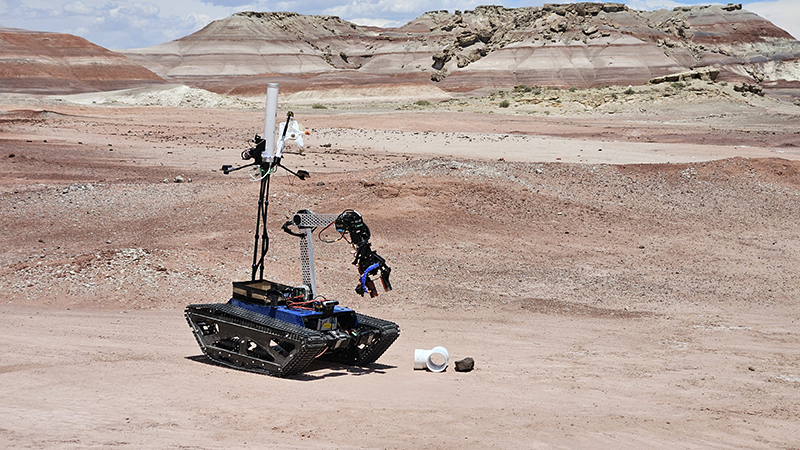
The University's Robotics team rover competing in the URC finals.
The University of New Haven Robotics Club isn’t afraid of hard problems or long odds. After months of intense preparation, their student-built rover earned 13th place in the globe at the 2025 University Rover Challenge (URC), outperforming powerhouse teams from universities such as Georgia Tech, Cornell, and Oregon State.
“Our small team size and the tank treads we used on our rover really set us apart,” said Aidan Stoner ’25, one of the team’s core members. “Very few teams in the competition’s history were as small as us, and even less that did as well as we did.”
Held each year in the Utah desert, the challenge draws top collegiate teams from around the world. Out of 114 applicants, only 38 qualified for the finals in Hanksville, Utah, where they’d face a grueling environment that pushes both engineering skills and perseverance.
“Getting 13th in the world was crazy,” Stoner said. “We made significant improvement from last year, and I was extremely happy with the results.”
For Erik Parker ’25, another team leader, the achievement reflected both the team’s excitement and their relentless drive. “It’s a huge spike of adrenaline when you find out you’ve made it,” Parker said. “But it’s also a cue that it’s time to lock in and finish what you've started.”
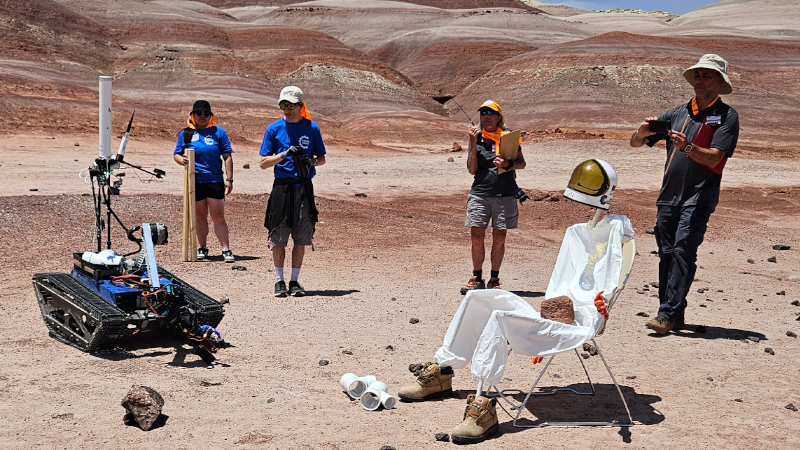
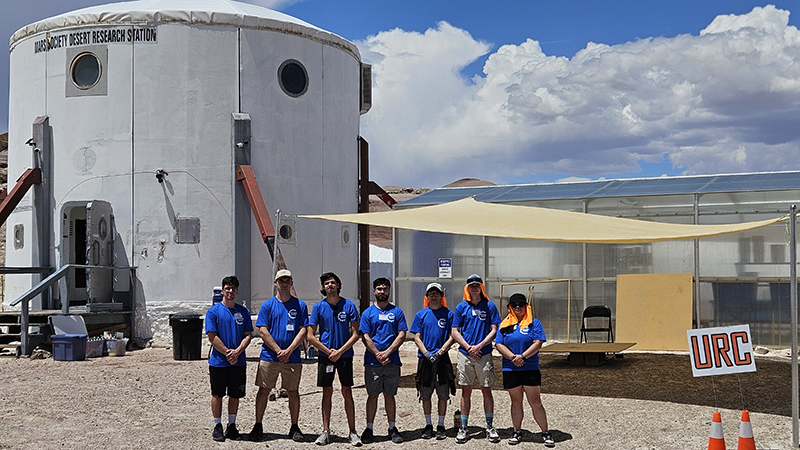
The University of New Haven Robotics Club at the URC finals in Hanksville, Utah.
‘We scored points even when all odds were against us’
The team’s journey wasn’t without major setbacks, such as a missing shipment of batteries days before the competition.
“Our shipping sponsor requested we send the batteries separately to simplify logistics,” Parker explained. “They guaranteed the arrival date would be days before we got to Utah, and I even put an Airtag in the package to track it.”
But the package never left a Massachusetts distribution center. “All our batteries were deemed lost,” Parker said. That meant the team had no power for their rover or even their tools.
In true engineering fashion, they improvised. They distributed spare batteries in their personal luggage to comply with TSA rules and bought more at a local Home Depot once in Utah. Their adviser, Shayok Mukhopadhyay, Ph.D., who Parker described as “incredible,” even drove over an hour at dawn to buy back-up drill batteries before a critical mission.
“It was a miracle it worked,” Parker said. “We scored points in both missions, even when all odds were against us.”
Through every challenge, the students relied on creativity, quick thinking, and sheer determination. “Even though we constantly had roadblocks, we managed to always find our way around them,” said Parker.
The University's student-built rover earned 13th place in the globe at the 2025 University Rover Challenge.
‘Really showed me that anything is possible’
Beyond the competition scores, the experience tested and strengthened the students' perseverance.
“For me, the most challenging moment was spending three weeks trying to fix one bug in my code with no progress,” Stoner said. “It wore my patience thin. But after I finally solved it, the dopamine rush was incredible.”
For both Stoner and Parker, the most rewarding moments weren’t flashy wins but small victories, such as the feeling of solving problems under pressure and seeing their rover in action. “It’s the culmination of thousands of hours of work in one package,” said Stoner.
They credited much of their success to relentless testing and preparation. The team pushed their rover to its limits on campus before packing it for Utah. “We would use it until failure, fix the problems, and test it again,” Parker said. “This went all the way until minutes before we packed the rover into the crate.”
And their design choices paid off. Unlike many other teams, the University of New Haven students successfully engineered a tank-tread system for their rover—a feat no other team has replicated.
Reflecting on the experience, Stoner summed it up best: “This experience really showed me that anything is possible, as long as you care enough and put in the effort.”
Thank You to Donors
We acknowledge the generous support of individuals Anil Shah (M.S. '86), Robert Alvine, Mike Ambrose (B.S. '84), and Bill Welsh, and companies Protospace MFG, BTX Global Logistics, ODrive, and Rokland.