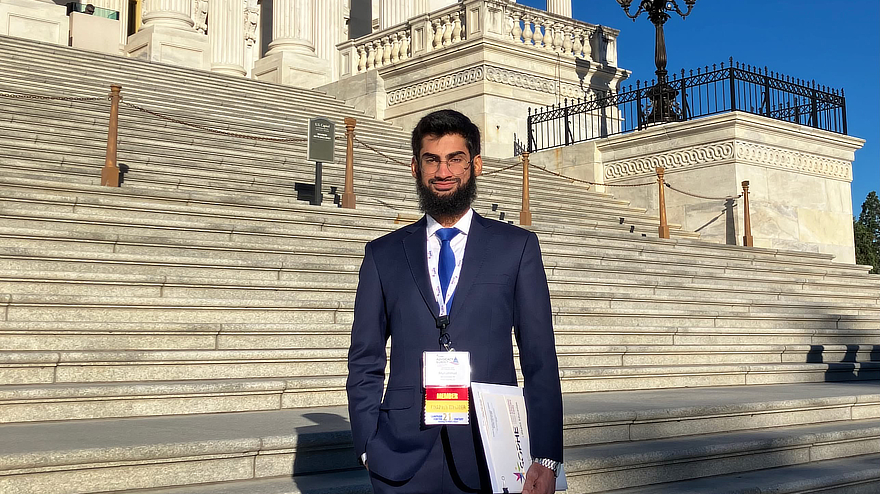
As part of his Summer Undergraduate Research Fellowship project, Muntasir Hossain ’23 immersed himself in machine learning, exploring ways to improve the identification of heart disease, while discovering a possible new career path.
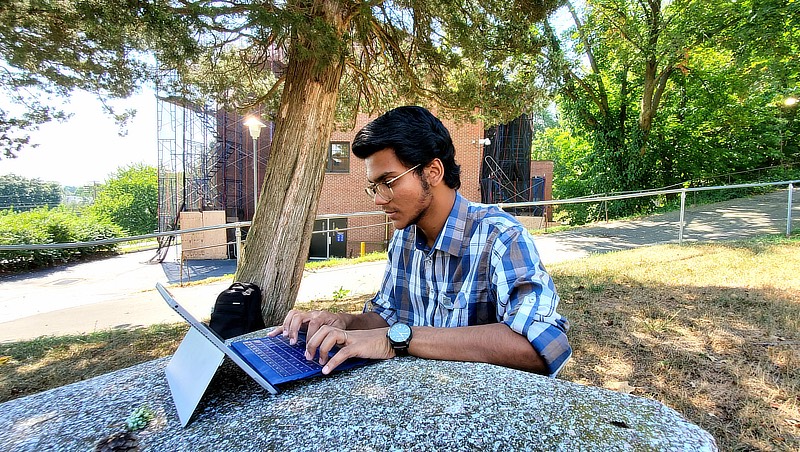
Muntasir Hossain ’23 is interested in machine learning and artificial intelligence (AI), and he took the opportunity to explore these cutting-edge topics in depth this summer.
Through the University’s Summer Undergraduate Research Fellowship (SURF) program, Hossain began his work by researching heart disease as a potential area of focus for machine learning. He learned about the severity of the disease, which does not have a cure, and he explored how machine learning – the study of teaching computers to recognize and identify patterns in data – could be used to detect what is currently the leading cause of death in the U.S.
“Machine learning can be used as a cost-effective means of detecting heart disease at an early stage and preventing it,” said Hossain, a computer science major. “The results would be used by diagnosticians to make a more reliable diagnosis very quickly.”
Because of the coronavirus pandemic, Hossain conducted his research and completed his SURF project online. Using Weka, an open source machine learning software, Hossain trained and tested multiple algorithms on a heart disease dataset.
"I was fascinated by how the algorithms would be able to find mathematical relationships and patterns in the dataset." Muntasir Hossain ’23
He focused on developing three essential algorithms that would accurately detect heart disease and identifying the minimum number of attributes – predictors of heart disease, such as angina – that he would need to get a comprehensive diagnosis. He also explored the impact the attributes had on predicting heart disease, using algorithms to better understand the data.
“I had to understand the process behind how the algorithms actually performed behind the scenes,” he said. “This was one of the most exciting parts of the research for me. I was fascinated by how the algorithms would be able to find mathematical relationships and patterns in the dataset.”
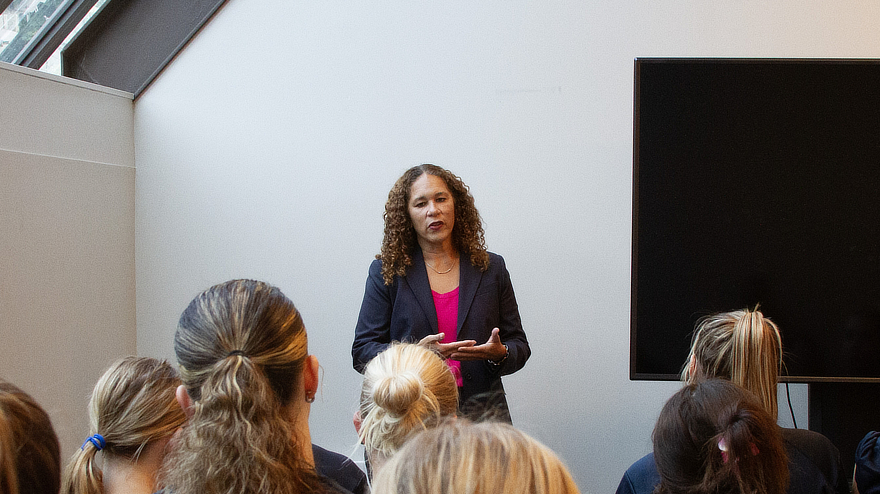
Working with Stephanie Gillespie, Ph.D., a lecturer and associate dean of the University’s Tagliatela College of Engineering, Hossain learned a great deal about machine learning algorithms, statistics, and heart disease. He also discovered a passion for AI and machine learning, and he is now considering a career as a machine learning engineer – something he has also explored with Dr. Gillespie.
"I hope this research shows that machine learning has amazing applications in today’s world and can be used to help people in so many different ways." Muntasir Hossain ’23
“Working with Dr. Gillespie has been absolutely wonderful,” said Hossain, who met with Dr. Gillespie weekly via Zoom while working on his project. “She guided me but gave me freedom to explore. I would share my ‘discoveries’ with a lot of enthusiasm and in great detail, and she would listen. Being able to share the information and ask questions helped me understand it all, and I am very thankful for such an amazing mentor.”
Hossain’s research suggests that machine learning can help lower the death rate of heart disease. He believes machine learning will continue to make an impact on the medical field.
“I hope this research shows that machine learning has amazing applications in today’s world and can be used to help people in so many different ways,” he said. “I hope that diagnosticians begin seeing the amazing potential of machine learning and start using it in their practices.”
Contact
Get the highlights!
Stay up to date with our weekly e-newsletter, highlighting stories from around the University and media clips featuring our faculty experts.
Recent News
Charger 360

Season 5, Episode 4: Ashley McClain ’07 and Ariana James ’27
In the Media