Curated by Hanna Melnyczuk, a professor at UMass Lowell, the exhibition is several years in the making, following a conversation between artists in 2022.
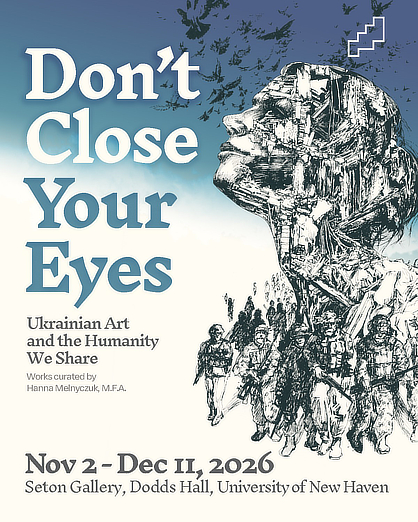
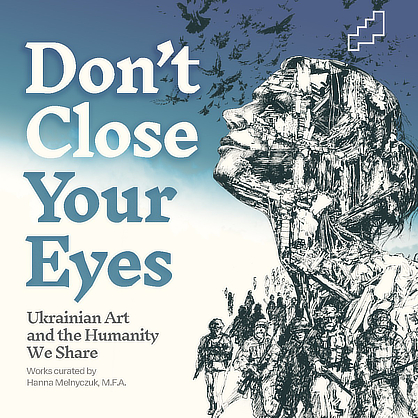
The University of New Haven's Seton Gallery will present, "Don't Close Your Eyes: Ukrainian Art and the Humanity We Share," which brings together selected works by Ukrainian artists affected by the war.
Working across painting, drawing, watercolor, ink and paper cut, the artists record war as it is lived: the shelter, the loss, the rupture of the everyday. The works stand as both image and testimony. Together they ask for something the exhibition's title makes explicit, the act of witnessing rather than turning away.
The exhibit was curated by Hanna Melnyczuk, M.F.A., Art & Design, UMass Lowell.
It is open from November 2 through December 11. The gallery is open Monday through Friday from 9:30 a.m. to 4 p.m. Weekend and after-hours visits are available by appointment.
An opening reception and lecture will take place on Thursday, Nov. 5 at 12 p.m.
'A second layer of witness'
Alongside the artworks, the exhibition presents reflections by University of New Haven students from the history and political science courses of University of New Haven professors Dr. Bradley Woodworth and Dr. Olena Lennon. Their disciplines approach conflict through historical and political analysis. The students first encountered the works in digital form, before seeing them in the gallery, and responded with written reflections.
The professors worked with Dr. Deniz Basar of the University's Art & Design program and the Seton Gallery director, who then led word-association workshops framed around the translation between word and image, in which the students' reflections were distilled into word clouds, giving their writing a visual form.
Their engagement moved from analysis to perception, and from words back into image. Installed in dialogue with the works, the reflections become part of the act of viewing. They add a second layer of witness, that of a generation encountering war from a distance and open a wider question about how images of war are seen, understood and carried.
'War transforms lives'
The idea for Don't Close Your Eyes began shortly after Russia's full-scale invasion of Ukraine in February 2022. During a Zoom call with artist friends, Prof. Melnyczuk discussed ways to help Ukraine and share the work Ukrainian artists were creating in response to the war. Through Instagram, Prof. Melnyczuk connected with Ukrainian artist Halyna Andrusenko, and together they selected 26 artists for the exhibition.
The project has since grown into multiple exhibitions at venues across Massachusetts, New Jersey, and Chicago. The exhibit curators also partnered with The Help Ukraine Group to organize an auction in New York City.
War transforms lives, and artists cannot remain untouched. In Don't Close Your Eyes, artists confront the trauma, death, and destruction brought to Ukraine by Russia's invasion. They become both visionaries and archivists, recording the emotional and physical devastation of their homeland.
'A range of personal experiences and artistic perspectives'
How do artists depict war? How can they convey the massacre in Bucha, the brutality of violence, or the anxiety of living under constant threat? Each artist finds a different visual language, revealing the many ways war can be experienced, interpreted, and remembered.
Inga Levi adapts the visual language of comic books to document the daily realities of war through complex, layered compositions. Halyna Andrusenko depicts Lviv's monuments wrapped in protective coverings against bombings and explores protection and vulnerability in a video of herself wrapping her parents in cloth.
Danylo Movchan, an iconic painter, juxtaposes vibrant colors with tragic imagery to evoke conflicting emotions. In Valeriia "T" Rybchenko's self-portrait "Loud," she appears to swallow a tank, conveying the overwhelming emotional weight of war. Ksenia Datsiuk uses her body to express the anxiety and heaviness that war settles into us.
Olga Zaremba's "The Anxious Suitcase" symbolizes the pain of leaving behind a former life. Olena Shtepura transforms classical paintings into dissolving images of grief, while Natalia Kurnosova draws on traditional Ukrainian paper-cutting to create cut-paper curtains when constant bombing made drawing impossible.
"The works in this exhibition reflect a range of personal experiences and artistic perspectives," said Melnyczuk. "While some respond directly to Russia's full-scale invasion in 2022, others reflect artists' engagement with the war since it began in 2014. Together, these works ask us to witness the devastation in Ukraine and recognize the lives forever changed by war. The artists reach across thousands of miles, asking us not to look away, but to stand with them in our shared humanity."
Contact
Get the highlights!
Stay up to date with our weekly e-newsletter, highlighting stories from around the University and media clips featuring our faculty experts.
Recent News
University News
University of New Haven Seton Art Gallery Exhibit Features Works by Ukrainian Artists Affected by War
The Charger Blog