U.S. Senator Richard Blumenthal joined Ukrainian combat veteran Sr. Lt. Mykola Melnyk and national security expert Olena Lennon, Ph.D., for a panel discussion exploring the war in Ukraine, the evolution of modern warfare, and the global importance of continued American support for Ukraine.
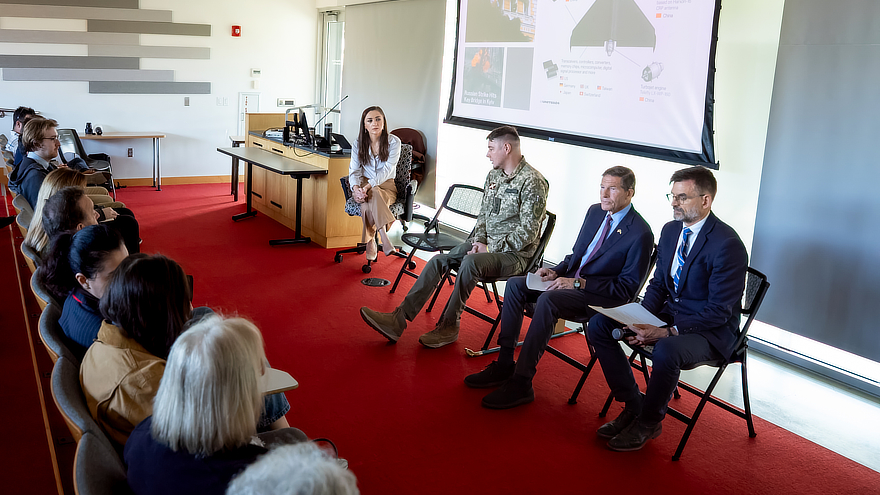
I recently joined fellow students as well as faculty, staff, and members of the local community for an insightful discussion titled The U.S.–Ukraine Security Partnership: U.S. Senator Blumenthal in Conversation with Ukrainian Veterans and Experts. The panel brought together legislative leadership, academic expertise, and firsthand experience from the front lines to examine the evolving nature of modern warfare and the profound geopolitical stakes of the conflict, with a strong emphasis on the realities on the ground in Ukraine. Featured panelists included U.S. Senator Richard Blumenthal (D-CT); Sr. Lt. Mykola Melnyk, a Ukrainian combat veteran and founder of the Brave Children of Ukraine charity; and Olena Lennon, Ph.D., practitioner-in-residence in the Department of National Security.
'A sobering assessment of the conflict'
Dr. Lennon opened the conversation by grounding the discussion in the grim daily reality facing Ukrainian civilians. Drawing from her academic expertise and recent observations, she noted that relentless missile and drone strikes pummeling major urban centers such as Kyiv, Odesa, Kharkiv, and Zaporizhzhia have effectively expanded the frontline to encompass residential neighborhoods, hospitals, and critical energy infrastructure.
A native of Ukraine, Dr. Lennon also shared insights from her recent visit to the Warsaw Security Forum, highlighting a growing consensus across European capitals that Ukraine is an indispensable pillar of European security architecture. She stressed that European leaders understand that regional safety outside of Ukraine is entirely dependent on sustaining Ukrainian defense.
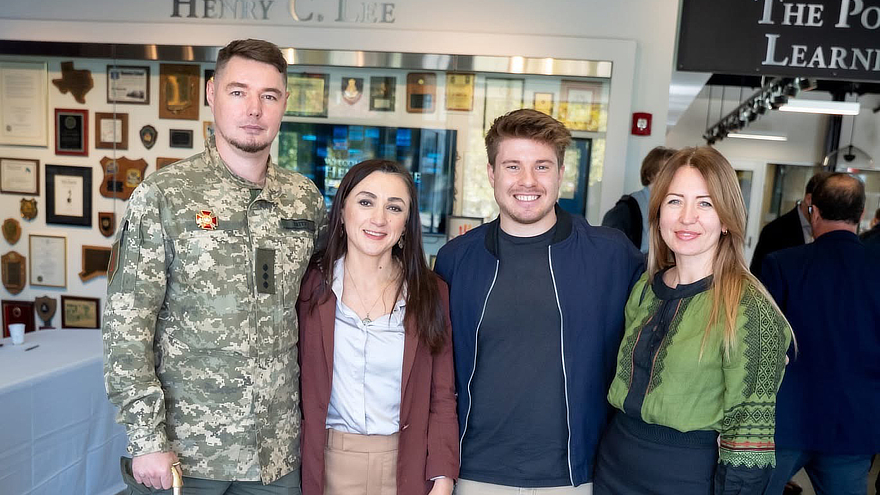
This human calculus and relentless war of attrition were brought into sharp focus by Sr. Lt. Mykola Melnyk. Having started his service as a platoon leader before moving into mechanized and assault infantry units, Sr. Lt. Melnyk participated directly in Ukraine's 2023 counteroffensive, during which he was severely wounded.
Navigating a grueling recovery journey involving prosthetic rehabilitation, Se. Lt. Melnyk offered a sobering assessment of the conflict, emphasizing that Ukraine had no choice but to fight against Russia. He noted that other European countries would likely fare far worse than Ukraine given current capabilities and the political or societal willingness to sustain modern warfare. For a nation targeted with total subjugation, cultural erasure, and what amounts to modern ethnic cleansing in occupied territories, surrender is simply not an option.
'Military structures must adapt'
Listening to Sr. Lt. Melnyk speak about the tactical evolution of the conflict provided a striking look at how fast modern war changes. He reflected that back in 2014 Ukrainian forces initially faced severe shortages of weapons and ammunition. By contrast, the battlefield has now evolved into a high-tech arena where drone operators fight drone operators, and, increasingly, AI-guided drones battle other AI-guided systems.
Sr. Lt. Melnyk, who has documented these lessons in his book currently undergoing English translation, stressed that military structures must adapt to this reality, pointing out that even a mechanized battalion with specialized drone capabilities must fundamentally rethink its unit organization to survive.
This innovation extends far beyond traditional trenches into a layered, all-hands-on-deck civil defense network. Sr. Lt. Melnyk described how air defense in cities such as Kyiv relies on multi-tiered solutions, including mobile units where veterans wearing prosthetic limbs take turns stationed on rooftops to shoot down incoming drones.
Furthermore, the discussion highlighted how critical commercial satellite communication networks, such as Starlink and Starshield, serve as the digital nervous system for defense. Operational friction, newly imposed speed limits on terminals moving above 100 mph, or intentional service restrictions managed under oversight can severely hinder a defender's ability to quickly detect, track, and intercept fast-moving Russian Geran and Shahed, as well as cruise and ballistic missiles before they strike vital sites, including schools, hospitals, and shopping malls.
'The multi-faceted role of American support'
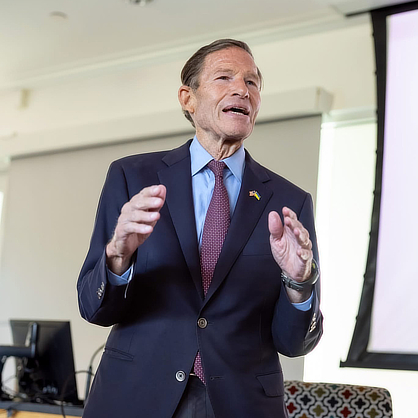
Shifting to the legislative landscape, Senator Blumenthal addressed the multi-faceted role of American support. Reflecting on his work alongside congressional colleagues, including his legislative efforts alongside the late Senator Lindsey Graham to advance military assistance and sanctions, Senator Blumenthal highlighted the passage of the Russia Sanctions Bill through the Senate with an overwhelming 86 to 11 bipartisan majority. The legislation is engineered to constrict Moscow's war machine by imposing rigorous tariffs and sanctions on Russian oligarchs, financial institutions, and major energy purchasers such as China and India.
The conversation did not shy away from the complexities of executive-waiver authorities, congressional oversight, and the continuous debate surrounding the delivery of advanced interceptors and air-defense systems. Senator Blumenthal candidly addressed how recent executive choices to waive certain sanctions or exert pressure on Ukraine to accept peace terms under unfavorable conditions have complicated the partnership. Despite these political hurdles, he emphasized that the overwhelming bipartisan margin in the Senate proves that American support at its core remains robust, driven by a shared recognition of what is at stake.
'Critical global ramifications'
What resonated particularly with me during Senator Blumenthal's remarks was a compelling historical parallel: he compared Ukraine's uncompromising determination and scrappy, persistent defense directly to the spirit of the United States during the War of Independence.
Blumenthal shared that wherever he travels wearing his Ukrainian support pin, Americans consistently thank him rather than question U.S. involvement, reflecting a deep-seated public understanding that this fight for freedom mirrors our own history. Furthermore, he drew a dark historical line back to Stalin's orchestrated starvation tactics during the Holodomor, arguing that Putin's ultimate aim is to erase the Ukrainian identity, language, and culture entirely.
Beyond direct military engagement, the panel emphasized the critical global ramifications tied to Ukraine's agricultural sector. Despite the relentless devastation of the war, Ukrainian farmers achieved a remarkable bumper harvest, proving the extraordinary resilience of the nation's soil and spirit. Yet, blockaded Black Sea ports and repeated attacks on grain and agricultural facilities, including targeting American companies operating in the region such as Cargill, threaten vital food supplies for hundreds of millions of people worldwide, heavily impacting vulnerable populations across Africa and the Middle East.
'Valuable student insights'
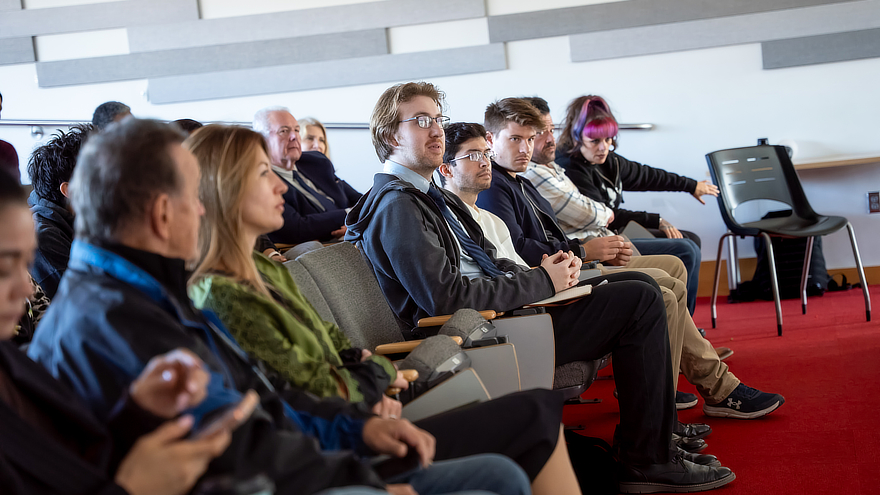
The interactive Q&A session brought valuable student insights into the conversation, bridging academic study with real-world advocacy. For instance, Ben Lovell '29, an international affairs student who interned abroad in Ukraine over the summer, raised a poignant question regarding the communication gap regarding what is taking place: how can students and observers effectively communicate the unique, harrowing stories of Ukrainian veterans to American audiences who are far removed from the daily sirens and shelters?
Responding to student inquiries, the panelists emphasized that personal connection and education are paramount. They noted that while American veterans and students may lack direct exposure to modern peer-to-peer high-tech warfare, sharing accounts of resilience, grassroots charity work, and the reality of life under daily bombardment helps counter misinformation. The dialogue reinforced that understanding the stakes in Eastern Europe requires active listening and an ongoing commitment to amplifying frontline voices.
The panel concluded with a unanimous reaffirmation that the defense of Ukraine is inextricably tied to broader European stability and American national security. The fight for freedom in Ukraine is a shared responsibility that demands our continued, unwavering commitment. As Senator Blumenthal emphasized throughout the discussion, upholding democratic sovereignty and resisting authoritarian aggression remains a defining test for the international community.
Special gratitude is extended to the event's sponsors, the College of Arts and Sciences and the Henry C. Lee College of Criminal Justice and Forensic Sciences, as well as to Ryan Noonan '20, '23 M.S., a U.S. Marine Corps veteran and outreach liaison for Senator Richard Blumenthal who previously led the University's student veteran initiatives, for making this gathering possible.
Contact
Get the highlights!
Stay up to date with our weekly e-newsletter, highlighting stories from around the University and media clips featuring our faculty experts.
Recent News
The Charger Blog
University of New Haven Hosts U.S. Senator Richard Blumenthal for Discussion on U.S.–Ukraine Security Partnership
The Charger Blog