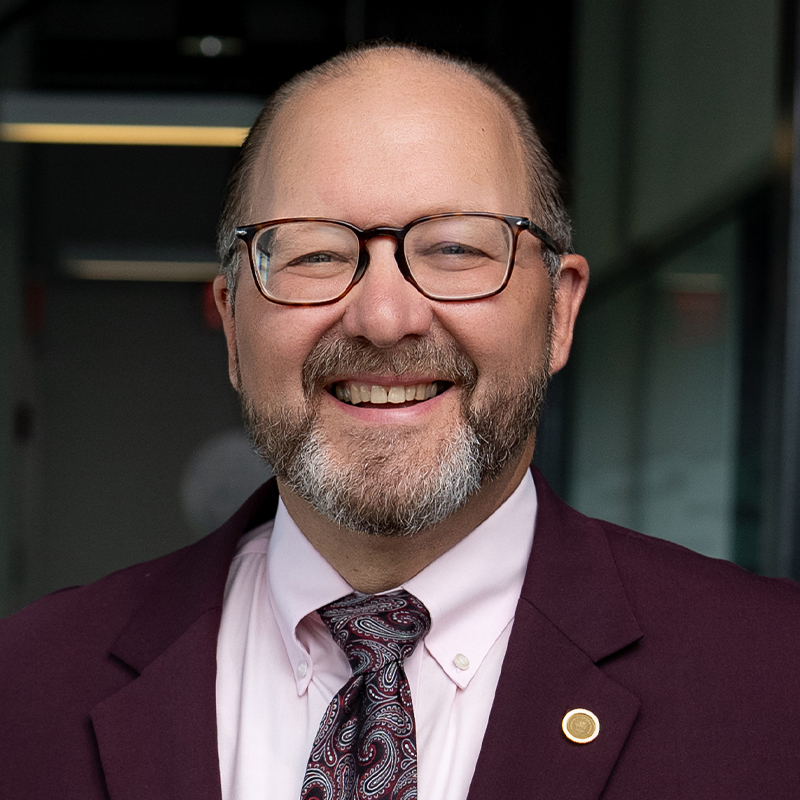
Pompea College of Business professor Subroto Roy, Ph.D., received a Best in Track Paper Award from the American Marketing Association for research examining how artificial intelligence can transform B2B marketing and prepare the next generation of marketing professionals.
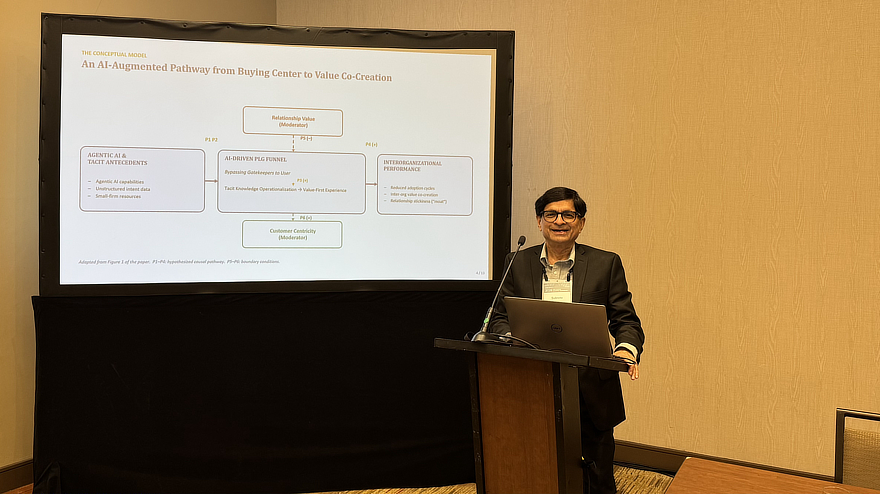
Every year, the American Marketing Association Summer Academic Conference brings together the scholars who write the textbooks, edit the journals, and shape what marketing students are taught around the world. It is the profession’s most important academic gathering.
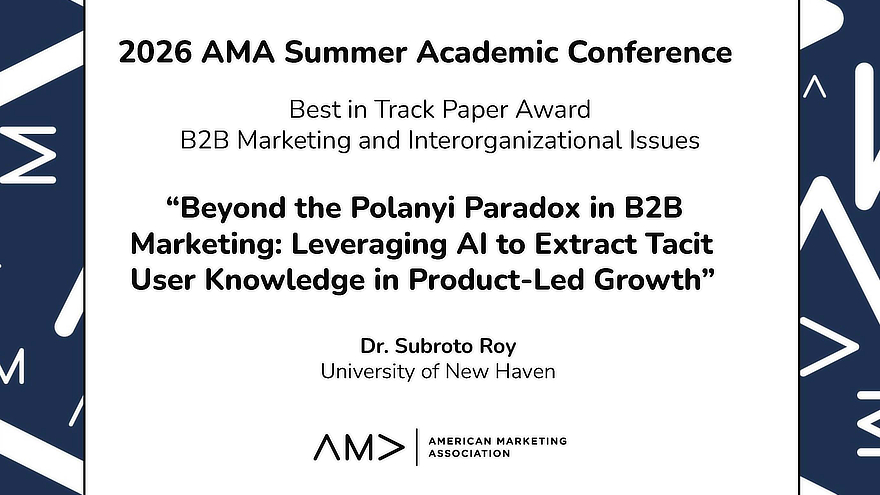
At this year’s event, my paper, “Beyond the Polanyi Paradox in B2B Marketing: Leveraging AI to Extract Tacit User Knowledge in Product-Led Growth,” received the Best in Track Paper Award in B2B Marketing and Interorganizational Issues category.
I am proud of the recognition. But the reason I am writing this is that, I believe, the award matters much more for our students than it does for me.
The philosopher Michael Polanyi observed that, “We know more than we can tell.” Ask the best user of any software what makes it indispensable, and they will struggle to put it into words. The gap between what a customer knows and what a customer can articulate has quietly limited marketing for a century. Surveys, focus groups, and CRM fields capture only what people can say out loud.
Artificial intelligence changes that. AI systems can now read the unstructured traces of how people actually work — what they try, where they hesitate, what they return to — and turn that tacit knowledge into something a firm can act on. In business-to-business markets, this rewrites the rules. Instead of spending months persuading gatekeepers in a buying center, a company can deliver value directly to the person who will use the product and let that experience make the case. A small firm with a modest budget can now compete with a big corporation.
'The judgement to ask the right question'
If you are studying marketing today, this is not an abstraction. Much of the entry-level work a marketing graduate did five years ago, such as building lists, drafting sequences, and assembling reports, is being automated as we speak. What is not being automated is the judgment to ask the right question, to recognize which signal actually matters, and to design an experience a customer will trust. The graduates who thrive in the AI age will be the ones who can direct AI rather than compete with it.
That is the direction we are taking in the Pompea College of Business. Our students should not simply hear that AI is changing the field; they should be working with the frameworks that explain how and why, while those frameworks are still being argued about.
People sometimes ask why a teaching-focused university invests in research. Here is the honest answer: The ideas I defended in front of the world’s marketing scholars this summer will be in front of my students this fall. Not a case study written six years ago, but work that is current, contested, and consequential. When your professors are publishing at the frontier, your classroom sits at the frontier, too, and the questions you learn to ask are the ones employers are paying for right now.
Marketing has rarely been a more interesting field to enter. We intend to make sure our students are prepared to enter.
Dr. Subroto Roy is professor of Marketing and chair of the Department of Accounting, Finance and Marketing in the Pompea College of Business at the University of New Haven, and co-editor of American Business Review.
Contact
Get the highlights!
Stay up to date with our weekly e-newsletter, highlighting stories from around the University and media clips featuring our faculty experts.
Recent News
In the Media

WTNH: University of New Haven breaks ground for new Pompea College of Business building
In the Media