As part of an art history class, students studying abroad at the University’s campus in Prato, Italy, recently had the opportunity to take an in-depth guided tour at a historic church in Florence with their professor, exploring firsthand what they’ve been discussing in the classroom.
Samantha Helwig ’24, ’25 M.S. is taking an art history class this semester while studying abroad at the University’s campus in Prato, Italy, which is a very short distance from some of the many works she and her classmates have been learning about. They recently had the opportunity to see much of what they’ve discussed in the classroom in person while visiting the first great basilica in Florence.
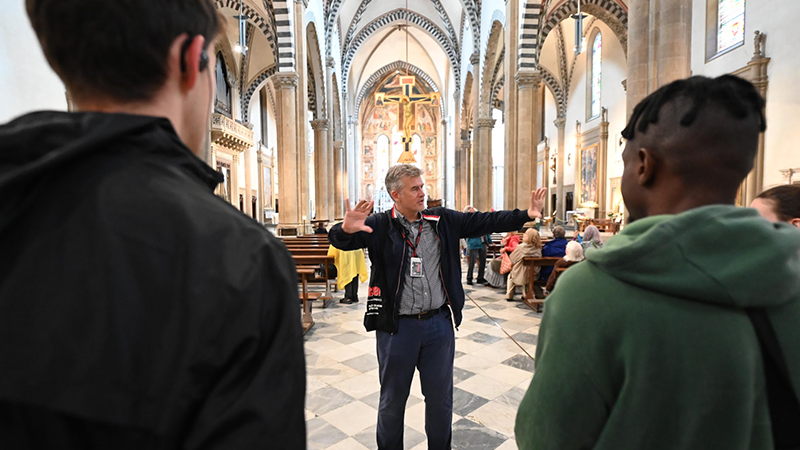
Helwig and her classmates recently made the trip to Florence – just a 20-minute train ride from Prato – as part of a course taught by Kevin Murphy, Ph.D., dean of the University’s Prato Campus. Dr. Murphy gave the students an in-depth guided tour of the Basilica of Santa Maria Novella, a historic Dominican church in the heart of the city. He connected what the students saw in the church to what they’ve discussed in the classroom.
“We just did a project that focused on poses, and we learned about stances and hand gestures in art,” said Helwig, a marine biology major. “We discussed it and saw it depicted on slides, but to see it in the murals and frescoes in the church was amazing.”
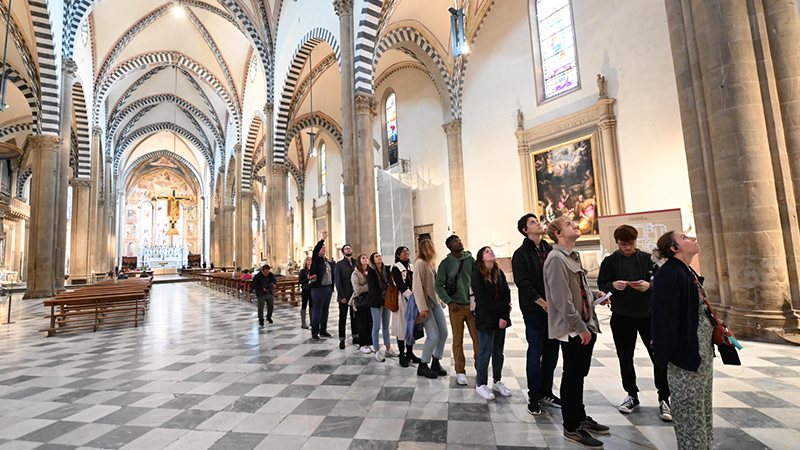
Dr. Murphy began his tour in front of the basilica, then brought the students inside to explore the massive interior. He explained that the Gothic church was heavily decorated during the Renaissance, as well as the significance of the frescoes throughout the church.
“The pointed arches are a characteristic of the Gothic style of the church,” he explained. “The Gothic architecture leads the eye up and typically makes a person feel small. But during the Renaissance, the architecture changed, just as people’s beliefs in relation to God changed.”
Supporters of the church
Explaining the changing role of science and the scientific approach, Dr. Murphy engaged the students and asked them questions. He showed them a brass meridian line embedded in the stone floor, instructing them to stand on the line and look up at a stained-glass window in the ceiling, pointing out a small hole. Showing how the light reaches the line on the floor, he explained how the sun’s reach changes as the days shorten in length throughout the fall. He then explained why this was included in the church’s design.
“It’s for measuring the solar year,” he said. “Churches lent themselves to be solar observatories. This is also important for determining certain religious festivals, such as Easter.”
“I liked how we explored architecture and learned about the brass line on the floor of the church,” said Adrienne Esposito ’26, a criminal justice major who is spending her first semester as a Charger at the University’s campus in Prato. “Seeing things that both are and aren’t religious gave this so much texture. I really like how Dr. Murphy explained everything. He’s a great teacher.”
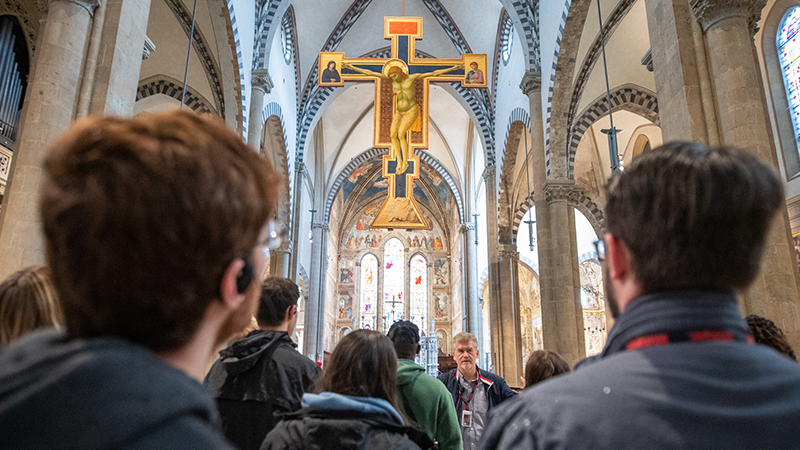
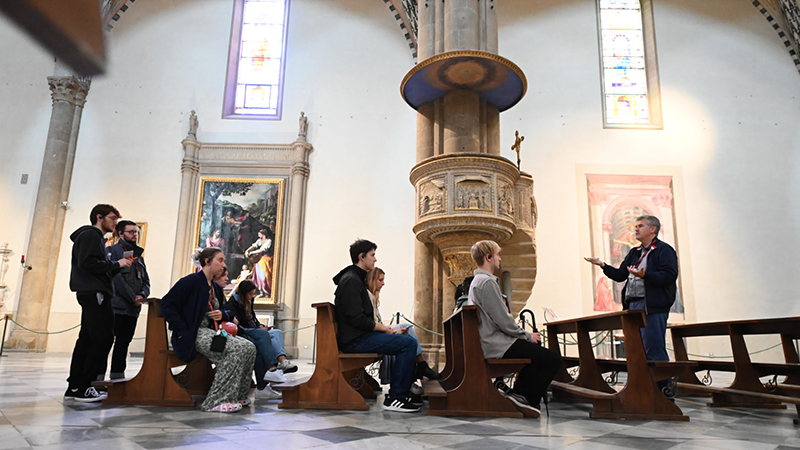
Students moved on to the pulpit where the astronomer Galileo Galilei was first publicly denounced for declaring the solar system to be heliocentric. They also learned about important and well-known works of art such as Masaccio’s Holy Trinity and The Crucifix by Giotto. Dr. Murphy pointed out how concepts they’d discussed in class such as horizon lines and vanishing points were reflected in the art and showed them where donors who supported the creation of the art were depicted in the works. He connected the discussion to topics that were familiar to the students.
“When people gave to the church, it was a way of expiating their sins, and they’d be supporting the friars, maintenance, and the church’s charity work,” he said. “They would also have their name on the work, similar to how buildings on campus are named after those who support the University.”
‘It was amazing to see such historic works of art’
As part of the tour, Dr. Murphy told the class how students studying abroad – including many who, like them, came from the United States – helped with the cleanup following a flood in the city in 1966. That flood damaged or destroyed several prominent works of art, highlighting the importance and need for art restorers.
At the end of the tour, students saw a variety of artifacts as well as frescoes suggesting that knowledge and faith aren’t necessarily incompatible. For Helwig, the marine biology major, it was a remarkable chance to see and explore the rich history in Florence.
“It was amazing to see such historic works of art, artifacts, and buildings that are still in Italy after all this time,” she said. “It’s incredible how the church and the paintings and sculptures inside have lived through history. Everything is so colorful, and it’s incredible the frescoes were never painted over. It was amazing to have the opportunity to see everything.”
Contact
Get the highlights!
Stay up to date with our weekly e-newsletter, highlighting stories from around the University and media clips featuring our faculty experts.
Recent News
Charger 360
Season 5, Episode 4: Ashley McClain ’07 and Ariana James ’27
In the Media