Info For:
Charger
Nation Training News
Read the latest University news, check out feature stories about signature University programs, or see our faculty quoted in some of the most well-known newspapers, TV shows, and radio programs.
News Categories
Randall Horton, professor of English, discusses his life experiences and Radical Reversal, a movement focused on amplifying the dialogue concerning incarceration and on showcasing rehabilitation equity through creative outlets.
Robert McDonald, a lecturer of criminal justice, discusses how five New Haven police officers will undergo the same process as anyone else in court after being charged in the handling of a man who became paralyzed while in police custody.
David Sacco, a practitioner in residence of finance, comments on the need to improve regulations already in place for the crypto markets, not just add more.
John DeCarlo, professor, and director of the Master's Program in Criminal Justice discusses how investigators are a part of a larger team that decides what type of information may be released to the public.
Trish Crouse, a practitioner in residence for political science and legal studies, comments that former President Donald Trump seems to be losing some supporters and examines if this will discourage a third presidential run with the Republican party after the felony convictions against the Trump Organization.
Howard Stoffer, professor of national security and international affairs, discusses if the United States should be concerned about the leaders of China and Saudi Arabia having an official meeting with other Arab leaders in the region.
Angeli Gianchandani, a practitioner in residence of marketing and the MBA program, gives negotiation tips to help resolve a disagreement, calling this as an essential life skill.
David Sacco, a practitioner in residence of finance, will take part in a virtual forum discussion on Wednesday, December 7, at 11 a.m. about the 2023 economic outlook for Connecticut and the U.S.
David Sacco, a practitioner in residence of finance, discusses environment al, social, and corporate governance (ESG) and why investors, and his students, are looking at the principles it represents.
John DeCarlo, professor and director of the Master's Program in Criminal Justice, comments on why the police may withhold evidence from the public on the investigation of four college students murdered at the University of Idaho.
Matthew Schmidt, associate professor of international affairs, national security, and political science, discusses the limit of the reparations Ukraine may receive if they defeat Russia or bring charges against Russian President Vladimir Putin to the International Criminal Court.
Robert McDonald, a lecturer of criminal justice, comments that law enforcement is taking measured steps to put together timelines and evidence as part of the ongoing investigation into the murder of four college students from the University of Idaho.
Michael Lawlor, associate professor of criminal justice and author of the Connecticut Red Flag Gun law, says with the number of mass shootings and suicides, more community members are reaching out to p olice using the red flag law if they know someone is struggling with a mental health crisis and has access to a gun.
Michael Lawlor, associate professor of criminal justice, the top criminal justice policy adviser to former governor Dannel Malloy is included in a story in which Malloy recounts his memories of the Sandy Hook Elementary School shooting and the actions he and Lawlor took on gun safety legislation.
Bradley Woodworth, associate professor of history, discusses why Hungary has vetoed a humanitarian aid package to Ukraine, making it, the only member of the EU to take this action.
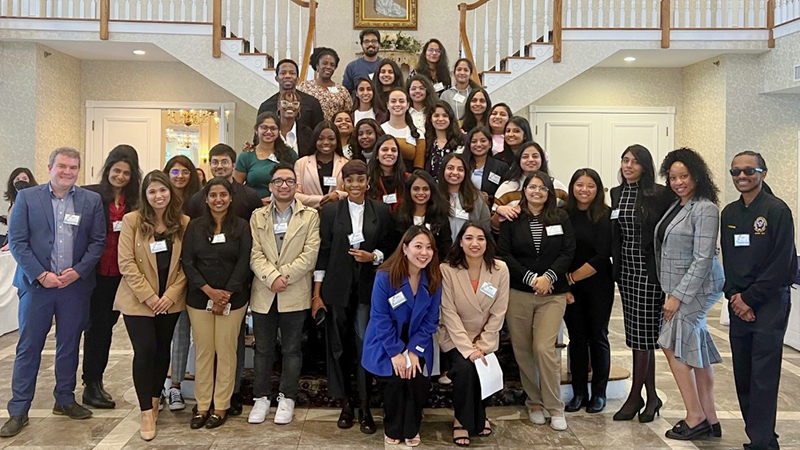
Dozens of Master of Public Health students recently attended the Connecticut Public Health Association’s Annual Conference, deepening their understanding of the field. It was an opportunity for them to learn about the latest research, and, for some students, to present their own.
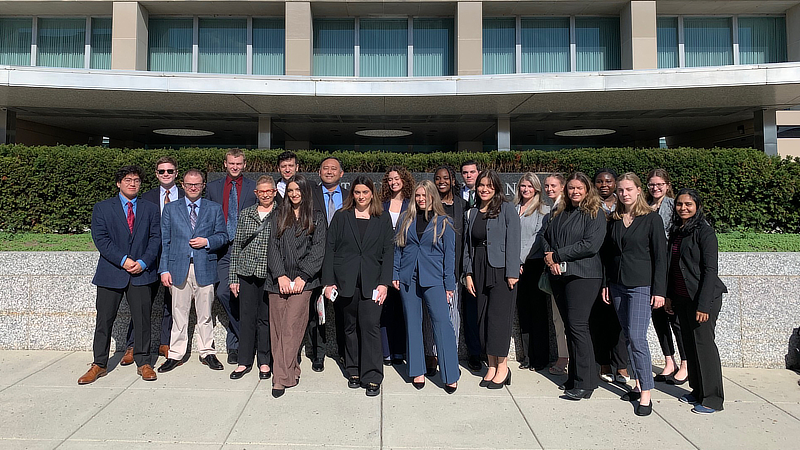
Several Chargers recently returned from Washington, D.C., where they attended a National Model United Nations conference. They applied what they’ve learned as members of the University’s MUN program, skills they say they will continue to draw on throughout their academic and professional careers.
Michael Lawlor, associate professor of criminal justice, discusses how Connecticut will pardon residents convicted of low-level possession of non-narcotic, non-hallucinogenic substances. The action will be taken by the governor on January 1, 2023.
Matthew Schmidt, associate professor of international affairs, national security, and political science, discusses his military theory on the strategy behind Ukraine using drones to strike Russian military targets.
Meet Ryan Noonan ’20, ’23 M.S., the University’s manager of military and veteran affairs, who says he came out of his shell as a student at the University – and he hopes to help current and future veteran students have the same great experience as Chargers.