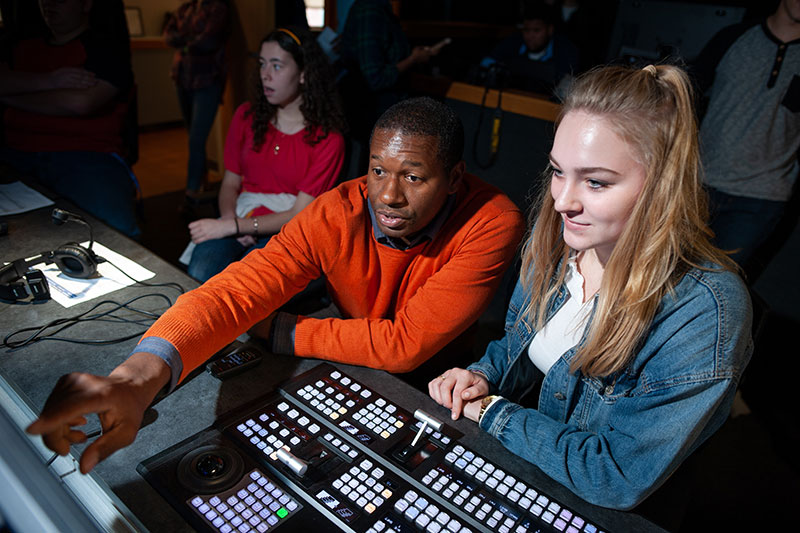
David Schroeder graduated from John Jay College of Criminal Justice with his Ph.D. in 2007. His research interests span several areas of criminal justice including homicide investigation, the utility of forensic evidence (most notably DNA), aberrant/episodic homicide, defense investigation, and tolerance issues in law enforcement. We sat down with David Schroeder and learned what he is doing inside and outside of the classroom.
The relatively small class sizes make it easy to relate to students and identify potential exceptional students. I also like the fact that the Center for Learning Resources is available so students can take assistance in writing. The Criminal Justice tutors are a real advantage as well, and the students can make use of the CLR free of charge. All of these things make teaching here fantastic.
I see teaching pretty much the same way I see the future of investigation. You need an open minded dedicated individual to convey and foster the process of learning. All the computer games and simulations can never replace the connection between the teacher and student. Much in the same way that all the technology used in solving crime these days will never replace a thinking investigator with his or her feet on the ground.
Depends on the discipline, I really have no idea … but a good criminal justice professor, at least those in my past that were truly amazing, needed to be able to communicate the multiple and varied problems in our criminal justice system from both sides … sometimes from more than two sides. People say ‘there are two sides to every story.’ Well in the justice system it would appear that there are, sometimes, many sides to any problem. The really good teachers give you the perspective from all sides, or as many as they can, and let the student figure things out for themselves. This, of course, is much easier said than done.
One of the best kept secrets in America is the drop in homicide clearance. Why we are solving fewer murders every year is nothing short of the greatest murder mystery of all time. Only through really perceptive analysis will we discover exactly why we, as a nation, are getting better at solving murders but solving fewer of them.
Yes definitely. Currently working with the Criminal Justice club and the Safe Zone committee has brought me into contact with students outside of the classroom in very meaningful ways.
To work so closely with Dr. Robert Keppel is kind of a dream come true. As an ex-homicide investigator, to work so closely with the man that tracked Ted Bundy and The Green River Killer is a lot like taking sailing lessons from Magellan.
The Henry C. Lee College of Criminal Justice and Forensic Sciences has a great reputation, not only among local law enforcement, but on a national scale as well. What Dr. Lee has been able to do in his field is truly remarkable and to bring that kind of experience to such a small institution provides for a very powerful mix of practice theory and application.
High. As I said before, I don’t lecture, I discuss. If students are not willing to participate in the reading there is very little I can do to foster original thought among those in my class. But that’s where it begins. Once you’ve done the reading and you’re ready for class, that’s when I expect you to tell me what you think … and to do that you must have thought about it.
Yes. A student in my principals of Criminal Investigation class one day simply walked in and said I want to do research. There was a paper I had been trying to write related to the data I collected with the NYPD several years ago. With my guidance this student generated a whole new way of viewing the problem, won a summer undergraduate research fellowship here at UNH, and after a summer of hard work presented his findings at the American Society of Criminology conference in November.
Take a piece of paper and on one side write all of the things that you want out of your first year in college. On the backside of the paper make a list of all of the things you know that you don’t want out of your first year in college. Then at the bottom answer the question ‘which do I want to be more fun, my freshman or senior year?’ Once you have done that you should have a pretty clear picture of what your expectations are. It is a good idea to have these expectations in mind when you are working out schedules, class times, and extracurricular activities.
The style of teaching I use would be most likely described as facilitation. I ask students questions regarding the material they were required to read. It is far more conversational than a one sided lecture but requires the students to be up on their reading.
All the classrooms are smart classrooms and I personally have made use of the document projectors and PowerPoint presentations. I personally like a more hands on approach with the material because investigation is not easy to teach and therefore relying on technology to do your job for you can be problematic. That said utilizing the smart classroom to convey a lot of information regarding the investigation of crime has proven very effective.
I would say as it directly relates to application. For instance deterrence is a theory - that you punish people for doing something so that they and other people will learn not to do it again. Clearly within our current criminal justice system there are plenty of avenues where that theory is not working; punishing people seems to have no effect on changing their behavior. Therefore, the application of where that theory will work and where it won’t – and more importantly why - will be as important to learn as the theory itself.
The Homicide Clearance rate. Clearly understanding why we are solving fewer murders every year is something quite compelling.
Regular participating in the American Society of Criminology conferences has been extremely influential in keeping the research that I do current. My work and training with the New York Tolerance Center has allowed me to stay on the forefront of racial, gender and LBGT issues.
Probably the largest strength of our department is a great deal of our faculty have been involved in the types of jobs our students want to do in their future.
It would have to be any class that Dr. Keppel teaches on homicide investigation.
Currently I have secured access to a great many homicides in the state of CT. Dr. Katherine Brown and I will be using this data to not only diagnosis the drop in homicide clearance but hopefully we will come up with a model of what make for an unsuccessful investigation. Something we can train detectives to avoid.
None, if you’re talking about planning their careers as freshmen. In other words, that all depends upon what they want to do when they graduate which probably shouldn’t be something they are worried about or thinking about when they start as freshmen. Entering into the CJ field when all you have known about it is what you have seen on TV and movies leaves you with serious misconceptions as to what certain criminal justice careers are or what the people in those careers actually do. One of the great benefits of our faculty is that as students move along in their academic careers they meet people who can provide for them factual and solid information regarding those careers. As such what a great many of our students want to be as freshman changes by the time they are seniors. Which I think is both intelligent and healthy.
My undergraduate degree was fragmented and to the unknowing eye would seem quite scattered. The reason this happened was simply because I wished to tailor my college experience to the breadth and scope of the education I wished to have. As such, my experience differs greatly from a BS in Criminal Justice here at UNH because all of that breadth and scope that I sought in five colleges on two continents can be found right here in one program.